Gaglione Domenico, Braca Paolo, Millefiori Leonardo Maria, Soldi Giovanni, Forti Nicola, Marano Stefano, Willett Peter K, Pattipati Krishna R
NATO STO Centre for Maritime Research and Experimentation (CMRE), 19126 La Spezia, Italy.
Dipartimento di Ingegneria dell'Informazione ed Elettrica e Matematica Applicata (DIEM), University of Salerno, 84084 Fisciano, Italy.
IEEE Access. 2020;8:175244-175264. doi: 10.1109/access.2020.3019922. Epub 2020 Sep 30.
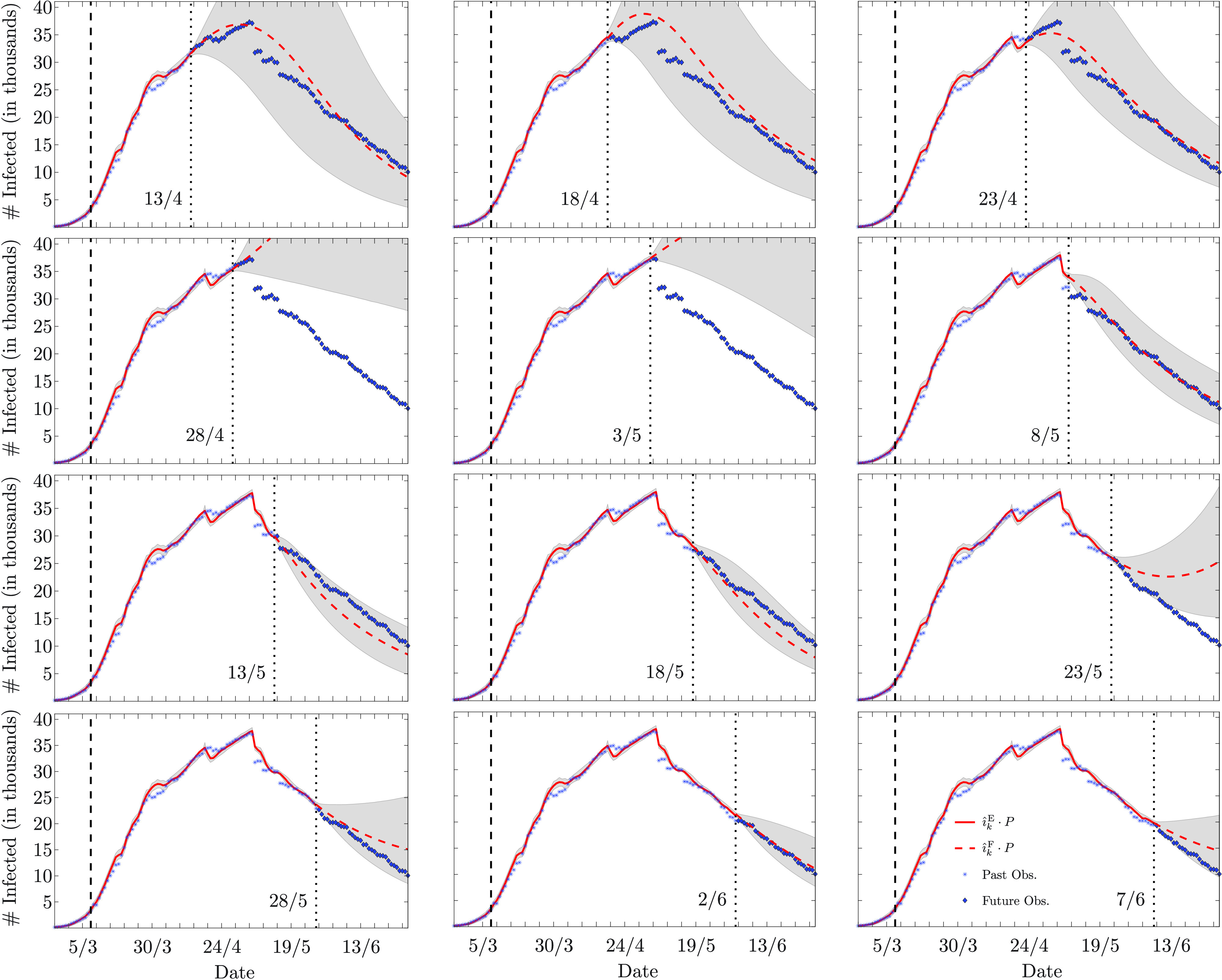
Since the beginning of 2020, the outbreak of a new strain of Coronavirus has caused hundreds of thousands of deaths and put under heavy pressure the world's most advanced healthcare systems. In order to slow down the spread of the disease, known as COVID-19, and reduce the stress on healthcare structures and intensive care units, many governments have taken drastic and unprecedented measures, such as closure of schools, shops and entire industries, and enforced drastic social distancing regulations, including local and national lockdowns. To effectively address such pandemics in a systematic and informed manner in the future, it is of fundamental importance to develop mathematical models and algorithms to predict the evolution of the spread of the disease to support policy and decision making at the governmental level. There is a strong literature describing the application of Bayesian sequential and adaptive dynamic estimation to surveillance (tracking and prediction) of objects such as missiles and ships; and in this article, we transfer some of its key lessons to epidemiology. We show that we can reliably estimate and forecast the evolution of the infections from daily - and possibly uncertain - publicly available information provided by authorities, e.g., daily numbers of infected and recovered individuals. The proposed method is able to estimate infection and recovery parameters, and to track and predict the epidemiological curve with good accuracy when applied to real data from Lombardia region in Italy, and from the USA. In these scenarios, the mean absolute percentage error computed after the lockdown is on average below 5% when the forecast is at 7 days, and below 10% when the forecast horizon is 14 days.
自2020年初以来,新型冠状病毒的爆发已导致数十万人死亡,并给世界上最先进的医疗体系带来了巨大压力。为了减缓被称为COVID-19的疾病传播,并减轻医疗结构和重症监护病房的压力,许多政府采取了激烈且前所未有的措施,如关闭学校、商店和整个行业,并实施严格的社交距离规定,包括地方和国家层面的封锁。为了在未来以系统且明智的方式有效应对此类大流行病,开发数学模型和算法来预测疾病传播的演变,以支持政府层面的政策制定和决策至关重要。有大量文献描述了贝叶斯序贯和自适应动态估计在导弹和船舶等物体监测(跟踪和预测)中的应用;在本文中,我们将其一些关键经验应用于流行病学。我们表明,我们能够根据当局提供的每日(可能存在不确定性)公开可用信息,如每日感染和康复人数,可靠地估计和预测感染情况的演变。当将所提出的方法应用于意大利伦巴第大区和美国的实际数据时,该方法能够估计感染和康复参数,并以良好的准确性跟踪和预测流行病学曲线。在这些情况下,封锁后计算的平均绝对百分比误差在预测7天时平均低于5%,在预测期限为14天时低于10%。