Pratt Molly, Forbes Jessica D, Knox Natalie C, Bernstein Charles N, Van Domselaar Gary
Department of Medical Microbiology and Infectious Diseases, University of Manitoba, Winnipeg, MB, Canada.
Department of Laboratory Medicine and Pathobiology, University of Toronto, Toronto, ON, Canada.
Front Cell Dev Biol. 2021 Nov 16;9:716604. doi: 10.3389/fcell.2021.716604. eCollection 2021.
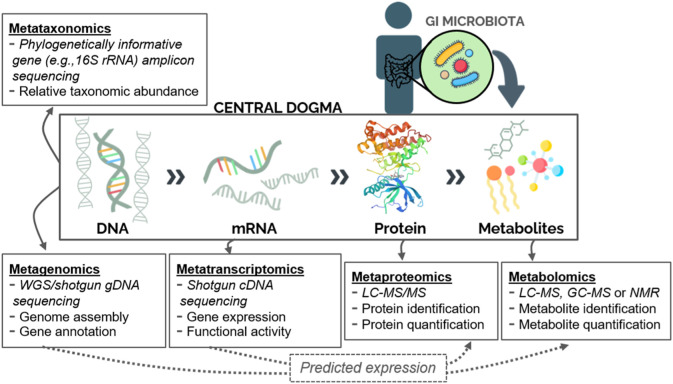
Chronic intestinal inflammation and microbial dysbiosis are hallmarks of colorectal cancer (CRC) and inflammatory bowel diseases (IBD), such as Crohn's disease and ulcerative colitis. However, the mechanistic relationship between gut dysbiosis and disease has not yet been fully characterized. Although the "trigger" of intestinal inflammation remains unknown, a wealth of evidence supports the role of the gut microbiome as a mutualistic pseudo-organ that significantly influences intestinal homeostasis and is capable of regulating host immunity. In recent years, culture-independent methods for assessing microbial communities as a whole (termed meta-omics) have grown beyond taxonomic identification and genome characterization (metagenomics) into new fields of research that collectively expand our knowledge of microbiomes. Metatranscriptomics, metaproteomics, and metabolomics are meta-omics techniques that aim to describe and quantify the functional activity of the gut microbiome. Uncovering microbial metabolic contributions in the context of IBD and CRC using these approaches provides insight into how the metabolic microenvironment of the GI tract shapes microbial community structure and how the microbiome, in turn, influences the surrounding ecosystem. Immunological studies in germ-free and wild-type mice have described several host-microbiome interactions that may play a role in autoinflammation. Chronic colitis is a precursor to CRC, and changes in the gut microbiome may be an important link triggering the neoplastic process in chronic colitis. In this review, we describe several microbiome-mediated mechanisms of host immune signaling, such as short-chain fatty acid (SCFA) and bile acid metabolism, inflammasome activation, and cytokine regulation in the context of IBD and CRC, and discuss the supporting role for these mechanisms by meta-omics data.
慢性肠道炎症和微生物群落失调是结直肠癌(CRC)和炎症性肠病(IBD)的特征,如克罗恩病和溃疡性结肠炎。然而,肠道微生物群落失调与疾病之间的机制关系尚未完全明确。尽管肠道炎症的“触发因素”仍不明确,但大量证据支持肠道微生物群作为一种互利共生的伪器官发挥作用,它能显著影响肠道内环境稳定,并能够调节宿主免疫。近年来,用于整体评估微生物群落的非培养方法(称为宏组学)已从分类鉴定和基因组表征(宏基因组学)发展到新的研究领域,这些领域共同拓展了我们对微生物群的认识。宏转录组学、宏蛋白质组学和代谢组学是旨在描述和量化肠道微生物群功能活性的宏组学技术。利用这些方法揭示炎症性肠病和结直肠癌背景下微生物的代谢贡献,有助于深入了解胃肠道的代谢微环境如何塑造微生物群落结构,以及微生物群如何反过来影响周围的生态系统。在无菌小鼠和野生型小鼠身上进行的免疫学研究描述了几种可能在自身炎症中起作用的宿主-微生物群相互作用。慢性结肠炎是结直肠癌的先兆,肠道微生物群的变化可能是触发慢性结肠炎肿瘤形成过程的重要环节。在这篇综述中,我们描述了几种微生物群介导的宿主免疫信号传导机制,如短链脂肪酸(SCFA)和胆汁酸代谢、炎性小体激活以及炎症性肠病和结直肠癌背景下的细胞因子调节,并讨论了宏组学数据对这些机制的支持作用。