Regenerative Medicine Research Center, Isfahan University of Medical Sciences, Isfahan, Iran.
Biomedical Engineering Department, Engineering Faculty, University of Isfahan, Isfahan, Iran.
Sci Rep. 2021 Dec 6;11(1):23452. doi: 10.1038/s41598-021-02282-3.
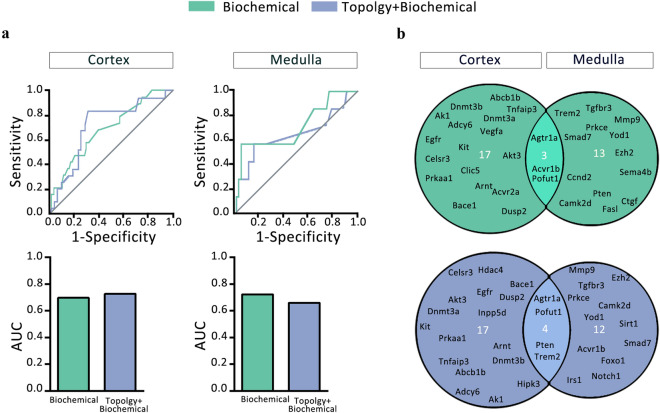
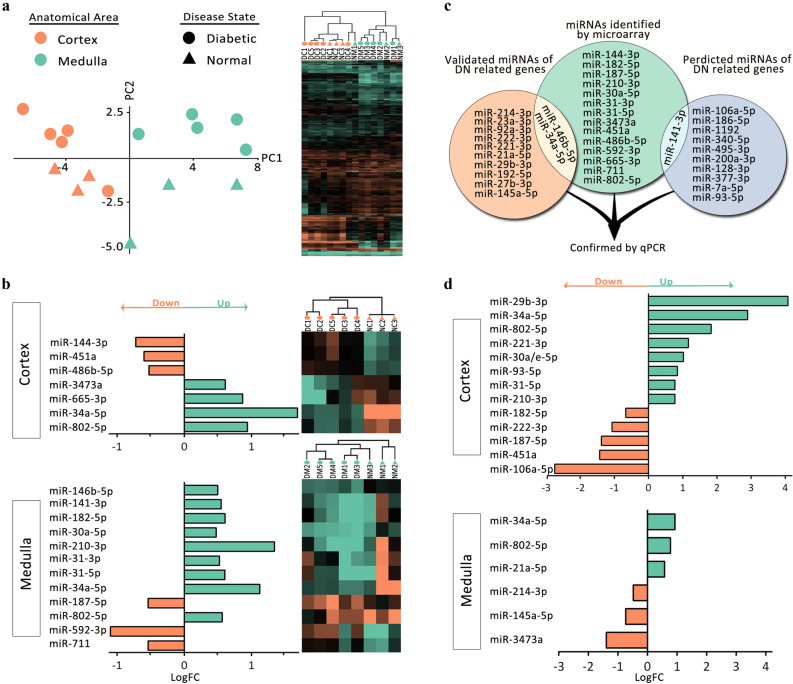
Diabetic nephropathy (DN), the leading cause of end-stage renal disease, has become a massive global health burden. Despite considerable efforts, the underlying mechanisms have not yet been comprehensively understood. In this study, a systematic approach was utilized to identify the microRNA signature in DN and to introduce novel drug targets (DTs) in DN. Using microarray profiling followed by qPCR confirmation, 13 and 6 differentially expressed (DE) microRNAs were identified in the kidney cortex and medulla, respectively. The microRNA-target interaction networks for each anatomical compartment were constructed and central nodes were identified. Moreover, enrichment analysis was performed to identify key signaling pathways. To develop a strategy for DT prediction, the human proteome was annotated with 65 biochemical characteristics and 23 network topology parameters. Furthermore, all proteins targeted by at least one FDA-approved drug were identified. Next, mGMDH-AFS, a high-performance machine learning algorithm capable of tolerating massive imbalanced size of the classes, was developed to classify DT and non-DT proteins. The sensitivity, specificity, accuracy, and precision of the proposed method were 90%, 86%, 88%, and 89%, respectively. Moreover, it significantly outperformed the state-of-the-art (P-value ≤ 0.05) and showed very good diagnostic accuracy and high agreement between predicted and observed class labels. The cortex and medulla networks were then analyzed with this validated machine to identify potential DTs. Among the high-rank DT candidates are Egfr, Prkce, clic5, Kit, and Agtr1a which is a current well-known target in DN. In conclusion, a combination of experimental and computational approaches was exploited to provide a holistic insight into the disorder for introducing novel therapeutic targets.
糖尿病肾病(DN)是终末期肾病的主要病因,已成为全球巨大的健康负担。尽管已经付出了相当大的努力,但尚未全面了解其潜在机制。在这项研究中,我们采用系统方法来鉴定 DN 中的 microRNA 特征,并引入 DN 中的新药物靶点(DTs)。通过微阵列分析和 qPCR 验证,在肾脏皮质和髓质中分别鉴定出 13 个和 6 个差异表达(DE)microRNA。为每个解剖部位构建了 microRNA-靶标相互作用网络,并鉴定出核心节点。此外,还进行了富集分析以鉴定关键信号通路。为了开发 DT 预测策略,用 65 种生化特性和 23 种网络拓扑参数注释了人类蛋白质组。此外,还鉴定了至少被一种 FDA 批准药物靶向的所有蛋白质。接下来,开发了一种高性能的机器学习算法 mGMDH-AFS,该算法能够容忍类别之间大规模的不平衡大小,用于对 DT 和非 DT 蛋白质进行分类。所提出的方法的敏感性、特异性、准确性和精度分别为 90%、86%、88%和 89%。此外,它显著优于最先进的方法(P 值≤0.05),并且显示出非常好的诊断准确性和预测与观察到的类标签之间的高度一致性。然后使用此经过验证的机器分析皮质和髓质网络,以识别潜在的 DTs。高排名 DT 候选物包括 Egfr、Prkce、clic5、Kit 和 Agtr1a,这是当前在 DN 中已知的靶点。总之,采用实验和计算方法相结合,为引入新的治疗靶点提供了对该疾病的整体认识。