Department of Infectomics and Molecular Pathogenesis, Center for Research and Advanced Studies (CINVESTAV-IPN), Mexico City, Mexico.
Center of Microbiology and Cell Biology, Venezuelan Institute for Scientific Research (IVIC), Caracas, Venezuela.
Sci Rep. 2021 Dec 6;11(1):23489. doi: 10.1038/s41598-021-02929-1.
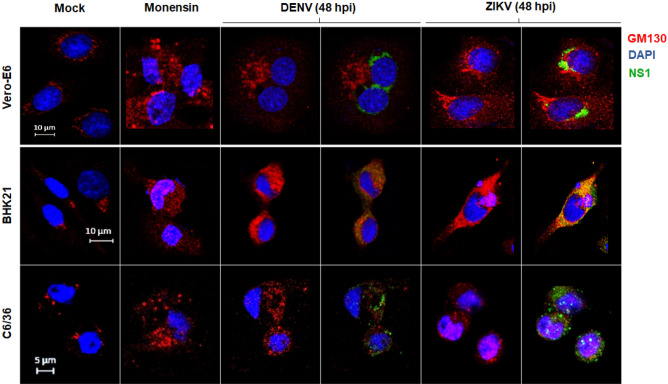
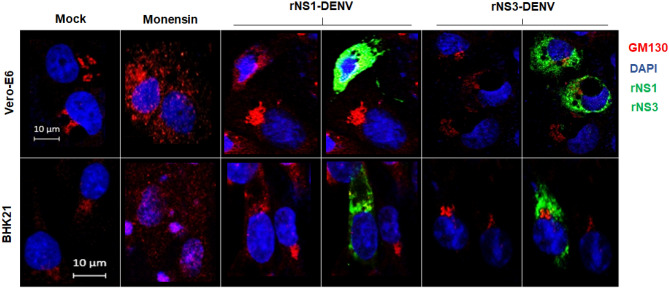
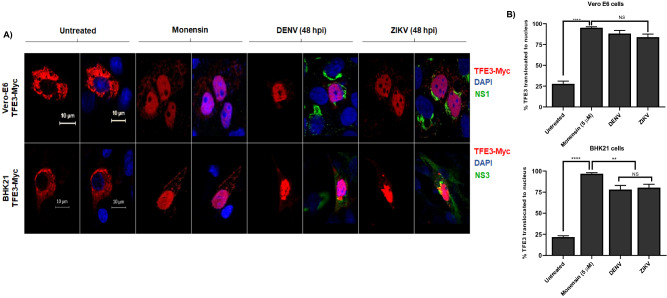
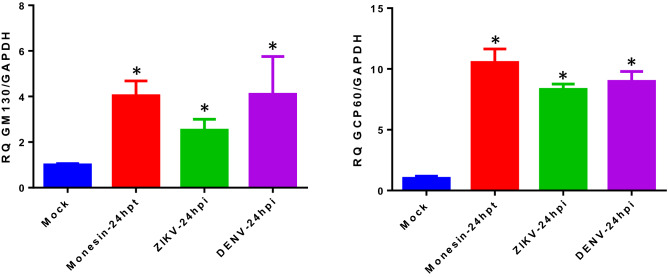
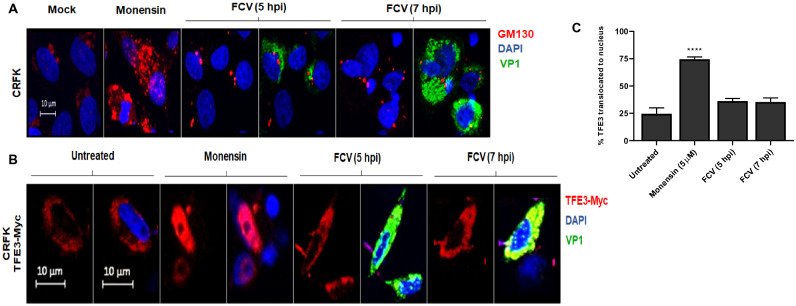
The stress of the Golgi apparatus is an autoregulatory mechanism that is induced to compensate for greater demand in the Golgi functions. No examples of Golgi stress responses due to physiological stimuli are known. Furthermore, the impact on this organelle of viral infections that occupy the vesicular transport during replication is unknown. In this work, we evaluated if a Golgi stress response is triggered during dengue and Zika viruses replication, two flaviviruses whose replicative cycle is heavily involved with the Golgi complex, in vertebrate and mosquito cells. Using GM-130 as a Golgi marker, and treatment with monensin as a positive control for the induction of the Golgi stress response, a significant expansion of the Golgi cisternae was observed in BHK-21, Vero E6 and mosquito cells infected with either virus. Activation of the TFE3 pathway was observed in the infected cells as indicated by the translocation from the cytoplasm to the nucleus of TFE3 and increased expression of pathway targeted genes. Of note, no sign of activation of the stress response was observed in CRFK cells infected with Feline Calicivirus (FCV), a virus released by cell lysis, not requiring vesicular transport. Finally, dilatation of the Golgi complex and translocation of TFE3 was observed in vertebrate cells expressing dengue and Zika viruses NS1, but not NS3. These results indicated that infections by dengue and Zika viruses induce a Golgi stress response in vertebrate and mosquito cells due to the increased demand on the Golgi complex imposed by virion and NS1 processing and secretion.
高尔基体应激是一种自调节机制,可诱导补偿高尔基体功能的更高需求。目前尚不知道由于生理刺激引起的高尔基体应激反应的例子。此外,病毒感染对占据复制过程中囊泡运输的细胞器的影响尚不清楚。在这项工作中,我们评估了登革热和寨卡病毒复制期间是否会触发高尔基体应激反应,这两种黄病毒的复制周期与高尔基复合体密切相关,在脊椎动物和蚊子细胞中。使用 GM-130 作为高尔基体标记,并用莫能菌素处理作为诱导高尔基体应激反应的阳性对照,观察到 BHK-21、Vero E6 和蚊子细胞感染这两种病毒后高尔基体潴泡明显扩张。如 TFE3 途径从细胞质易位到细胞核和途径靶向基因的表达增加所表明的,观察到感染细胞中 TFE3 途径的激活。值得注意的是,在感染猫杯状病毒(FCV)的 CRFK 细胞中未观察到应激反应的激活迹象,FCV 是通过细胞裂解释放的病毒,不需要囊泡运输。最后,在表达登革热和寨卡病毒 NS1 的脊椎动物细胞中观察到高尔基体复合物扩张和 TFE3 易位,但 NS3 则没有。这些结果表明,登革热和寨卡病毒感染会导致脊椎动物和蚊子细胞中的高尔基体应激反应,这是由于病毒粒子和 NS1 加工和分泌对高尔基体复合物的需求增加所致。