College of Economics, Sichuan Agricultural University, Sichuan, Chengdu, PR China.
School of Economics & Management, Huazhong Agricultural University, Hubei, Wuhan, PR China.
PLoS One. 2021 Dec 7;16(12):e0260437. doi: 10.1371/journal.pone.0260437. eCollection 2021.
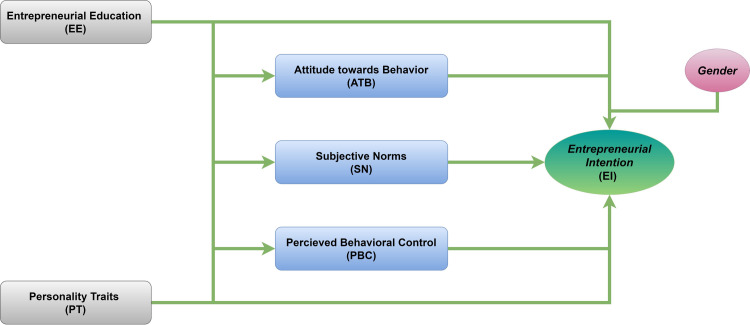
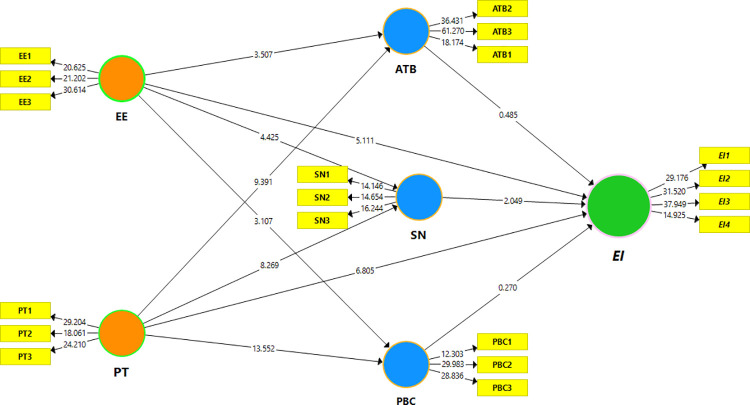
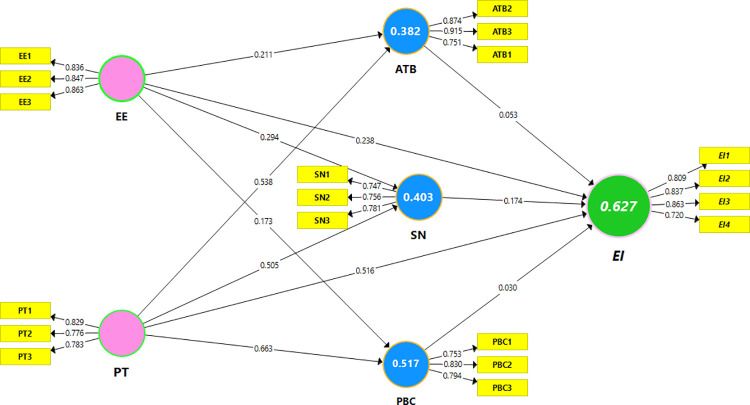
This cross-sectional study sought to identify gender differences in individual behavioral attitudes, personal traits, and entrepreneurial education based on planned behavior theory. The Smart partial least squares (PLS) structural equation model and PLS path modeling were used. A survey design was used to collect data from 309 samples using quantitative measures. The model was tested for validity and reliability and showed variance (full, R2 = 58.9% and split, R2 = 62.7% and R2 = 52.7%) in male and female model predictive power, respectively. Subjective norms (SN), personality traits (PT), and entrepreneurial education (EE) significantly impacted the male sample's intention. Females' intentions toward entrepreneurship was less affected by attitude toward behavior (ATB), subjective norms (SN), perceived behavioral control (PBC), and entrepreneurship education (EE). Further, attitudes, social norms, and behavioral controls as mediation variables indicate a significant and positive role of male and female intentions. These findings imply that behavioral beliefs (ATB, PBC, and SN) influence entrepreneurial intention-action translation. The results significantly supported the designed hypotheses and shed light on individual personality traits (PT) and entrepreneurship education (EE) underpinning enterprise intention. The study determined that EE and PT are the strongest predictors of intention, thus highlighting the role of these motives in the entrepreneurial process. This study contributes to the growing body of knowledge on youth entrepreneurs, expands our understanding of entrepreneurship as a practical career choice, and offers a novel account differentiating male and female PT. The drive to evaluate the effects of entrepreneurial intention among budding disparities in Pakistan requires a more profound knowledge of the aspects that endorse entrepreneurship as a choice of profession and enhances youth incentive abilities to engage in entrepreneurial activities based on exploitation.
这项横断面研究旨在根据计划行为理论,确定个体行为态度、个人特质和创业教育方面的性别差异。采用 Smart 偏最小二乘(PLS)结构方程模型和 PLS 路径建模。采用调查设计,使用定量测量方法从 309 个样本中收集数据。对模型进行了有效性和可靠性检验,结果表明男性和女性模型的预测能力存在差异(总体,R2=58.9%;分裂,R2=62.7%和 R2=52.7%)。主观规范(SN)、人格特质(PT)和创业教育(EE)对男性样本的意图有显著影响。女性创业意向受行为态度(ATB)、主观规范(SN)、感知行为控制(PBC)和创业教育(EE)的影响较小。此外,态度、社会规范和行为控制作为中介变量表明,男性和女性的意图具有显著的积极作用。这些发现表明,行为信念(ATB、PBC 和 SN)影响创业意向-行动的转化。研究结果显著支持了设计的假设,并阐明了个体人格特质(PT)和创业教育(EE)对企业意图的支持作用。研究确定,EE 和 PT 是意图的最强预测因素,因此强调了这些动机在创业过程中的作用。本研究丰富了关于青年企业家的知识体系,拓展了我们对创业作为一种实际职业选择的理解,并提供了一个新颖的角度,区分了男性和女性的 PT。评估创业意图对巴基斯坦萌芽差异的影响需要更深入地了解支持创业作为职业选择的方面,并增强青年激励能力,使他们能够根据创业活动的开发来参与创业活动。