CNRS UMR9187, INSERM U1196, Institut Curie, PSL Research University, F-91405 Orsay, France.
CNRS UMR9187, INSERM U1196, Université Paris-Saclay, F-91405 Orsay, France.
Nucleic Acids Res. 2021 Dec 16;49(22):12644-12660. doi: 10.1093/nar/gkab1166.
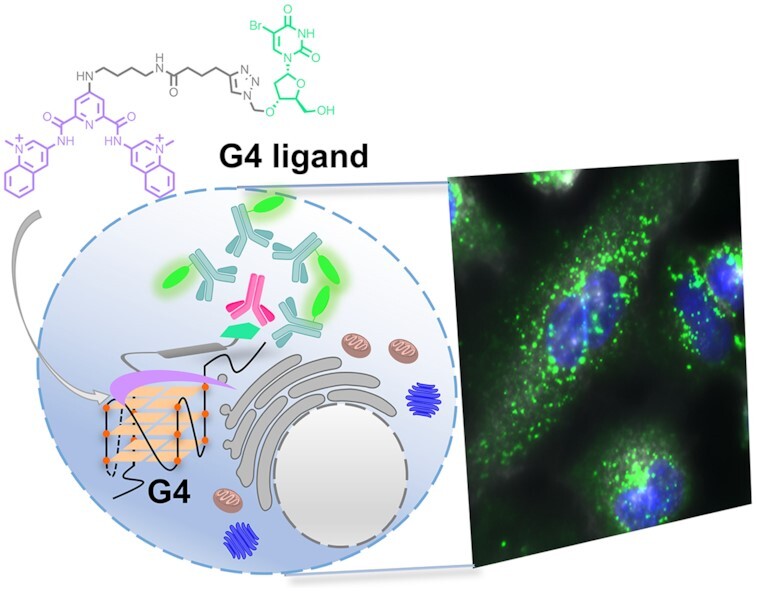
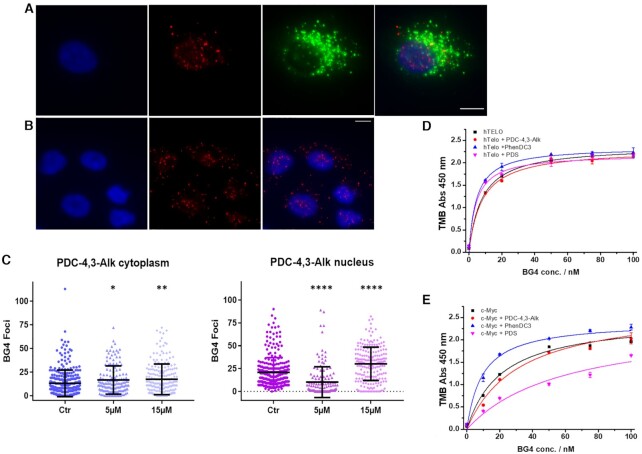
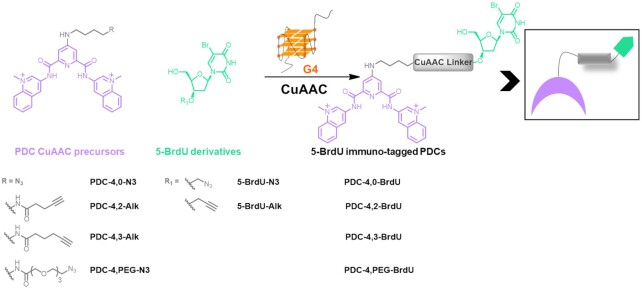
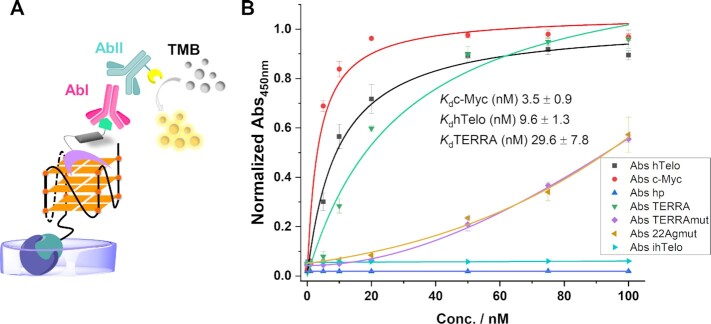
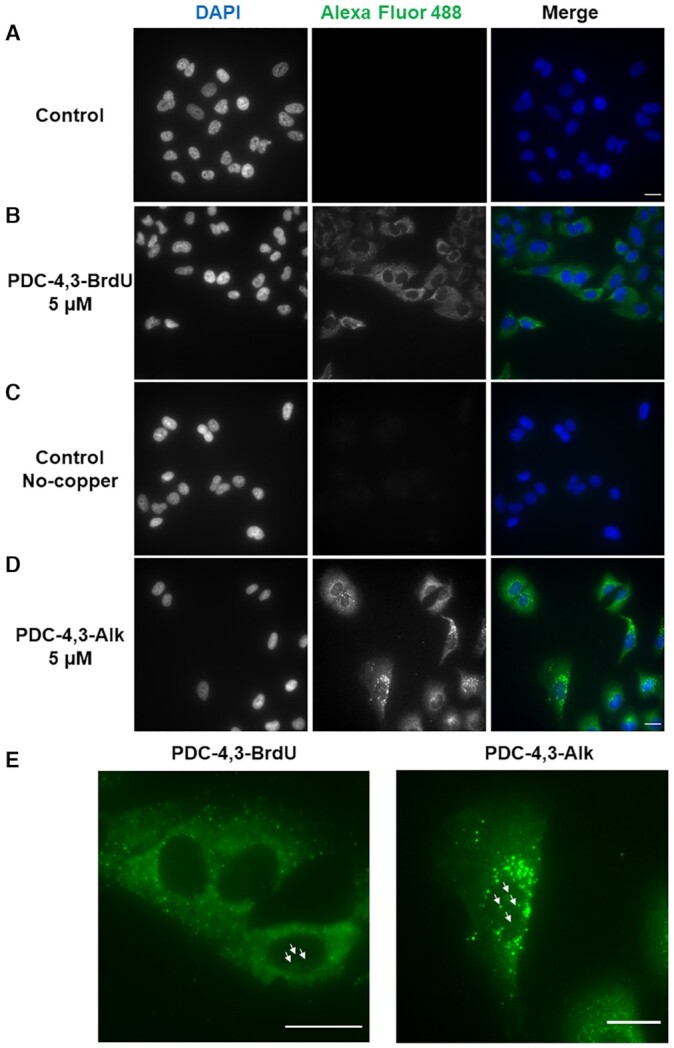
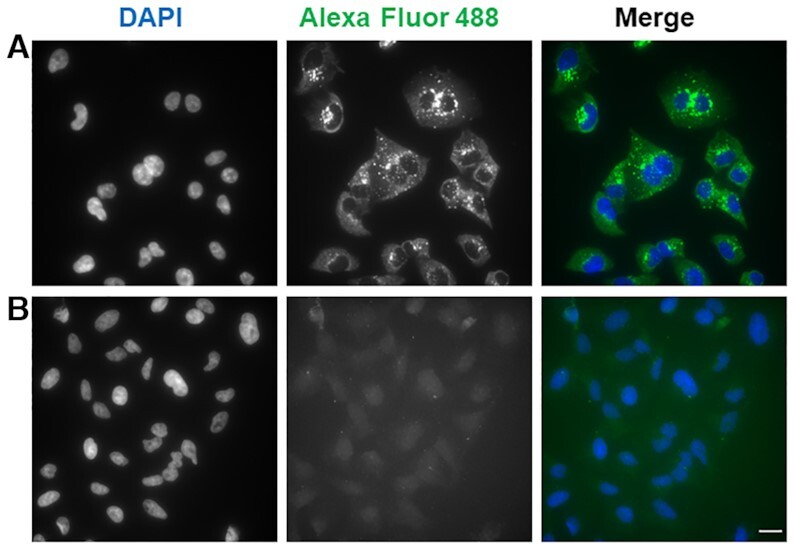
G-quadruplexes (G4s) are secondary structures forming in G-rich nucleic acids. G4s are assumed to play critical roles in biology, nonetheless their detection in cells is still challenging. For tracking G4s, synthetic molecules (G4 ligands) can be used as reporters and have found wide application for this purpose through chemical functionalization with a fluorescent tag. However, this approach is limited by a low-labeling degree impeding precise visualization in specific subcellular regions. Herein, we present a new visualization strategy based on the immuno-recognition of 5-bromo-2'-deoxyuridine (5-BrdU) modified G4 ligands, functionalized prior- or post-G4-target binding by CuAAC. Remarkably, recognition of the tag by antibodies leads to the detection of the modified ligands exclusively when bound to a G4 target both in vitro, as shown by ELISA, and in cells, thereby providing a highly efficient G4-ligand Guided Immunofluorescence Staining (G4-GIS) approach. The obtained signal amplification revealed well-defined fluorescent foci located in the perinuclear space and RNase treatment revealed the preferential binding to G4-RNA. Furthermore, ligand treatment affected significantly BG4 foci formation in cells. Our work headed to the development of a new imaging approach combining the advantages of immunostaining and G4-recognition by G4 ligands leading to visualization of G4/ligands species in cells with unrivaled precision and sensitivity.
四链体(G4s)是在富含 G 的核酸中形成的二级结构。G4s 被认为在生物学中发挥着关键作用,但在细胞中检测它们仍然具有挑战性。为了追踪 G4s,可以使用合成分子(G4 配体)作为报告分子,并通过与荧光标记物的化学官能化而广泛应用于该目的。然而,这种方法受到低标记程度的限制,阻碍了在特定亚细胞区域中的精确可视化。在此,我们提出了一种新的可视化策略,基于 5-溴-2'-脱氧尿苷(5-BrdU)修饰的 G4 配体的免疫识别,该配体在 G4 靶标结合之前或之后通过 CuAAC 进行功能化。值得注意的是,抗体对标记物的识别仅导致当配体与 G4 靶标结合时检测到修饰的配体,这在体外(如 ELISA 所示)和细胞中均得到证明,从而提供了一种高效的 G4-配体导向免疫荧光染色(G4-GIS)方法。获得的信号放大显示了位于核周空间中的定义明确的荧光焦点,并且 RNase 处理揭示了对 G4-RNA 的优先结合。此外,配体处理显著影响了 BG4 焦点在细胞中的形成。我们的工作旨在开发一种新的成像方法,该方法结合了免疫染色和 G4 配体对 G4 的识别的优势,从而可以以前所未有的精度和灵敏度在细胞中可视化 G4/配体物种。