Institut de Neuropsiquiatria i Addiccions (INAD), Parc de Salut Mar, Universitat Autònoma de Barcelona (UAB), Barcelona, Spain; Institut Hospital del Mar d'Investigacions Mèdiques, (IMIM), Parce de Salut Mar, Barcelona, Spain; Centro de Investigación Biomédica en Red de Salud Mental, CIBERSAM, Madrid, Spain.
Institut Hospital del Mar d'Investigacions Mèdiques, (IMIM), Parce de Salut Mar, Barcelona, Spain; Centro de Investigación Biomédica en Red de Salud Mental, CIBERSAM, Madrid, Spain.
Eur Neuropsychopharmacol. 2022 Mar;56:4-12. doi: 10.1016/j.euroneuro.2021.11.006. Epub 2021 Nov 19.
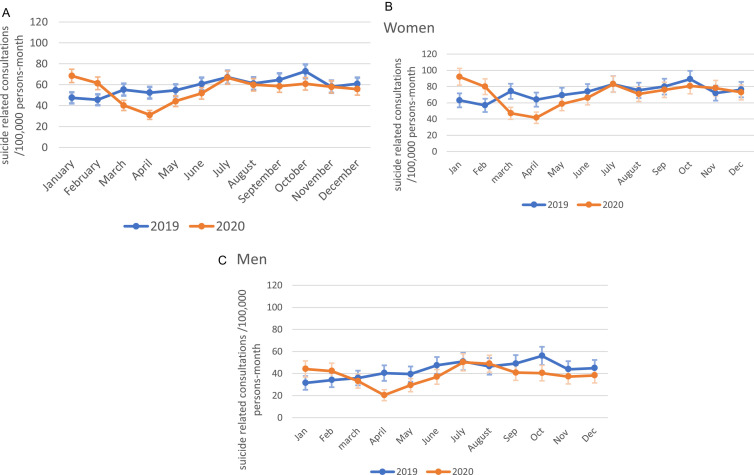
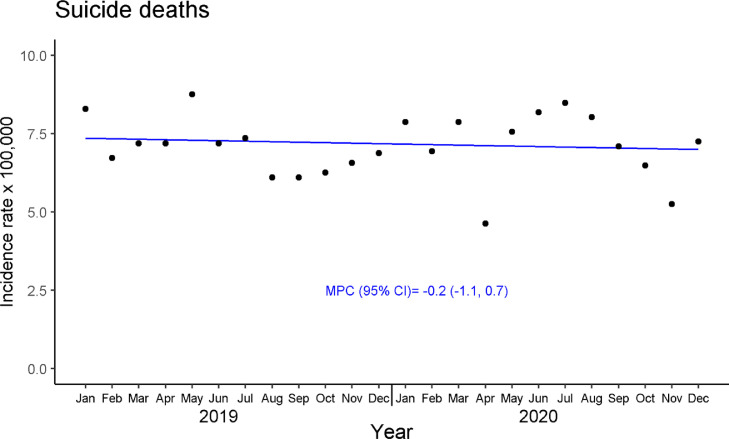
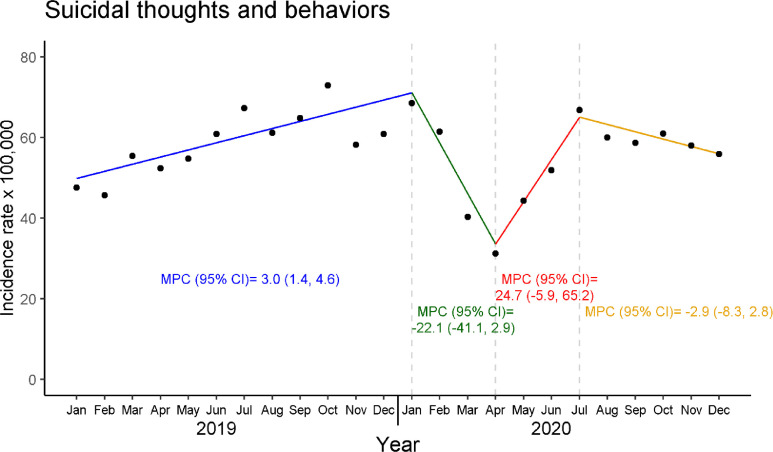
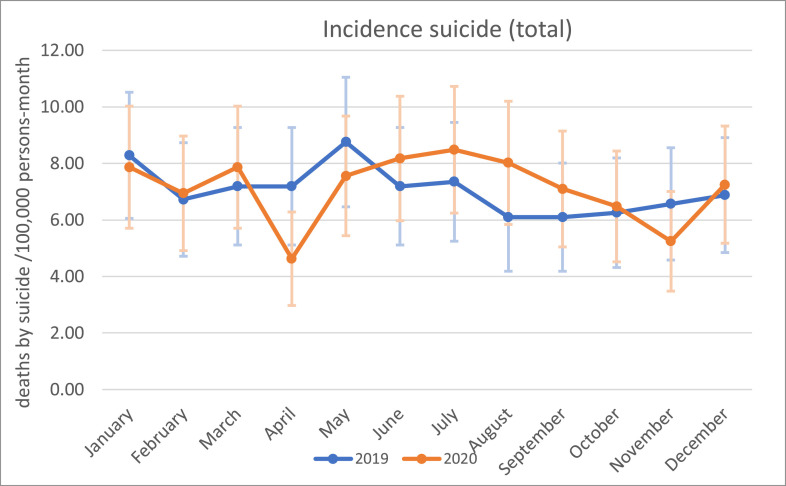
The COVID-19 pandemic is expected to increase suicidal behavior. However, data available to date are inconsistent. This study examines suicidal thoughts and behaviors and suicide trends in 2020 relative to 2019 as an approximation to the impact of the pandemic on suicidal behavior and death in the general population of Catalonia, Spain. Data on suicide-related thoughts and behaviors (STBs) and suicidal mortality were obtained from the Catalonia Suicide Risk Code (CSRC) register and the regional police, respectively. We compared the monthly crude incidence of STBs and suicide mortality rates of 2020 with those of 2019. Joinpoint regression analysis was used to assess changes in trends over time during the studied period. In 2020, 4,263 consultations for STBs and 555 suicide deaths were registered in Catalonia (approx. 7.5 million inhabitants). Compared to 2019, in 2020 STBs rates decreased an average of 6.3% (incidence rate ratio, IRR=0.94, 95% CI 0,90-0,98) and overall suicide death rates increased 1.2% (IRR=1.01, 95% CI 0.90-1.13). Joinpoint regression results showed a substantial decrease in STBs rates with a monthly percent change (MPC) of -22.1 (95% CI: -41.1, 2.9) from January-April 2020, followed by a similar increase from April-July 2020 (MPC=24.7, 95% CI: -5.9, 65.2). The most restrictive measures implemented in response to the COVID-19 pandemic reduced consultations for STBs, suggesting that the "stay at home" message may have discouraged people from contacting mental health services. STBs and mortality should continue to be monitored in 2021 and beyond to understand better the mid-to-long term impact of COVID-19 on suicide trends.
预计 COVID-19 大流行将增加自杀行为。然而,迄今为止的数据并不一致。本研究通过比较 2020 年和 2019 年自杀相关想法和行为(STBs)以及自杀趋势,来评估大流行对西班牙加泰罗尼亚一般人群自杀行为和死亡的影响。自杀相关想法和行为(STBs)和自杀死亡率的数据分别来自加泰罗尼亚自杀风险代码(CSRC)登记处和地区警方。我们比较了 2020 年和 2019 年每月 STBs 的粗发病率和自杀死亡率。使用 Joinpoint 回归分析评估了研究期间随时间变化的趋势变化。2020 年,在加泰罗尼亚登记了 4263 例 STBs 咨询和 555 例自杀死亡(约 750 万居民)。与 2019 年相比,2020 年 STBs 发生率平均下降了 6.3%(发病率比,IRR=0.94,95%CI 0.90-0.98),总自杀死亡率上升了 1.2%(IRR=1.01,95%CI 0.90-1.13)。Joinpoint 回归结果显示,从 2020 年 1 月至 4 月,STBs 发生率每月下降 22.1%(95%CI:-41.1,2.9),随后从 4 月至 7 月相似增加(MPC=24.7,95%CI:-5.9,65.2)。为应对 COVID-19 大流行而实施的最严格措施减少了 STBs 的咨询量,这表明“待在家中”的信息可能阻止了人们联系心理健康服务。2021 年及以后应继续监测 STBs 和死亡率,以更好地了解 COVID-19 对自杀趋势的中长期影响。