Departament de Medicina, Facultat de Medicina i Ciències de la Salut, Universitat de Barcelona (UB), c. Casanova, 143, 08036 Barcelona, Spain; Bipolar and Depressive Disorders Unit, Hospìtal Clinic de Barcelona, c. Villarroel, 170, 08036 Barcelona, Spain; Institut d'Investigacions Biomèdiques August Pi i Sunyer (IDIBAPS), c. Villarroel, 170, 08036 Barcelona, Spain; Institute of Neurosciences (UBNeuro), p. de la Vall d'Hebron, 171, 08035 Barcelona, Spain.
Bipolar and Depressive Disorders Unit, Hospìtal Clinic de Barcelona, c. Villarroel, 170, 08036 Barcelona, Spain; Department of Biomedical and Neuromotor Sciences, University of Bologna, Bologna, Italy.
J Affect Disord. 2023 Oct 1;338:384-392. doi: 10.1016/j.jad.2023.06.034. Epub 2023 Jun 17.
Psychological, socio-demographics, and clinical factors play an important role in patients with COVID-19, but their relationship is complex. The network approach might be used to disentangle complex interactions in different systems. Using data from a multicentre, cross-sectional, survey among patients with COVID-19 in Spain (July-November 2020), we investigated the network structure of mental disorders symptoms, social support, and psychological resilience, and changes in network structures according to the presence of a pre-existing mental disorder or hospitalization for COVID-19.
Subjects completed a survey to evaluate sociodemographic characteristics, COVID-19 infection status, resilience, social support, and symptoms of depression, anxiety disorders, post-traumatic stress disorder, panic attacks, and substance use disorder. 2084 patients with COVID-19 were included in the analysis. Network analysis was conducted to evaluate network and bridge centrality, and the network properties were compared between COVID-19 patients with and without a history of lifetime mental disorder, and between hospitalized and non-hospitalized patients.
Generalization of our findings may be difficult since differences in network connectivity may exist in different populations or samples.
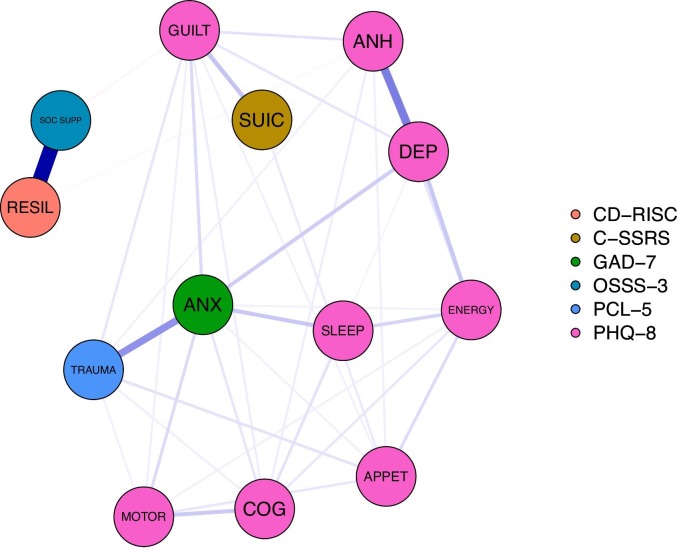
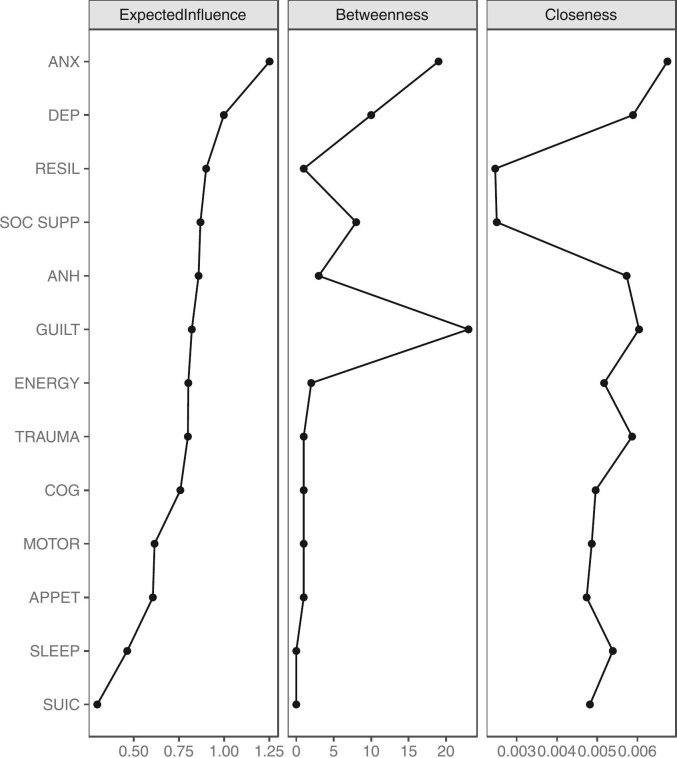
Anxiety and depression showed high centrality in patients with COVID-19 and anxiety showed the highest bridge influence in the network. Resilience and social support showed a low influence on mental disorder symptoms. Global network estimations show no statistically significant changes between patients with and without pre-existing mental disorders or between hospitalized and non-hospitalized patients.
Anxiety might be a key treatment target in patients with COVID-19 since its treatment might prevent other mental health adverse outcomes.
心理、社会人口学和临床因素在 COVID-19 患者中起着重要作用,但它们之间的关系很复杂。网络方法可用于厘清不同系统中的复杂相互作用。我们使用西班牙多中心、横断面、COVID-19 患者调查(2020 年 7 月至 11 月)的数据,研究了精神障碍症状、社会支持和心理弹性的网络结构,以及根据是否存在预先存在的精神障碍或因 COVID-19 住院,网络结构的变化。
受试者完成了一项调查,以评估社会人口统计学特征、COVID-19 感染状况、韧性、社会支持以及抑郁、焦虑障碍、创伤后应激障碍、惊恐发作和物质使用障碍的症状。共有 2084 例 COVID-19 患者纳入分析。进行网络分析以评估网络和桥接中心性,并比较 COVID-19 患者是否有终身精神障碍史、住院和非住院患者之间的网络特性。
由于不同人群或样本中网络连接的差异可能存在,因此我们研究结果的推广可能具有难度。
焦虑和抑郁在 COVID-19 患者中具有较高的中心性,而在网络中,焦虑显示出最高的桥接影响。韧性和社会支持对精神障碍症状的影响较低。全球网络估计显示,有或没有预先存在的精神障碍的患者之间,或住院和非住院患者之间,网络连接没有统计学上的显著变化。
由于焦虑的治疗可能预防其他心理健康不良后果,因此焦虑可能是 COVID-19 患者的一个关键治疗目标。