• 文献检索
  • 文档翻译
  • 深度研究
  • 学术资讯
  • Suppr Zotero 插件Zotero 插件
  • 邀请有礼
  • 套餐&价格
  • 历史记录
应用&插件
Suppr Zotero 插件Zotero 插件浏览器插件Mac 客户端Windows 客户端微信小程序
定价
高级版会员购买积分包购买API积分包
服务
文献检索文档翻译深度研究API 文档MCP 服务
关于我们
关于 Suppr公司介绍联系我们用户协议隐私条款
关注我们

Suppr 超能文献

核心技术专利:CN118964589B侵权必究
粤ICP备2023148730 号-1Suppr @ 2026

文献检索

告别复杂PubMed语法,用中文像聊天一样搜索,搜遍4000万医学文献。AI智能推荐,让科研检索更轻松。

立即免费搜索

文件翻译

保留排版,准确专业,支持PDF/Word/PPT等文件格式,支持 12+语言互译。

免费翻译文档

深度研究

AI帮你快速写综述,25分钟生成高质量综述,智能提取关键信息,辅助科研写作。

立即免费体验

泰国军民疟疾疫情应对:多方利益攸关方共同参与消除疟疾的范例。

Civilian-military malaria outbreak response in Thailand: an example of multi-stakeholder engagement for malaria elimination.

机构信息

Malaria Elimination Initiative, Institute of Global Health Sciences, University of California, San Francisco, San Francisco, California, USA.

Sisaket Provincial Health Office, Sisaket, Sisaket Province, Thailand.

出版信息

Malar J. 2021 Dec 7;20(1):458. doi: 10.1186/s12936-021-03995-6.

DOI:10.1186/s12936-021-03995-6
PMID:34876133
原文链接:https://pmc.ncbi.nlm.nih.gov/articles/PMC8650387/
Abstract

BACKGROUND

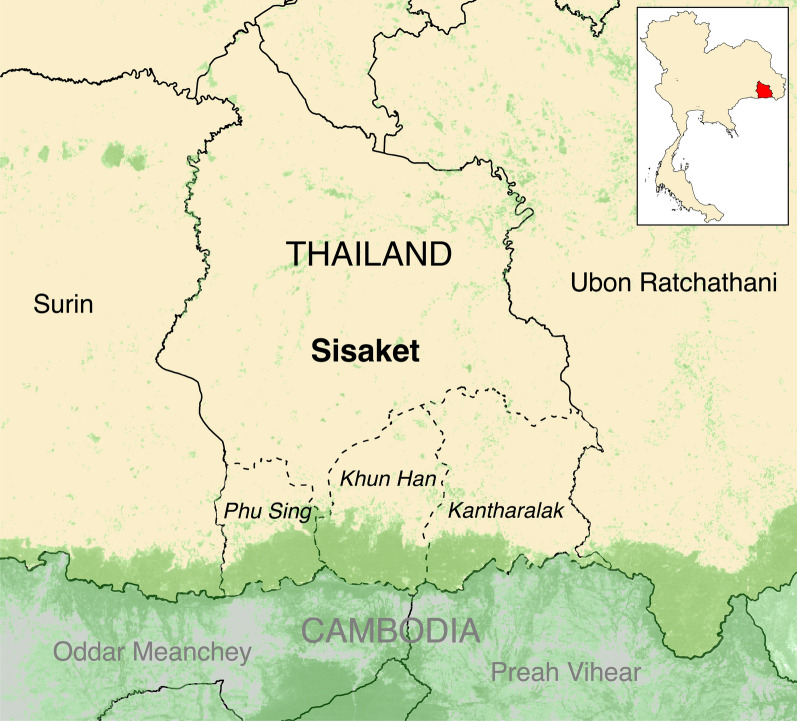
In April 2017, the Thai Ministry of Public Health (MoPH) was alerted to a potential malaria outbreak among civilians and military personnel in Sisaket Province, a highly forested area bordering Cambodia. The objective of this study was to present findings from the joint civilian-military outbreak response.

METHODS

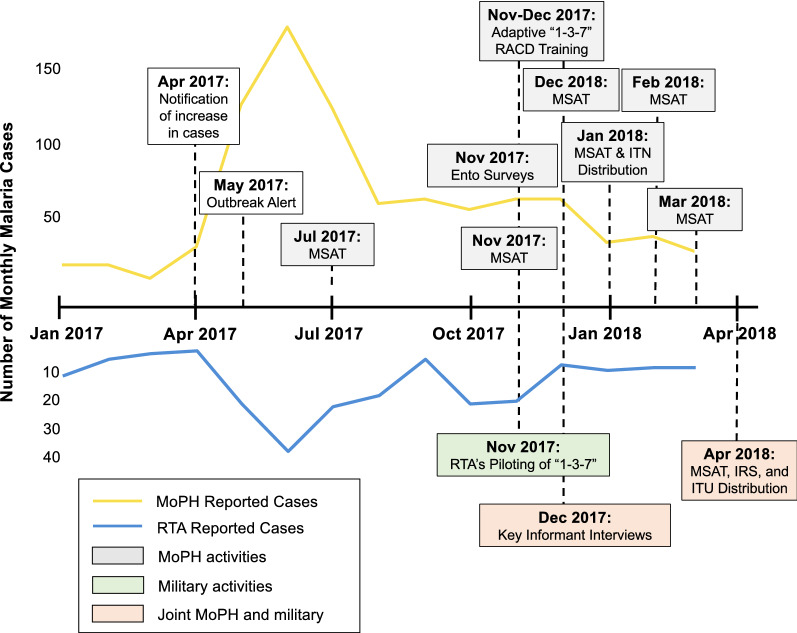
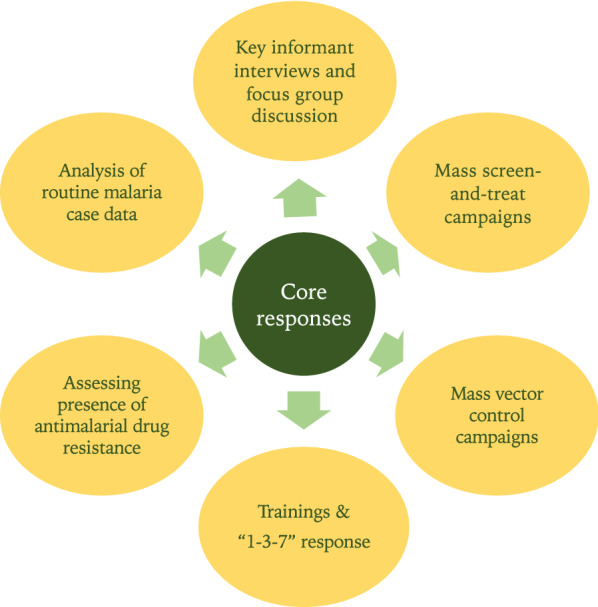
A mixed-methods approach was used to assess risk factors among cases reported during the 2017 Sisaket malaria outbreak. Routine malaria surveillance data from January 2013 to March 2018 obtained from public and military medical reporting systems and key informant interviews (KIIs) (n = 72) were used to develop hypotheses about potential factors contributing to the outbreak. Joint civilian-military response activities included entomological surveys, mass screen and treat (MSAT) and vector control campaigns, and scale-up of the "1-3-7" reactive case detection approach among civilians alongside a pilot "1-3-7" study conducted by the Royal Thai Army (RTA).

RESULTS

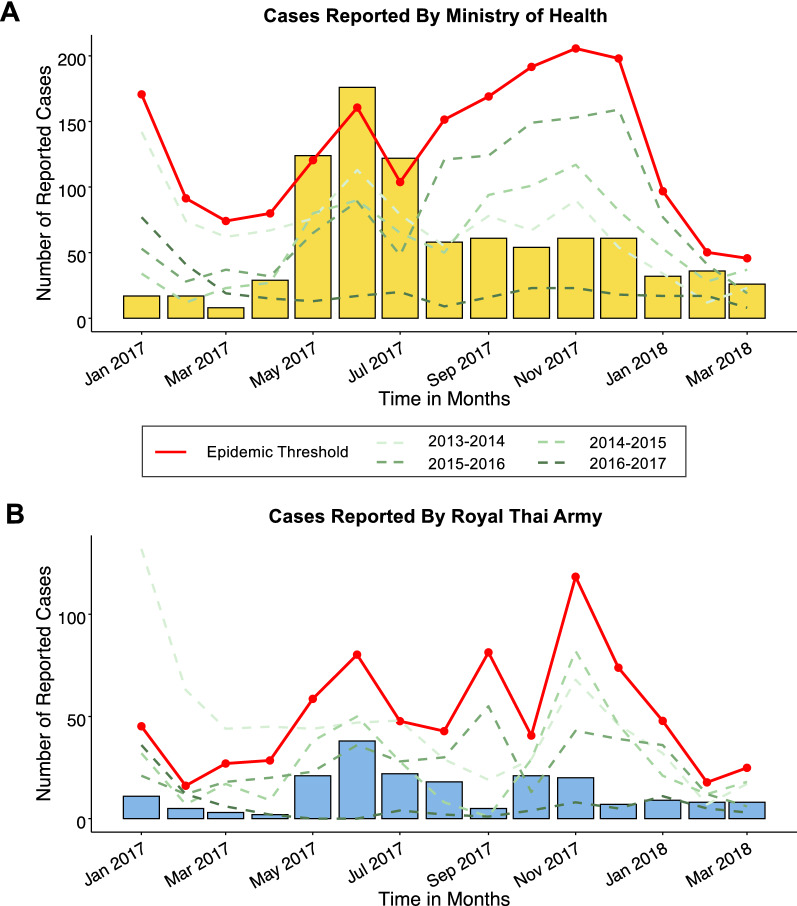
Between May-July 2017, the monthly number of MoPH-reported cases surpassed the epidemic threshold. Outbreak cases detected through the MoPH mainly consisted of Thai males (87%), working as rubber tappers (62%) or military/border police (15%), and Plasmodium vivax infections (73%). Compared to cases from the previous year (May-July 2016), outbreak cases were more likely to be rubber tappers (OR = 14.89 [95% CI: 5.79-38.29]; p < 0.001) and infected with P. vivax (OR=2.32 [1.27-4.22]; p = 0.006). Themes from KIIs were congruent with findings from routine surveillance data. Though limited risk factor information was available from military cases, findings from RTA's "1-3-7" study indicated transmission was likely occurring outside military bases. Data from entomological surveys and MSAT campaigns support this hypothesis, as vectors were mostly exophagic and parasite prevalence from MSAT campaigns was very low (range: 0-0.7% by PCR/microscopy).

CONCLUSIONS

In 2017, an outbreak of mainly P. vivax occurred in Sisaket Province, affecting mainly military and rubber tappers. Vector control use was limited to the home/military barracks, indicating that additional interventions were needed during high-risk forest travel periods. Importantly, this outbreak catalyzed joint civilian-military collaborations and integration of the RTA into the national malaria elimination strategy (NMES). The Sisaket outbreak response serves as an example of how civilian and military public health systems can collaborate to advance national malaria elimination goals in Southeast Asia and beyond.

摘要

背景

2017 年 4 月,泰国公共卫生部(MoPH)接到警报,称在毗邻柬埔寨的森林茂密的四色菊府,平民和军人中可能爆发疟疾。本研究旨在介绍军民联合应对疫情的结果。

方法

采用混合方法评估 2017 年四色菊府疟疾疫情期间报告病例的危险因素。利用公共和军事医疗报告系统(n=72)获取 2013 年 1 月至 2018 年 3 月的常规疟疾监测数据,并进行关键知情人访谈(KII),根据这些数据提出可能导致疫情爆发的潜在因素假设。军民联合应对活动包括昆虫学调查、大规模筛查和治疗(MSAT)以及病媒控制运动,以及在平民中扩大“1-3-7”反应性病例发现方法,并在泰国皇家军队(RTA)进行试点“1-3-7”研究。

结果

2017 年 5 月至 7 月期间,MoPH 报告的月病例数超过了疫情阈值。MoPH 发现的疫情病例主要为泰国男性(87%),从事橡胶收割(62%)或军人/边境警察(15%)工作,感染间日疟原虫(73%)。与前一年(2016 年 5 月至 7 月)相比,疫情病例更有可能是橡胶收割者(OR=14.89[95%CI:5.79-38.29];p<0.001)和感染间日疟原虫(OR=2.32[1.27-4.22];p=0.006)。KII 的主题与常规监测数据的结果一致。尽管从军事病例中获得的危险因素信息有限,但 RTA 的“1-3-7”研究结果表明,传播可能发生在军事基地之外。昆虫学调查和 MSAT 运动的数据支持这一假设,因为蚊子主要是外吸性的,MSAT 运动中的寄生虫患病率非常低(通过 PCR/显微镜检测,范围为 0-0.7%)。

结论

2017 年,四色菊府发生了以间日疟原虫为主的疫情,主要影响军人和橡胶收割者。病媒控制仅在家庭/军营使用,这表明在高风险森林旅行期间需要采取额外的干预措施。重要的是,此次疫情促使军民合作,并将 RTA 纳入国家消除疟疾战略(NMES)。四色菊府疫情应对行动为军民公共卫生系统如何合作,推进东南亚乃至其他地区国家消除疟疾目标提供了范例。
https://cdn.ncbi.nlm.nih.gov/pmc/blobs/d5db/8650387/b16e6b9de29b/12936_2021_3995_Fig4_HTML.jpg
https://cdn.ncbi.nlm.nih.gov/pmc/blobs/d5db/8650387/4e59d426c5a4/12936_2021_3995_Fig1_HTML.jpg
https://cdn.ncbi.nlm.nih.gov/pmc/blobs/d5db/8650387/0893dde1b3e0/12936_2021_3995_Fig2_HTML.jpg
https://cdn.ncbi.nlm.nih.gov/pmc/blobs/d5db/8650387/fa801d51e31e/12936_2021_3995_Fig3_HTML.jpg
https://cdn.ncbi.nlm.nih.gov/pmc/blobs/d5db/8650387/b16e6b9de29b/12936_2021_3995_Fig4_HTML.jpg
https://cdn.ncbi.nlm.nih.gov/pmc/blobs/d5db/8650387/4e59d426c5a4/12936_2021_3995_Fig1_HTML.jpg
https://cdn.ncbi.nlm.nih.gov/pmc/blobs/d5db/8650387/0893dde1b3e0/12936_2021_3995_Fig2_HTML.jpg
https://cdn.ncbi.nlm.nih.gov/pmc/blobs/d5db/8650387/fa801d51e31e/12936_2021_3995_Fig3_HTML.jpg
https://cdn.ncbi.nlm.nih.gov/pmc/blobs/d5db/8650387/b16e6b9de29b/12936_2021_3995_Fig4_HTML.jpg

相似文献

1
Civilian-military malaria outbreak response in Thailand: an example of multi-stakeholder engagement for malaria elimination.泰国军民疟疾疫情应对:多方利益攸关方共同参与消除疟疾的范例。
Malar J. 2021 Dec 7;20(1):458. doi: 10.1186/s12936-021-03995-6.
2
Mapping malaria transmission foci in Northeast Thailand from 2011 to 2021: approaching elimination in a hypoendemic area.2011年至2021年泰国东北部疟疾传播病灶的测绘:在低流行地区接近消除疟疾
Malar J. 2024 Jul 17;23(1):212. doi: 10.1186/s12936-024-05026-6.
3
Imported Plasmodium falciparum and locally transmitted Plasmodium vivax: cross-border malaria transmission scenario in northwestern Thailand.输入性恶性疟原虫和本地传播的间日疟原虫:泰国西北部的跨境疟疾传播情况
Malar J. 2017 Jun 21;16(1):258. doi: 10.1186/s12936-017-1900-2.
4
Cluster-randomized trial of monthly malaria prophylaxis versus focused screening and treatment: a study protocol to define malaria elimination strategies in Cambodia.每月疟疾预防与重点筛查和治疗的整群随机试验:柬埔寨疟疾消除策略定义研究方案
Trials. 2018 Oct 16;19(1):558. doi: 10.1186/s13063-018-2931-x.
5
From Plasmodium vivax outbreak to elimination: lessons learnt from a retrospective analysis of data from Guantang.从疟原虫 vivax 爆发到消除:关于关塘数据回顾性分析的经验教训
Malar J. 2020 Nov 23;19(1):427. doi: 10.1186/s12936-020-03501-4.
6
Demonstration of indigenous malaria elimination through Track-Test-Treat-Track (T4) strategy in a Malaria Elimination Demonstration Project in Mandla, Madhya Pradesh.在马哈拉施特拉邦曼德拉的消除疟疾示范项目中,通过“追踪-测试-治疗-追踪(T4)”策略展示了本土疟疾的消除。
Malar J. 2020 Sep 17;19(1):339. doi: 10.1186/s12936-020-03402-6.
7
Forest malaria in Cambodia: the occupational and spatial clustering of Plasmodium vivax and Plasmodium falciparum infection risk in a cross-sectional survey in Mondulkiri province, Cambodia.柬埔寨森林地区疟疾:柬埔寨蒙多基里省横断面调查中间日疟原虫和恶性疟原虫感染风险的职业及空间聚集情况
Malar J. 2020 Nov 19;19(1):413. doi: 10.1186/s12936-020-03482-4.
8
Survey for asymptomatic malaria cases in low transmission settings of Iran under elimination programme.伊朗消除规划下低传播地区无症状疟疾病例调查。
Malar J. 2012 Apr 25;11:126. doi: 10.1186/1475-2875-11-126.
9
A novel method for extracting nucleic acids from dried blood spots for ultrasensitive detection of low-density Plasmodium falciparum and Plasmodium vivax infections.一种从干血斑中提取核酸的新方法,用于超灵敏检测低密度疟原虫和间日疟原虫感染。
Malar J. 2017 Sep 18;16(1):377. doi: 10.1186/s12936-017-2025-3.
10
Spatiotemporal epidemiology, environmental correlates, and demography of malaria in Tak Province, Thailand (2012-2015).泰国达府疟疾的时空流行病学、环境相关性和人口统计学研究(2012-2015 年)。
Malar J. 2019 Jul 16;18(1):240. doi: 10.1186/s12936-019-2871-2.

引用本文的文献

1
Mapping malaria transmission foci in Northeast Thailand from 2011 to 2021: approaching elimination in a hypoendemic area.2011年至2021年泰国东北部疟疾传播病灶的测绘:在低流行地区接近消除疟疾
Malar J. 2024 Jul 17;23(1):212. doi: 10.1186/s12936-024-05026-6.
2
Early warning systems for malaria outbreaks in Thailand: an anomaly detection approach.泰国疟疾疫情爆发的预警系统:异常检测方法。
Malar J. 2024 Jan 8;23(1):11. doi: 10.1186/s12936-024-04837-x.
3
1-3-7 surveillance and response approach in malaria elimination: China's practice and global adaptions.

本文引用的文献

1
A foci cohort analysis to monitor successful and persistent foci under Thailand's Malaria Elimination Strategy.以泰国消除疟疾策略为背景的聚焦点队列分析,以监测成功和持续聚焦点的情况。
Malar J. 2021 Feb 27;20(1):118. doi: 10.1186/s12936-021-03648-8.
2
Eliminating Plasmodium falciparum malaria: results from tailoring active case detection approaches to remote populations in forested border areas in north-eastern Cambodia.消除恶性疟原虫疟疾:在柬埔寨东北部森林边境地区针对偏远人口定制主动病例检测方法的结果。
Malar J. 2021 Feb 22;20(1):108. doi: 10.1186/s12936-021-03622-4.
3
Contributing to Elimination of Cross-Border Malaria Through a Standardized Solution for Case Surveillance, Data Sharing, and Data Interpretation: Development of a Cross-Border Monitoring System.
1-3-7 疟疾消除中的监测和应对方法:中国的实践与全球适应。
Malar J. 2023 May 9;22(1):152. doi: 10.1186/s12936-023-04580-9.
4
Reactive Case Detection Strategy for Malaria Control and Elimination: A 12 Year Systematic Review and Meta-Analysis from 25 Malaria-Endemic Countries.用于疟疾控制与消除的被动病例检测策略:来自25个疟疾流行国家的12年系统评价与荟萃分析
Trop Med Infect Dis. 2023 Mar 18;8(3):180. doi: 10.3390/tropicalmed8030180.
5
Understanding work-related travel and its relation to malaria occurrence in Thailand using geospatial maximum entropy modelling.利用地理空间最大熵模型理解泰国与工作相关的旅行及其与疟疾发生的关系。
Malar J. 2023 Feb 13;22(1):52. doi: 10.1186/s12936-023-04478-6.
6
Modelling malaria in southernmost provinces of Thailand: a two-step process for analysis of highly right-skewed data with a large proportion of zeros.对泰国最南部省份疟疾建模:一种分析高度右偏数据和大量零值的两步法。
Malar J. 2022 Nov 15;21(1):334. doi: 10.1186/s12936-022-04363-8.
7
Assessing Thailand's 1-3-7 surveillance strategy in accelerating malaria elimination.评估泰国 1-3-7 监测策略在加速消除疟疾中的作用。
Malar J. 2022 Jul 18;21(1):222. doi: 10.1186/s12936-022-04229-z.
通过病例监测、数据共享和数据解释的标准化解决方案为消除跨境疟疾做贡献:跨境监测系统的开发。
JMIR Public Health Surveill. 2020 Sep 1;6(3):e15409. doi: 10.2196/15409.
4
Determinants of dihydroartemisinin-piperaquine treatment failure in Plasmodium falciparum malaria in Cambodia, Thailand, and Vietnam: a prospective clinical, pharmacological, and genetic study.中医疗法治疗失败的决定因素:柬埔寨、泰国和越南间日疟原虫疟疾的前瞻性临床、药理学和遗传学研究。
Lancet Infect Dis. 2019 Sep;19(9):952-961. doi: 10.1016/S1473-3099(19)30391-3. Epub 2019 Jul 22.
5
Transmission risk beyond the village: entomological and human factors contributing to residual malaria transmission in an area approaching malaria elimination on the Thailand-Myanmar border.村庄之外的传播风险:在接近消除疟疾的泰国-缅甸边境地区,导致残留疟疾传播的昆虫学和人为因素。
Malar J. 2019 Jul 1;18(1):221. doi: 10.1186/s12936-019-2852-5.
6
Novel Approaches to Control Malaria in Forested Areas of Southeast Asia.东南亚森林地区疟疾控制的新方法。
Trends Parasitol. 2019 Jun;35(6):388-398. doi: 10.1016/j.pt.2019.03.011. Epub 2019 May 7.
7
Emergence of Plasmodium falciparum triple mutant in Cambodia.柬埔寨出现恶性疟原虫三重突变体。
Lancet Infect Dis. 2017 Dec;17(12):1233. doi: 10.1016/S1473-3099(17)30635-7.
8
Natural Plasmodium vivax infections in Anopheles mosquitoes in a malaria endemic area of northeastern Thailand.泰国东北部疟疾流行地区按蚊体内的间日疟原虫自然感染情况。
Parasitol Res. 2017 Dec;116(12):3349-3359. doi: 10.1007/s00436-017-5653-1. Epub 2017 Oct 29.
9
Adapting Reactive Case Detection Strategies for falciparum Malaria in a Low-Transmission Area in Cambodia.适应柬埔寨低传播地区恶性疟原虫的反应性病例检测策略。
Clin Infect Dis. 2018 Jan 6;66(2):296-298. doi: 10.1093/cid/cix781.
10
Regional initiatives for malaria elimination: Building and maintaining partnerships.消除疟疾的区域倡议:建立和维持伙伴关系。
PLoS Med. 2017 Oct 5;14(10):e1002401. doi: 10.1371/journal.pmed.1002401. eCollection 2017 Oct.