Lee Yongjun, Forte Johnathas D'arf Severo, Chaves Andrey, Kumar Anshuman, Tran Trang Thu, Kim Youngbum, Roy Shrawan, Taniguchi Takashi, Watanabe Kenji, Chernikov Alexey, Jang Joon I, Low Tony, Kim Jeongyong
Department of Energy Science, Sungkyunkwan University, Suwon, 16419, Republic of Korea.
Departamento de Física, Universidade Federal do Ceará, Campus do Pici, 60455-900, Fortaleza, Ceará, Brazil.
Nat Commun. 2021 Dec 7;12(1):7095. doi: 10.1038/s41467-021-27418-x.
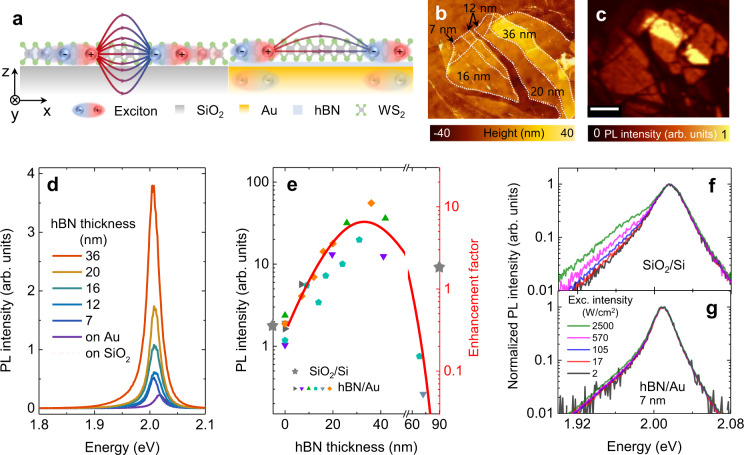
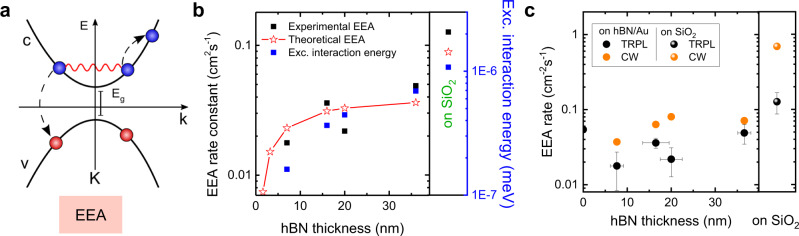
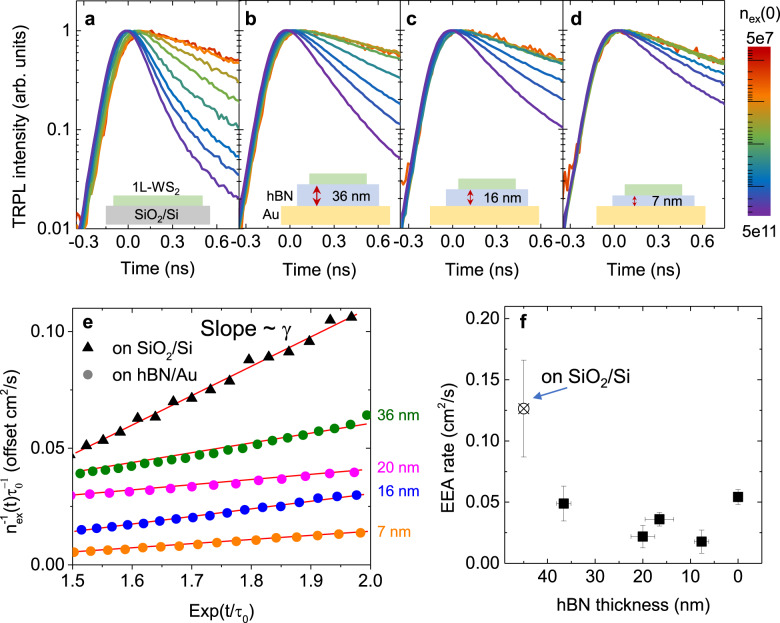
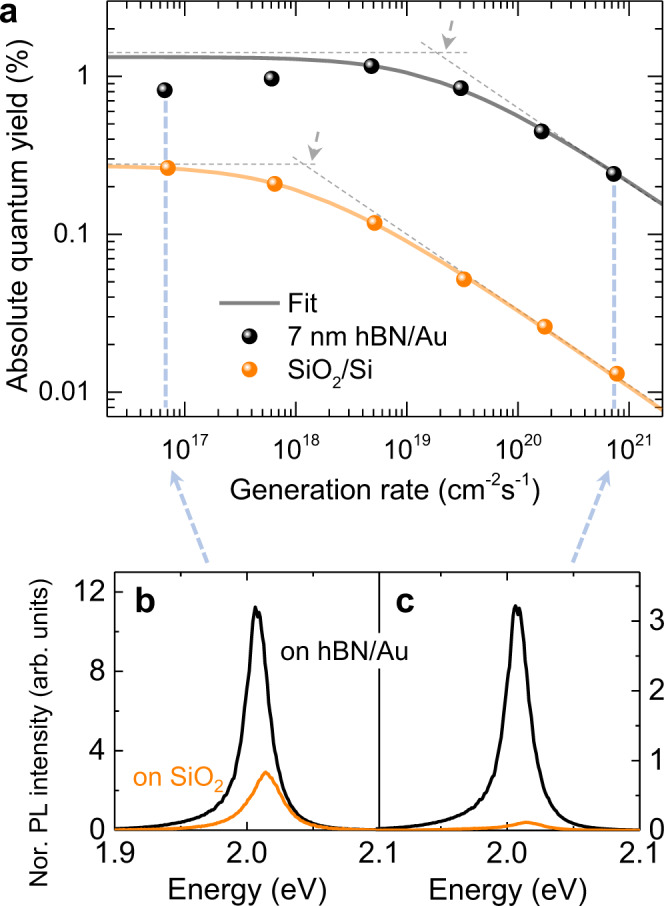
Monolayer transition metal dichalcogenides (1L-TMDs) have tremendous potential as atomically thin, direct bandgap semiconductors that can be used as convenient building blocks for quantum photonic devices. However, the short exciton lifetime due to the defect traps and the strong exciton-exciton interaction in TMDs has significantly limited the efficiency of exciton emission from this class of materials. Here, we show that exciton-exciton interaction in 1L-WS can be effectively screened using an ultra-flat Au film substrate separated by multilayers of hexagonal boron nitride. Under this geometry, induced dipolar exciton-exciton interaction becomes quadrupole-quadrupole interaction because of effective image dipoles formed within the metal. The suppressed exciton-exciton interaction leads to a significantly improved quantum yield by an order of magnitude, which is also accompanied by a reduction in the exciton-exciton annihilation (EEA) rate, as confirmed by time-resolved optical measurements. A theoretical model accounting for the screening of the dipole-dipole interaction is in a good agreement with the dependence of EEA on exciton densities. Our results suggest that fundamental EEA processes in the TMD can be engineered through proximal metallic screening, which represents a practical approach towards high-efficiency 2D light emitters.
单层过渡金属二硫属化物(1L-TMDs)作为原子级薄的直接带隙半导体具有巨大潜力,可用作量子光子器件的便捷构建模块。然而,由于缺陷陷阱导致的激子寿命短以及TMDs中激子 - 激子的强相互作用,显著限制了这类材料激子发射的效率。在此,我们表明,使用由多层六方氮化硼隔开的超平金膜衬底,可以有效屏蔽1L-WS中的激子 - 激子相互作用。在这种几何结构下,由于金属内部形成有效的镜像偶极子,诱导的偶极激子 - 激子相互作用变为四极 - 四极相互作用。激子 - 激子相互作用的抑制导致量子产率显著提高一个数量级,同时激子 - 激子湮灭(EEA)速率降低,时间分辨光学测量证实了这一点。一个考虑偶极 - 偶极相互作用屏蔽的理论模型与EEA对激子密度的依赖性吻合良好。我们的结果表明,TMDs中的基本EEA过程可以通过近端金属屏蔽来调控,这代表了一种实现高效二维发光体的实用方法。