Hunt Ethan T, von Klinggraeff Lauren, Jones Alexis, Burkart Sarah, Dugger Rodrick, Armstrong Bridget, Beets Michael W, Turner-McGrievy Gabrielle, Geraci Marco, Weaver R Glenn
Department of Exercise Science University of South Carolina Columbia South Carolina USA.
Department of Health Education and Behavior University of South Carolina Columbia South Carolina USA.
Obes Sci Pract. 2021 May 26;7(6):719-726. doi: 10.1002/osp4.532. eCollection 2021 Dec.
Children who fail to meet activity, sleep, and screen-time guidelines are at increased risk for obesity. Further, children who are Black are more likely to have obesity when compared to children who are White, and children from low-income households are at increased risk for obesity when compared to children from higher-income households. The objective of this study was to evaluate the proportion of days meeting obesogenic behavior guidelines during the school year compared to summer vacation by race and free/reduced priced lunch (FRPL) eligibility.
Mixed-effects linear and logistic regressions estimated the proportion of days participants met activity, sleep, and screen-time guidelines during summer and school by race and FRPL eligibility within an observational cohort sample.
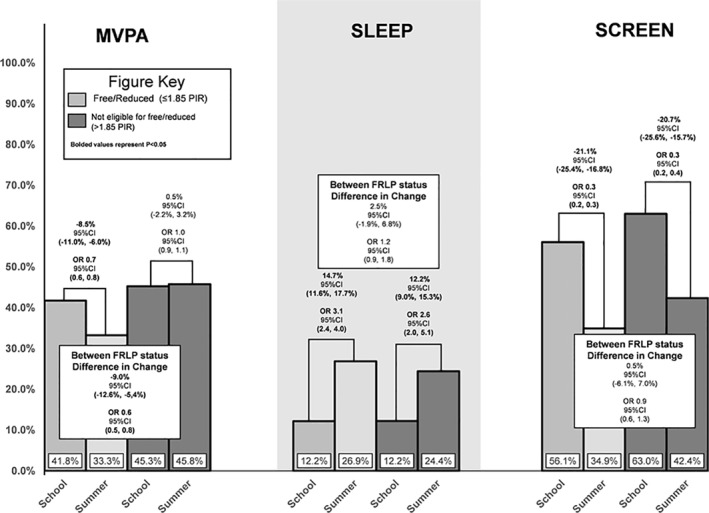
Children (n = 268, grades = K - 4, 44.1%FRPL, 59.0% Black) attending three schools participated. Children's activity, sleep, and screen-time were collected during an average of 23 school days and 16 days during summer vacation. During school, both children who were White and eligible for FRPL met activity, sleep, and screen-time guidelines on a greater proportion of days when compared to their Black and non-eligible counterparts. Significant differences in changes from school to summer in the proportion of days children met activity (-6.2%, 95CI = -10.1%, -2.3%; OR = 0.7, 95CI = 0.6, 0.9) and sleep (7.6%, 95CI = 2.9%, 12.4%; OR = 2.1, 95CI = 1.4, 3.0) guidelines between children who were Black and White were observed. Differences in changes in activity (-8.5%, 95CI = -4.9%, -12.1%; OR = 1.5, 95CI = 1.3, 1.8) were observed between children eligible versus uneligible for FRPL.
Summer vacation may be an important time for targeting activity and screen-time of children who are Black and/or eligible for FRPL.
未达到活动、睡眠和屏幕使用时间指南要求的儿童肥胖风险会增加。此外,与白人儿童相比,黑人儿童更易患肥胖症;与高收入家庭的儿童相比,低收入家庭的儿童肥胖风险更高。本研究的目的是按种族和免费/低价午餐(FRPL)资格评估学年期间与暑假期间符合致胖行为指南的天数比例。
混合效应线性回归和逻辑回归估计了观察队列样本中按种族和FRPL资格划分的参与者在夏季和学年期间符合活动、睡眠和屏幕使用时间指南的天数比例。
来自三所学校的儿童(n = 268,年级为K - 4,44.1%符合FRPL资格,59.0%为黑人)参与了研究。在平均23个上学日和16个暑假日期间收集了儿童的活动、睡眠和屏幕使用时间数据。在上学期间,与黑人及不符合FRPL资格的儿童相比,白人且符合FRPL资格的儿童在更多天数里符合活动、睡眠和屏幕使用时间指南要求。观察到黑人儿童和白人儿童在从上学到暑假期间符合活动指南的天数比例变化存在显著差异(-6.2%,95%置信区间 = -10.1%,-2.3%;比值比 = 0.7,95%置信区间 = 0.6,0.9)以及符合睡眠指南的天数比例变化存在显著差异(7.6%,95%置信区间 = 2.9%,12.4%;比值比 = 2.1,95%置信区间 = 1.4,3.0)。观察到符合FRPL资格与不符合FRPL资格的儿童在活动天数比例变化上存在差异(-8.5%,95%置信区间 = -4.9%,-12.1%;比值比 = 1.5,95%置信区间 = 1.3,1.8)。
暑假可能是针对黑人儿童和/或符合FRPL资格儿童的活动和屏幕使用时间进行干预的重要时期。