Arnold School of Public Health, University of South Carolina, Columbia, SC, USA.
UTHealth Houston, School of Public Health, Austin, TX, USA.
Int J Behav Nutr Phys Act. 2024 Aug 6;21(1):86. doi: 10.1186/s12966-024-01637-z.
Among elementary-aged children (5-12yrs), summer vacation is associated with accelerated gains in Body Mass Index (BMI). A key behavioral driver of BMI gain is a lack of physical activity (PA). Previous studies indicate PA decreases during summer, compared to the school year but whether this difference is consistent among boys and girls, across age, and by income status remains unclear. This study examined differences in school and summer movement behaviors in a diverse cohort of children across three years.
Children (N = 1,203, age range 5-14 years, 48% girls) wore wrist-placed accelerometers for a 14-day wear-period during school (April/May) and summer (July) in 2021 to 2023, for a total of 6 timepoints. Mixed-effects models examined changes in school vs. summer movement behaviors (moderate-to-vigorous physical activity [MVPA], sedentary) for boys and girls, separately, and by age and household income groups (low, middle, and upper based on income-to-poverty ratio).
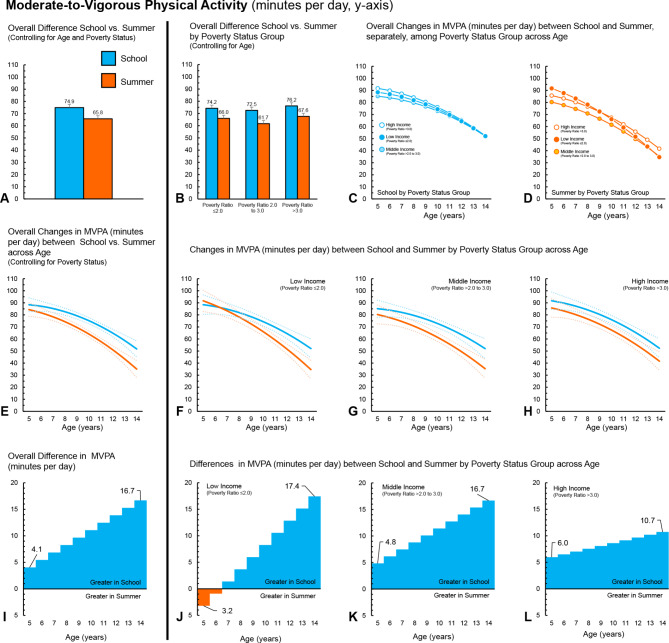
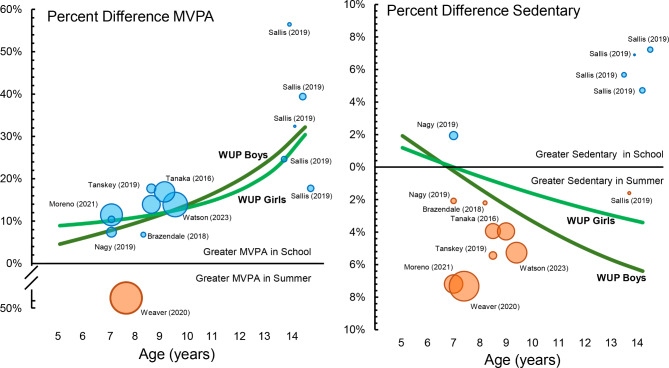
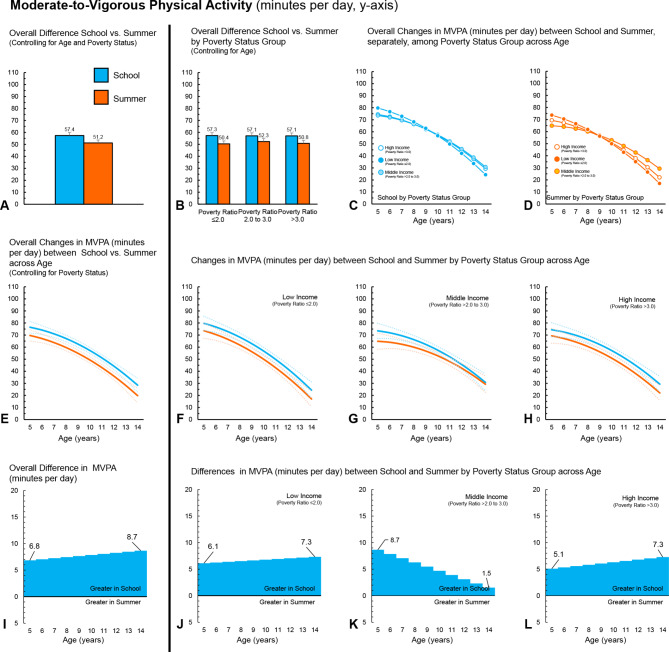
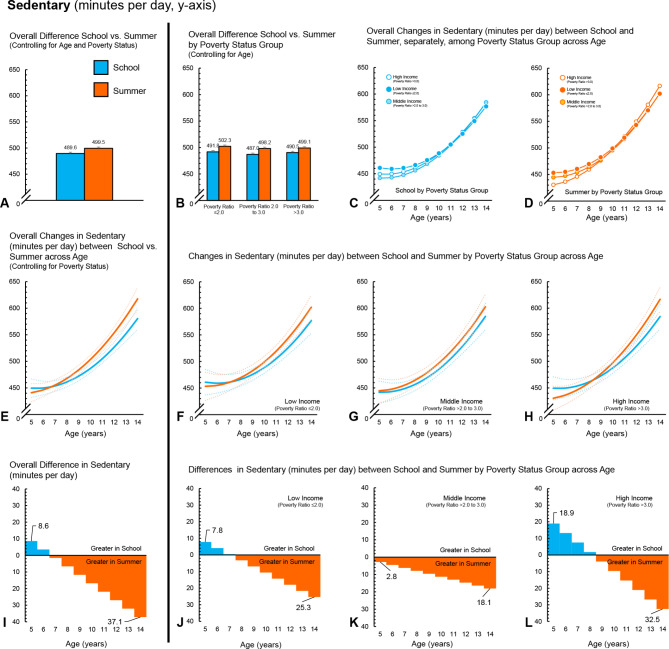
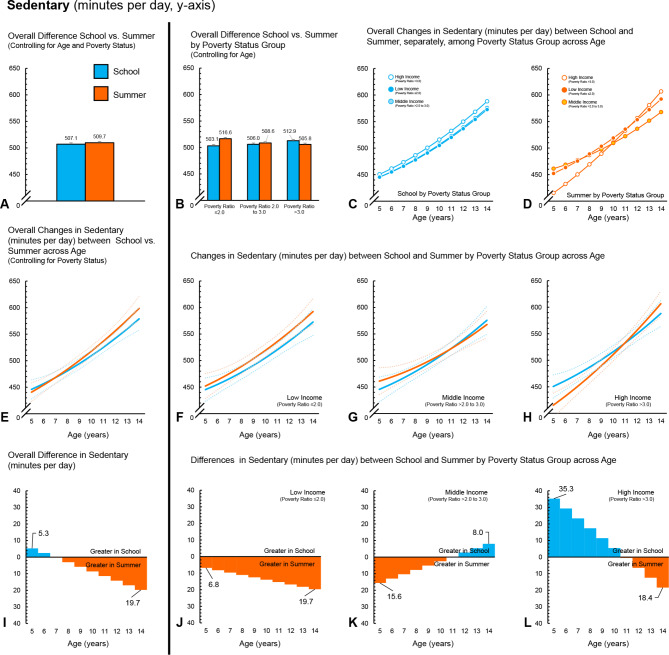
Children provided a total of 35,435 valid days of accelerometry. Overall, boys (+ 9.1 min/day, 95CI 8.1 to 10.2) and girls (+ 6.2 min/day, 95CI 5.4 to 7.0) accumulated more MVPA during school compared to summer. Boys accumulated less time sedentary (-9.9 min/day, 95CI -13.0 to -6.9) during school, while there was no difference in sedentary time (-2.7 min/day, 95CI -5.7 to 0.4) for girls. Different patterns emerged across ages and income groups. Accumulation of MVPA was consistently greater during school compared to summer across ages and income groups. Generally, the difference between school and summer widened with increasing age, except for girls from middle-income households. Accumulation of sedentary time was higher during school for younger children (5-9yrs), whereas for older children (10-14yrs), sedentary time was greater during summer for the middle- and upper-income groups. For boys from low-income households and girls from middle-income households, sedentary time was consistently greater during summer compared to school across ages.
Children are less active and more sedentary during summer compared to school, which may contribute to accelerated BMI gain. However, this differs by biological sex, age, and income. These findings highlight the complex factors influencing movement behaviors between school and summer.
在儿童(5-12 岁)中,暑假期间身体质量指数(BMI)会加速增长。BMI 增长的一个关键行为驱动因素是缺乏身体活动(PA)。先前的研究表明,与学年相比,暑假期间的 PA 会减少,但这种差异在男孩和女孩之间、在不同年龄段以及不同收入群体中是否一致尚不清楚。本研究在三年内对来自不同群体的儿童进行了一项研究,以检查他们在学校和暑假期间的运动行为差异。
2021 年至 2023 年,共有 1203 名年龄在 5-14 岁之间的儿童(48%为女孩)佩戴了 wrist-placed 加速度计,在学校(4 月/5 月)和暑假(7 月)期间佩戴了 14 天,共进行了 6 次时间点测量。混合效应模型分别检查了男孩和女孩在学校和暑假期间运动行为(中等到剧烈体力活动[MVPA]、久坐)的变化,并按年龄和家庭收入群体(低收入、中收入和高收入,基于收入与贫困比率)进行了分层。
儿童共提供了 35435 天有效的加速度计数据。总体而言,男孩(+9.1 分钟/天,95%CI 8.1 到 10.2)和女孩(+6.2 分钟/天,95%CI 5.4 到 7.0)在学校期间比暑假期间的 MVPA 更多。男孩在学校期间久坐时间减少(-9.9 分钟/天,95%CI -13.0 到 -6.9),而女孩的久坐时间没有差异(-2.7 分钟/天,95%CI -5.7 到 0.4)。不同的模式出现在不同的年龄和收入群体中。在所有年龄和收入群体中,MVPA 的积累在校期间都明显高于暑假。总体而言,除了中等收入家庭的女孩外,随着年龄的增长,学校和暑假之间的差距逐渐拉大。对于 5-9 岁的儿童,暑假期间的久坐时间较高,而对于 10-14 岁的儿童,中高收入群体在暑假期间的久坐时间较长。对于来自低收入家庭的男孩和来自中等收入家庭的女孩,整个年龄段的暑假期间,久坐时间都明显高于暑假。
与学校相比,儿童在暑假期间的活动量较少,久坐时间较多,这可能导致 BMI 加速增长。然而,这因性别、年龄和收入而异。这些发现突出了影响学校和暑假期间运动行为的复杂因素。