Capital Institute of Pediatrics, 2 Yabao Rd, Beijing, 100020, China.
Beijing Municipal Key Laboratory of Child Development and Nutriomics, Beijing, China.
BMC Pediatr. 2020 Feb 15;20(1):70. doi: 10.1186/s12887-020-1969-6.
World Health Organisation (WHO) Guidelines on Physical Activity, Sedentary Behaviour and Sleep for Children under 5 Years of Age were released in 2019. The aim of this study was to examine the proportion of Chinese kindergarten children who met each individual guideline and each combination of the guidelines and the associations with adiposity.
Participants were 254 kindergarten children aged 4.1-6.3 years recruited from three kindergartens in urban area of Beijing. Physical activity, sedentary behaviour and sleep duration were assessed using 24-h accelerometry over three consecutive days. Screen time was reported by parents. Weight and height were measured; and children were categorised into normal weight and overweight/obese groups according to the WHO age- and sex- specific criteria. Frequency analyses were performed to examine the proportion of children meeting individual and combination of these guidelines. Logistics regression analyses were conducted to examine the associations between guideline compliance and adiposity.
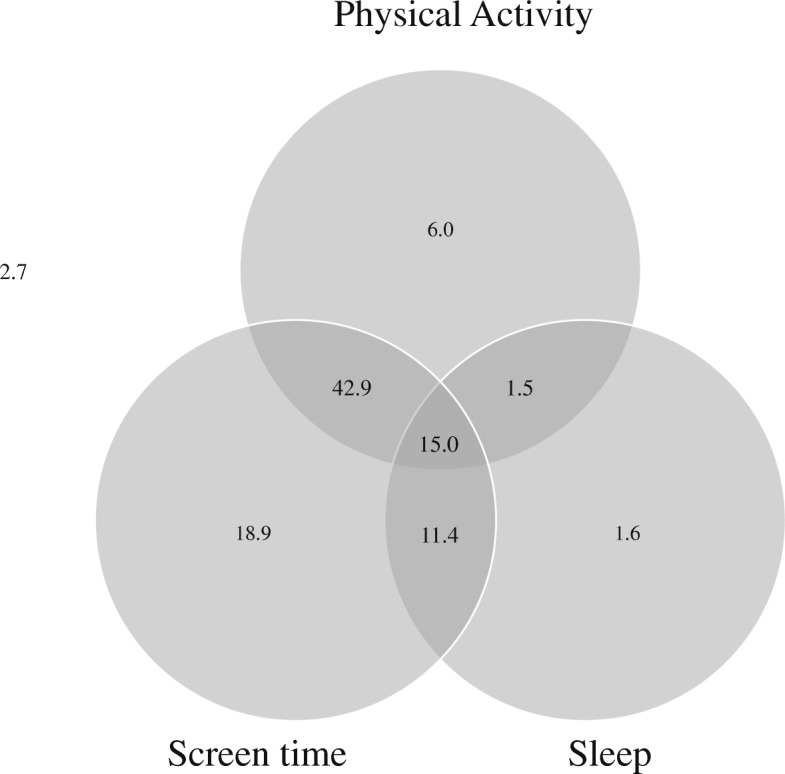
The proportion of children who met the physical activity (≥ 3 h daily physical activity, including ≥1 h daily moderate- to vigorous-intensity physical activity (MVPA)), sedentary screen time (< 1 h/day), and sleep guidelines (10-13 h/day) were 65.4, 88.2 and 29.5%, respectively; only 15.0% met all three guidelines and 2.7% did not meet any of the guidelines. Not meeting the physical activity guideline, sleep guideline, or combination of any two guidelines, or all three guidelines was not associated with overweight or obesity; however, children who did not meet the sedentary screen time guidelines were at higher risk for overweight and obesity (odds ratio = 3.76, 95% CI: 1.50-9.45).
In our study, only a small proportion of children met all three guidelines. Most Chinese kindergarten children met physical activity guidelines or screen time guidelines, whereas fewer children met sleep guideline. Not meeting sedentary screen time guidelines was associated with adiposity, which warrant further interventions for limiting screen time in young children.
世界卫生组织(WHO)于 2019 年发布了《关于 5 岁以下儿童身体活动、久坐行为和睡眠的指南》。本研究旨在调查中国幼儿园儿童中,符合各单项指南、各指南组合以及与肥胖相关的比例。
参与者为来自北京市城区三所幼儿园的 254 名 4.1-6.3 岁的儿童。通过连续三天的 24 小时加速计评估儿童的身体活动、久坐行为和睡眠时间。家长报告屏幕时间。测量体重和身高;并根据世卫组织年龄和性别特定标准,将儿童分为正常体重和超重/肥胖组。频率分析用于检查符合这些指南的儿童的比例。逻辑回归分析用于检查符合指南与肥胖的关联。
符合以下指南的儿童比例分别为:身体活动(每天≥3 小时,包括每天≥1 小时的中等到剧烈强度身体活动(MVPA))、久坐屏幕时间(<1 小时/天)和睡眠指南(10-13 小时/天)的儿童比例分别为 65.4%、88.2%和 29.5%;仅 15.0%的儿童符合所有三项指南,2.7%的儿童不符合任何一项指南。不符合身体活动指南、睡眠指南或任意两项指南组合、或所有三项指南与超重或肥胖无关;然而,不符合久坐屏幕时间指南的儿童超重和肥胖的风险更高(比值比=3.76,95%置信区间:1.50-9.45)。
在我们的研究中,只有一小部分儿童符合所有三项指南。大多数中国幼儿园儿童符合身体活动指南或屏幕时间指南,而较少的儿童符合睡眠指南。不符合久坐屏幕时间指南与肥胖有关,这需要进一步干预来限制幼儿的屏幕时间。