York Elizabeth N, Martin Sarah-Jane, Meijboom Rozanna, Thrippleton Michael J, Bastin Mark E, Carter Edwin, Overell James, Connick Peter, Chandran Siddharthan, Waldman Adam D, Hunt David P J
Centre for Clinical Brain Sciences, University of Edinburgh, Edinburgh EH16 4SB, UK.
Department of Neurosciences, University of Glasgow, Glasgow G51 4LB, UK.
Brain Commun. 2021 Nov 3;3(4):fcab249. doi: 10.1093/braincomms/fcab249. eCollection 2021.
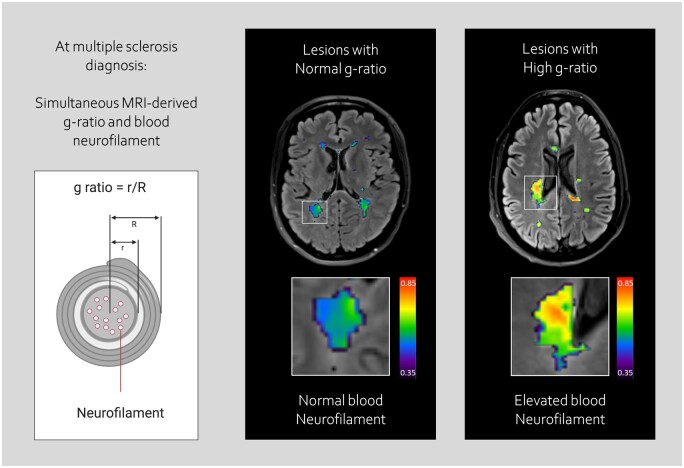
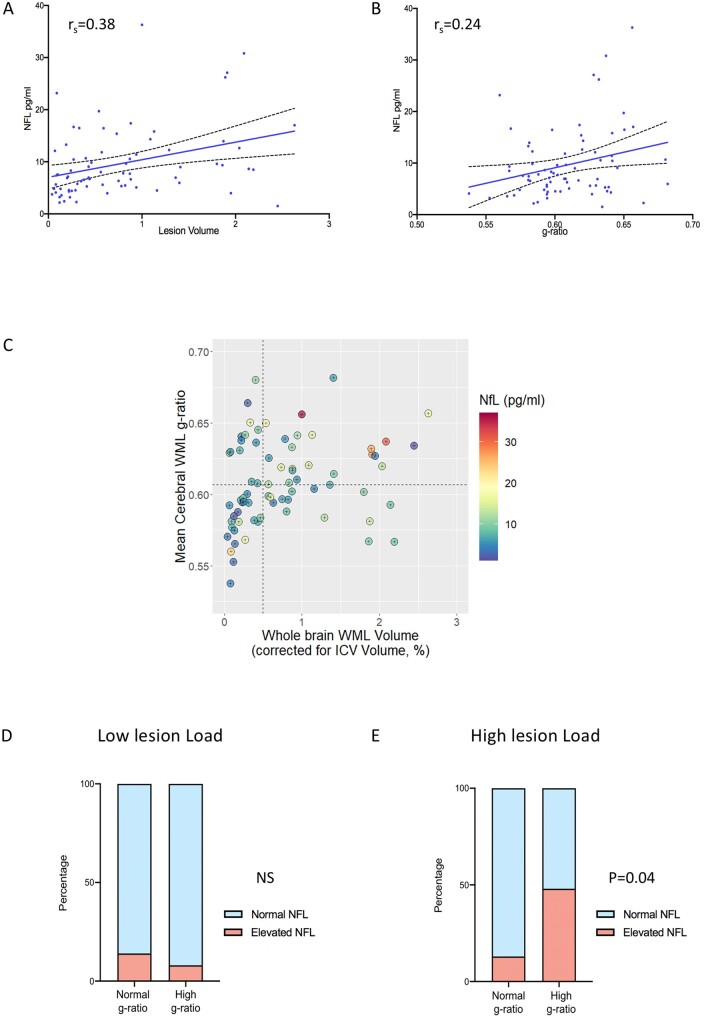
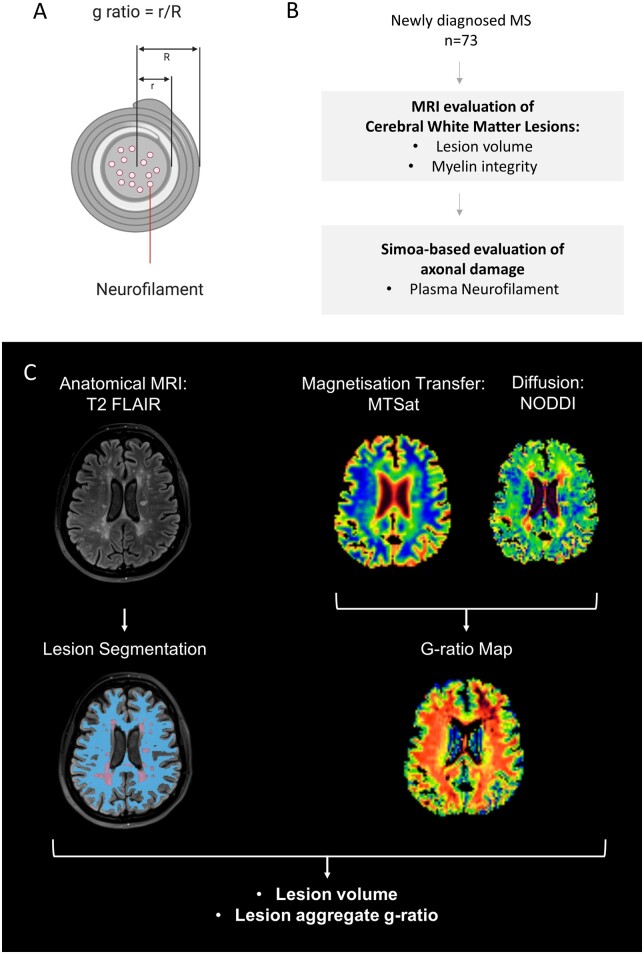
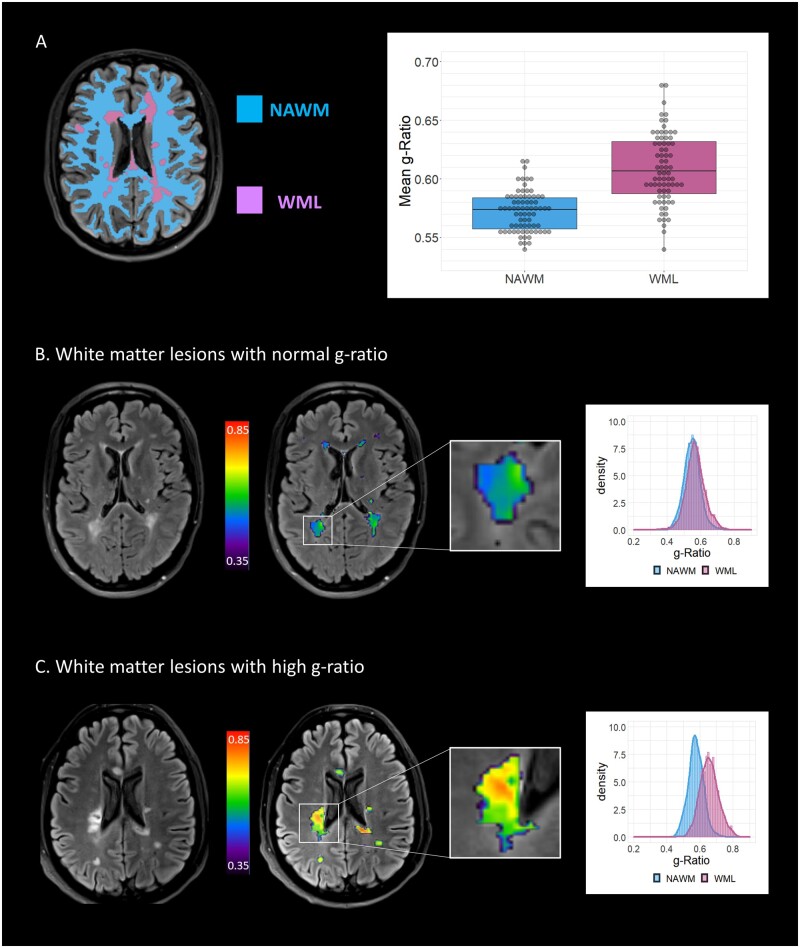
Myelin loss is associated with axonal damage in established multiple sclerosis. This relationship is challenging to study in early disease. Here, we ask whether myelin loss is associated with axonal damage at diagnosis by combining non-invasive neuroimaging and blood biomarkers. We performed quantitative microstructural MRI and single-molecule ELISA plasma neurofilament measurement in 73 patients with newly diagnosed, immunotherapy naïve relapsing-remitting multiple sclerosis. Myelin integrity was evaluated using aggregate g-ratios, derived from magnetization transfer saturation and neurite orientation dispersion and density imaging diffusion data. We found significantly higher g-ratios within cerebral white matter lesions (suggesting myelin loss) compared with normal-appearing white matter (0.61 versus 0.57, difference 0.036, 95% CI: 0.029-0.043, < 0.001). Lesion volume (Spearman's rho r= 0.38, < 0.001) and g-ratio (r= 0.24, < 0.05) correlated independently with plasma neurofilament. In patients with substantial lesion load ( = 38), those with higher g-ratio (defined as greater than median) were more likely to have abnormally elevated plasma neurofilament than those with normal g-ratio (defined as less than median) [11/23 (48%) versus 2/15 (13%), < 0.05]. These data suggest that, even at multiple sclerosis diagnosis, reduced myelin integrity is associated with axonal damage. MRI-derived g-ratio may provide useful additional information regarding lesion severity and help to identify individuals with a high degree of axonal damage at disease onset.
在已确诊的多发性硬化症中,髓鞘损失与轴突损伤相关。这种关系在疾病早期很难进行研究。在这里,我们通过结合非侵入性神经影像学和血液生物标志物来探讨在诊断时髓鞘损失是否与轴突损伤相关。我们对73例新诊断的、未接受过免疫治疗的复发缓解型多发性硬化症患者进行了定量微观结构MRI和单分子ELISA血浆神经丝测量。使用从磁化传递饱和度、神经突方向离散度和密度成像扩散数据得出的总体g比率来评估髓鞘完整性。我们发现,与外观正常的白质相比,脑白质病变内的g比率显著更高(表明髓鞘损失)(0.61对0.57,差异0.036,95%可信区间:0.029 - 0.043,<0.001)。病变体积(斯皮尔曼等级相关系数r = 0.38,<0.001)和g比率(r = 0.24,<0.05)与血浆神经丝独立相关。在病变负荷较大的患者(n = 38)中,g比率较高(定义为大于中位数)的患者比g比率正常(定义为小于中位数)的患者更有可能出现血浆神经丝异常升高[11/23(48%)对2/15(13%),<0.05]。这些数据表明,即使在多发性硬化症诊断时,髓鞘完整性降低也与轴突损伤相关。MRI得出的g比率可能为病变严重程度提供有用的额外信息,并有助于识别疾病发作时轴突损伤程度较高的个体。