Department of Pharmacy and Pharmaceutical Sciences, St. Jude Children's Research Hospital, Memphis, Tennessee, USA.
Department of Clinical Pharmacy and Translational Science, University of Tennessee College of Pharmacy, Memphis, Tennessee, USA.
Microbiol Spectr. 2021 Dec 22;9(3):e0158521. doi: 10.1128/Spectrum.01585-21. Epub 2021 Dec 8.
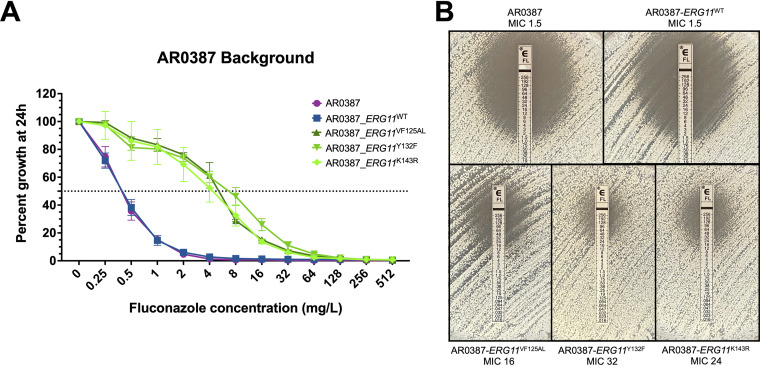
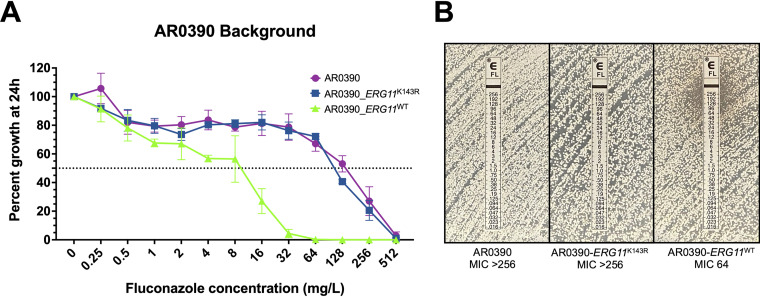
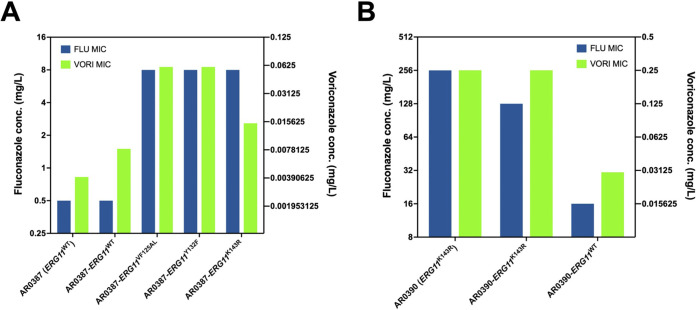
Resistance to fluconazole is one of clinical characteristics most frequently challenging the treatment of invasive Candida auris infections, and is observed among >90% of all characterized clinical isolates. In this work, the native C. auris allele in a previously characterized fluconazole-susceptible clinical isolate was replaced with the alleles from three highly fluconazole-resistant clinical isolates (MIC ≥256 mg/L), encoding the amino acid substitutions VF125AL, Y132F, and K143R, using Cas9-ribonucleoprotein (RNP) mediated transformation system. Reciprocally, the allele from the same fluconazole-susceptible clinical isolate, lacking any resistance-associated mutation, was introduced into a previously characterized fluconazole-resistant clinical isolate, replacing the native allele, using the same methods. The resulting collection of strains was subjected to comprehensive triazole susceptibility testing, and the direct impact each of these clinically-derived mutations on triazole MIC was determined. Introduction of each of the three mutant alleles was observed to increase fluconazole and voriconazole MIC by 8- to 16-fold. The MIC for the other clinically available triazoles were not significantly impacted by any mutation. In the fluconazole-resistant clinical isolate background, correction of the K143R encoding mutation led to a similar 16-fold decrease in fluconazole MIC, and 8-fold decrease in voriconazole MIC, while the MIC of other triazoles were minimally changed. Taken together, these findings demonstrate that mutations in C. auris significantly contribute to fluconazole and voriconazole resistance, but alone cannot explain the substantially elevated MIC observed among clinical isolates of C. auris. Candida auris is an emerging multidrug-resistant and health care-associated pathogen of urgent clinical concern. The triazoles are the most widely prescribed antifungal agents worldwide and are commonly utilized for the treatment of invasive infections. Greater than 90% of all C. auris clinical isolates are observed to be resistant to fluconazole, and nearly all fluconazole-resistant isolates of C. auris are found to have one of three mutations (encoding VF125AL, Y132F, or K143R) in the gene encoding the target of the triazoles, . However, the direct contribution of these mutations in to fluconazole resistance and the impact these mutations may have the susceptibility of the other triazoles remains unknown. The present study seeks to address this knowledge gap and potentially inform the future application the triazole antifungals for the treatment of infections caused by C. auris.
对氟康唑的耐药性是侵袭性耳念珠菌感染治疗最常面临的临床特征之一,在所有特征明确的临床分离株中,超过 90%的分离株都存在这种耐药性。在这项工作中,使用 Cas9-核糖核蛋白 (RNP) 介导的转化系统,将先前特征明确的氟康唑敏感临床分离株中的天然耳念珠菌 等位基因替换为三个高度耐氟康唑的临床分离株(MIC≥256mg/L)的 等位基因,这些等位基因分别编码 VF125AL、Y132F 和 K143R 氨基酸取代。反过来,使用相同的方法,将来自同一氟康唑敏感临床分离株的不携带任何耐药相关突变的 等位基因引入先前特征明确的氟康唑耐药临床分离株中,取代天然的 等位基因。对所得菌株进行了全面的三唑类药物敏感性测试,并确定了这些临床衍生的 突变对三唑类药物 MIC 的直接影响。观察到引入三个突变的 等位基因都会使氟康唑和伏立康唑 MIC 增加 8 到 16 倍。任何 突变都不会显著影响其他临床可用三唑类药物的 MIC。在氟康唑耐药的临床分离株背景下,校正编码 K143R 的突变导致氟康唑 MIC 相似地降低 16 倍,伏立康唑 MIC 降低 8 倍,而其他三唑类药物的 MIC 则略有变化。总之,这些发现表明,耳念珠菌 中的突变显著导致了氟康唑和伏立康唑耐药,但不能单独解释临床分离株中观察到的耳念珠菌 MIC 显著升高。耳念珠菌是一种新兴的多药耐药性和与医疗保健相关的病原体,具有迫切的临床关注。三唑类药物是全球应用最广泛的抗真菌药物,常用于治疗侵袭性念珠菌感染。超过 90%的耳念珠菌临床分离株对氟康唑耐药,几乎所有氟康唑耐药的耳念珠菌分离株都在编码三唑类药物靶点的基因中发现了三个突变之一(编码 VF125AL、Y132F 或 K143R)。然而,这些突变在 中对氟康唑耐药性的直接贡献以及这些突变对其他三唑类药物敏感性的影响尚不清楚。本研究旨在填补这一知识空白,并为未来应用三唑类抗真菌药物治疗耳念珠菌引起的感染提供信息。