Department of Civil and Environmental Engineering, 1147 Glenn L. Martin Hall, USA.
Department of Civil and Environmental Engineering, 1147 Glenn L. Martin Hall, USA; Maryland Transportation Institute, 3244 Jeong H. Kim Engineering Bldng, University of Maryland, College Park, MD 20742, USA.
Sci Total Environ. 2022 Feb 20;808:152033. doi: 10.1016/j.scitotenv.2021.152033. Epub 2021 Dec 6.
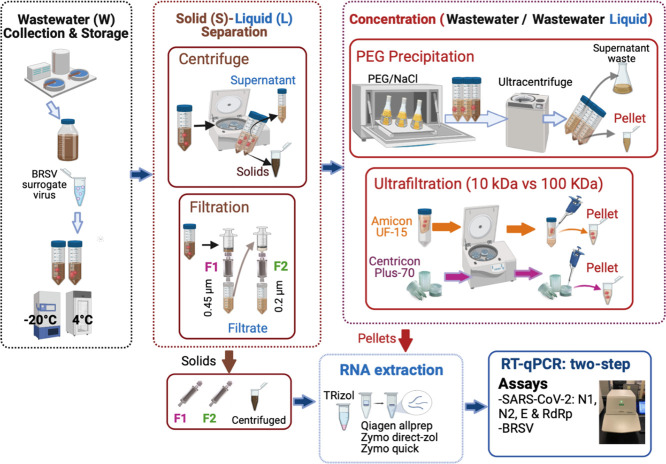
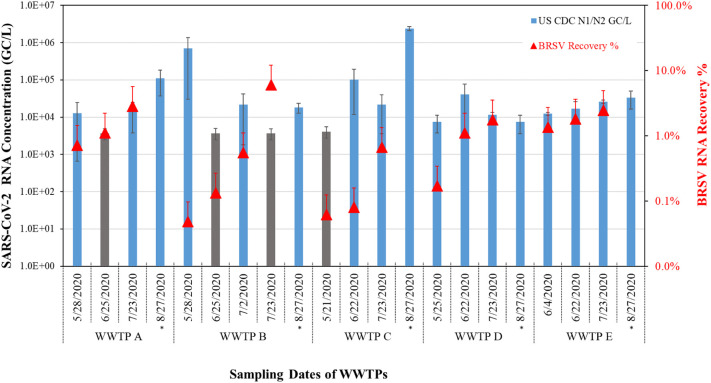
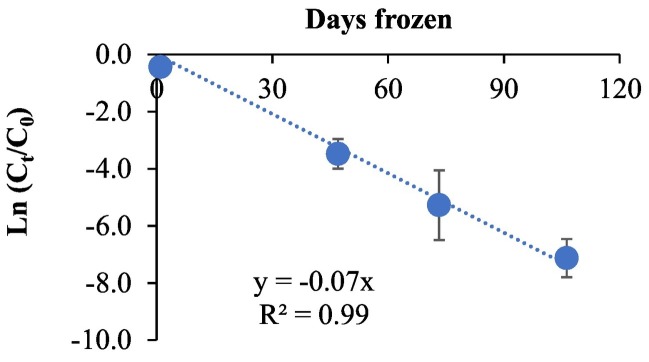
In this study, 14 virus concentration protocols based on centrifugation, filtration, polyethylene glycol (PEG) precipitation and ultrafiltration were tested for their efficacy for the quantification of SARS-CoV-2 in wastewater samples. These protocols were paired with four RNA extraction procedures resulting in a combination of 50 unique approaches. Bovine respiratory syncytial virus (BRSV) was used as a process control and seeded in each wastewater sample subjected to all 50 protocols. The recovery of BRSV obtained through the application of 50 unique approaches ranged from <0.03 to 64.7% (±1.6%). Combination of centrifugation as the solid removal step, ultrafiltration (Amicon-UF-15; 100 kDa cut-off; protocol 9) as the primary virus concentration method, and Zymo Quick-RNA extraction kit provided the highest BRSV recovery (64.7 ± 1.6%). To determine the impact of prolonged storage of large wastewater sample volume (900 mL) at -20 °C on enveloped virus decay, the BRSV seeded wastewaters samples were stored at -20 °C up to 110 days and analyzed using the most efficient concentration (protocol 9) and extraction (Zymo Quick-RNA kit) methods. BRSV RNA followed a first-order decay rate (k = 0.04/h with r = 0.99) in wastewater. Finally, 21 wastewater influent samples from five wastewater treatment plants (WWTPs) in southern Maryland, USA were analyzed between May to August 2020 to determine SARS-CoV-2 RNA concentrations. SARS-CoV-2 RNA was quantifiable in 17/21 (81%) of the influent wastewater samples with concentration ranging from 1.10 (±0.10) × 10 to 2.38 (±0.16) × 10 gene copies/L. Among the RT-qPCR assays tested, US CDC N1 assay was the most sensitive followed by US CDC N2, E_Sarbeco, and RdRp assays. Data presented in this study may enhance our understanding on the effective concentration and extraction of SARS-CoV-2 from wastewater.
在这项研究中,测试了 14 种基于离心、过滤、聚乙二醇(PEG)沉淀和超滤的病毒浓缩方案,以评估它们在废水样本中定量 SARS-CoV-2 的效果。这些方案与四种 RNA 提取程序配对,总共产生了 50 种独特的方法。牛呼吸道合胞病毒(BRSV)被用作过程对照,并接种在所有 50 种方案中处理的每个废水样本中。通过应用 50 种独特方法获得的 BRSV 回收率范围为 <0.03 至 64.7%(±1.6%)。以离心作为固液分离步骤、超滤(Amicon-UF-15;100 kDa 截止;方案 9)作为主要病毒浓缩方法、和 Zymo Quick-RNA 提取试剂盒相结合的方法,提供了最高的 BRSV 回收率(64.7±1.6%)。为了确定在 -20°C 下储存大量废水样本(900 mL)对包膜病毒衰减的影响,将接种了 BRSV 的废水样本在 -20°C 下储存长达 110 天,并使用最有效的浓缩(方案 9)和提取(Zymo Quick-RNA 试剂盒)方法进行分析。BRSV RNA 在废水中遵循一级衰减速率(k = 0.04/h,r = 0.99)。最后,分析了 2020 年 5 月至 8 月期间美国马里兰州南部五个废水处理厂(WWTP)的 21 个废水进水样本,以确定 SARS-CoV-2 RNA 浓度。在 21 个进水废水样本中,有 17/21(81%)可定量检测到 SARS-CoV-2 RNA,浓度范围为 1.10(±0.10)×10 至 2.38(±0.16)×10 基因拷贝/L。在测试的 RT-qPCR 检测方法中,美国 CDC N1 检测方法最敏感,其次是美国 CDC N2、E_Sarbeco 和 RdRp 检测方法。本研究中提供的数据可以增强我们对 SARS-CoV-2 从废水中有效浓缩和提取的理解。