Centre for Environmental Biotechnology, School of Natural Sciences, Bangor Universitygrid.7362.0, Bangor, Gwynedd, United Kingdom.
School of Ocean Sciences, Bangor Universitygrid.7362.0, Anglesey, United Kingdom.
Microbiol Spectr. 2022 Aug 31;10(4):e0110222. doi: 10.1128/spectrum.01102-22. Epub 2022 Aug 11.
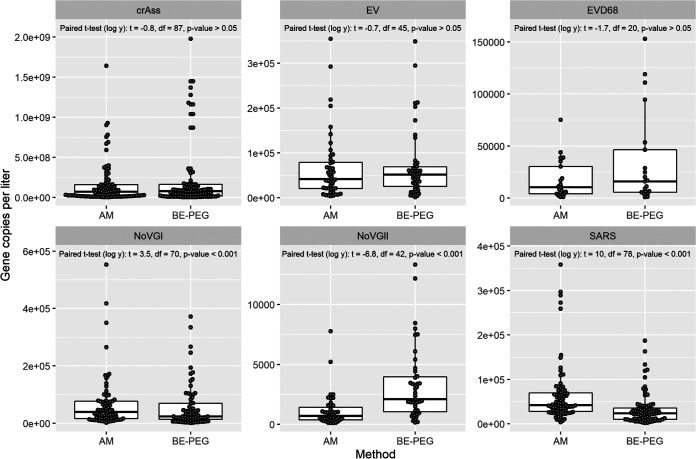
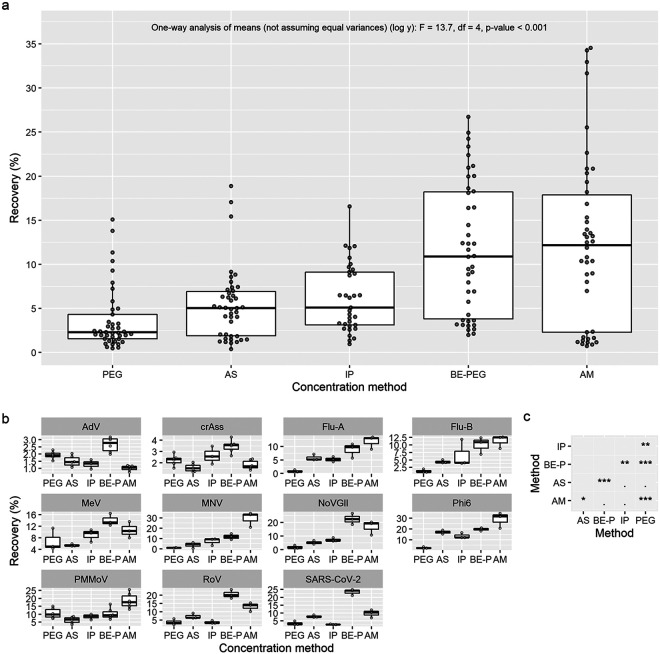
Wastewater-based epidemiology (WBE) has been widely used to track levels of SARS-CoV-2 infection in the community during the COVID-19 pandemic. Due to the rapid expansion of WBE, many methods have been used and developed for virus concentration and detection in wastewater. However, very little information is available on the relative performance of these approaches. In this study, we compared the performance of five commonly used wastewater concentration methods for the detection and quantification of pathogenic viruses (SARS-CoV-2, norovirus, rotavirus, influenza, and measles viruses), fecal indicator viruses (crAssphage, adenovirus, pepper mild mottle virus), and process control viruses (murine norovirus and bacteriophage Phi6) in laboratory spiking experiments. The methods evaluated included those based on either ultrafiltration (Amicon centrifugation units and InnovaPrep device) or precipitation (using polyethylene glycol [PEG], beef extract-enhanced PEG, and ammonium sulfate). The two best methods were further tested on 115 unspiked wastewater samples. We found that the volume and composition of the wastewater and the characteristics of the target viruses greatly affected virus recovery, regardless of the method used for concentration. All tested methods are suitable for routine virus concentration; however, the Amicon ultrafiltration method and the beef extract-enhanced PEG precipitation methods yielded the best recoveries. We recommend the use of ultrafiltration-based concentration for low sample volumes with high virus titers and ammonium levels and the use of precipitation-based concentration for rare pathogen detection in high-volume samples. As wastewater-based epidemiology is utilized for the surveillance of COVID-19 at the community level in many countries, it is crucial to develop and validate reliable methods for virus detection in sewage. The most important step in viral detection is the efficient concentration of the virus particles and/or their genome for subsequent analysis. In this study, we compared five different methods for the detection and quantification of different viruses in wastewater. We found that dead-end ultrafiltration and beef extract-enhanced polyethylene glycol precipitation were the most reliable approaches. We also discovered that sample volume and physico-chemical properties have a great effect on virus recovery. Hence, wastewater process methods and start volumes should be carefully selected in ongoing and future wastewater-based national surveillance programs for COVID-19 and beyond.
基于污水的流行病学(WBE)已被广泛用于在 COVID-19 大流行期间追踪社区中 SARS-CoV-2 感染的水平。由于 WBE 的快速扩展,已经开发和使用了许多用于污水中病毒浓缩和检测的方法。然而,关于这些方法的相对性能的信息很少。在这项研究中,我们比较了五种常用于检测和定量污水中致病性病毒(SARS-CoV-2、诺如病毒、轮状病毒、流感病毒和麻疹病毒)、粪便指示病毒(crAssphage、腺病毒、辣椒轻斑驳病毒)和过程控制病毒(鼠诺如病毒和噬菌体 Phi6)的常用污水浓缩方法的性能,这些方法包括基于超滤(Amicon 离心单元和 InnovaPrep 设备)或沉淀(使用聚乙二醇[PEG]、牛肉提取物增强型 PEG 和硫酸铵)的方法。在实验室加标实验中评估了这 5 种方法。我们发现,污水的体积和组成以及目标病毒的特性极大地影响了病毒的回收率,无论使用哪种浓缩方法。进一步将这两种最佳方法应用于 115 个未加标污水样本。我们发现,所有测试方法都适用于常规病毒浓缩;然而,Amicon 超滤法和牛肉提取物增强型 PEG 沉淀法的回收率最好。我们建议对于低病毒滴度和高铵水平的小样本量使用基于超滤的浓缩方法,对于大体积样本中罕见病原体的检测使用基于沉淀的浓缩方法。由于许多国家在社区层面利用污水流行病学来监测 COVID-19,因此开发和验证可靠的污水病毒检测方法至关重要。病毒检测的最重要步骤是有效地浓缩病毒颗粒和/或其基因组,以便进行后续分析。在这项研究中,我们比较了五种不同的污水中检测和定量不同病毒的方法。我们发现死端超滤和牛肉提取物增强型聚乙二醇沉淀是最可靠的方法。我们还发现样本体积和理化性质对病毒回收率有很大影响。因此,在正在进行的和未来的基于污水的 COVID-19 及其他疾病的国家监测计划中,应仔细选择污水处理方法和起始体积。