Ahmed Warish, Bivins Aaron, Metcalfe Suzanne, Smith Wendy J M, Verbyla Matthew E, Symonds Erin M, Simpson Stuart L
CSIRO Land and Water, Ecosciences Precinct, 41 Boggo Road, Dutton Park, QLD 4102, Australia.
Department of Civil & Environmental Engineering & Earth Science, University of Notre Dame, 156 Fitzpatrick Hall, Notre Dame, IN, 46556, USA.
Water Res. 2022 Apr 15;213:118132. doi: 10.1016/j.watres.2022.118132. Epub 2022 Feb 3.
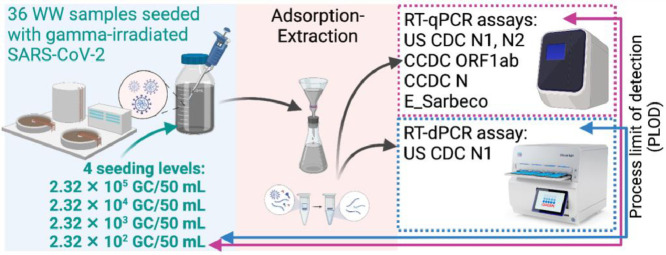
Effective wastewater surveillance of SARS-CoV-2 RNA requires the rigorous characterization of the limit of detection resulting from the entire sampling process - the process limit of detection (PLOD). Yet to date, no studies have gone beyond quantifying the assay limit of detection (ALOD) for RT-qPCR or RT-dPCR assays. While the ALOD is the lowest number of gene copies (GC) associated with a 95% probability of detection in a single PCR reaction, the PLOD represents the sensitivity of the method after considering the efficiency of all processing steps (e.g., sample handling, concentration, nucleic acid extraction, and PCR assays) to determine the number of GC in the wastewater sample matrix with a specific probability of detection. The primary objective of this study was to estimate the PLOD resulting from the combination of primary concentration and extraction with six SARS-CoV-2 assays: five RT-qPCR assays (US CDC N1 and N2, China CDC N and ORF1ab (CCDC N and CCDC ORF1ab), and E_Sarbeco RT-qPCR, and one RT-dPCR assay (US CDC N1 RT-dPCR) using two models (exponential survival and cumulative Gaussian). An adsorption extraction (AE) concentration method (i.e., virus adsorption on membrane and the RNA extraction from the membrane) was used to concentrate gamma-irradiated SARS-CoV-2 seeded into 36 wastewater samples. Overall, the US CDC N1 RT-dPCR and RT-qPCR assays had the lowest ALODs (< 10 GC/reaction) and PLODs (<3,954 GC/50 mL; 95% probability of detection) regardless of the seeding level and model used. Nevertheless, consistent amplification and detection rates decreased when seeding levels were < 2.32 × 10 GC/50 mL even for US CDC N1 RT-qPCR and RT-dPCR assays. Consequently, when SARS-CoV-2 RNA concentrations are expected to be low, it may be necessary to improve the positive detection rates of wastewater surveillance by analyzing additional field and RT-PCR replicates. To the best of our knowledge, this is the first study to assess the SARS-CoV-2 PLOD for wastewater and provides important insights on the analytical limitations for trace detection of SARS-CoV-2 RNA in wastewater.
对严重急性呼吸综合征冠状病毒2(SARS-CoV-2)RNA进行有效的废水监测,需要对整个采样过程的检测限进行严格表征,即过程检测限(PLOD)。然而,迄今为止,尚无研究超越对逆转录定量聚合酶链反应(RT-qPCR)或逆转录数字PCR(RT-dPCR)检测的分析检测限(ALOD)进行量化。虽然ALOD是在单个PCR反应中与95%检测概率相关的最低基因拷贝数(GC),但PLOD代表了在考虑所有处理步骤(如样品处理、浓缩、核酸提取和PCR检测)效率后,以特定检测概率确定废水样品基质中GC数量的方法灵敏度。本研究的主要目的是使用两种模型(指数存活模型和累积高斯模型),估计六种SARS-CoV-2检测方法(五种RT-qPCR检测方法:美国疾病控制与预防中心(US CDC)N1和N2、中国疾病预防控制中心(China CDC)N和开放阅读框1ab(CCDC N和CCDC ORF1ab)以及E_Sarbeco RT-qPCR,以及一种RT-dPCR检测方法:US CDC N1 RT-dPCR)与一级浓缩和提取相结合产生的PLOD。采用吸附提取(AE)浓缩方法(即病毒吸附在膜上并从膜上提取RNA)对接种到36个废水样品中的经伽马射线辐照的SARS-CoV-2进行浓缩。总体而言,无论接种水平和使用的模型如何,US CDC N1 RT-dPCR和RT-qPCR检测方法的ALOD最低(<10 GC/反应),PLOD最低(<3954 GC/50 mL;95%检测概率)。然而,即使对于US CDC N1 RT-qPCR和RT-dPCR检测方法,当接种水平<2.32×10 GC/50 mL时,一致的扩增和检测率也会下降。因此,当预计SARS-CoV-2 RNA浓度较低时,可能有必要通过分析更多的现场和RT-PCR重复样本,提高废水监测的阳性检测率。据我们所知,这是第一项评估废水SARS-CoV-2 PLOD的研究,为废水中SARS-CoV-2 RNA痕量检测的分析局限性提供了重要见解。