European Molecular Biology Laboratory, European Bioinformatics Institute, Wellcome Genome Campus, Hinxton, Cambridge, UK.
Oxford Nanopore Technologies, Gosling Building, Oxford Science Park, Oxford, UK.
Nat Commun. 2021 Dec 10;12(1):7198. doi: 10.1038/s41467-021-27393-3.
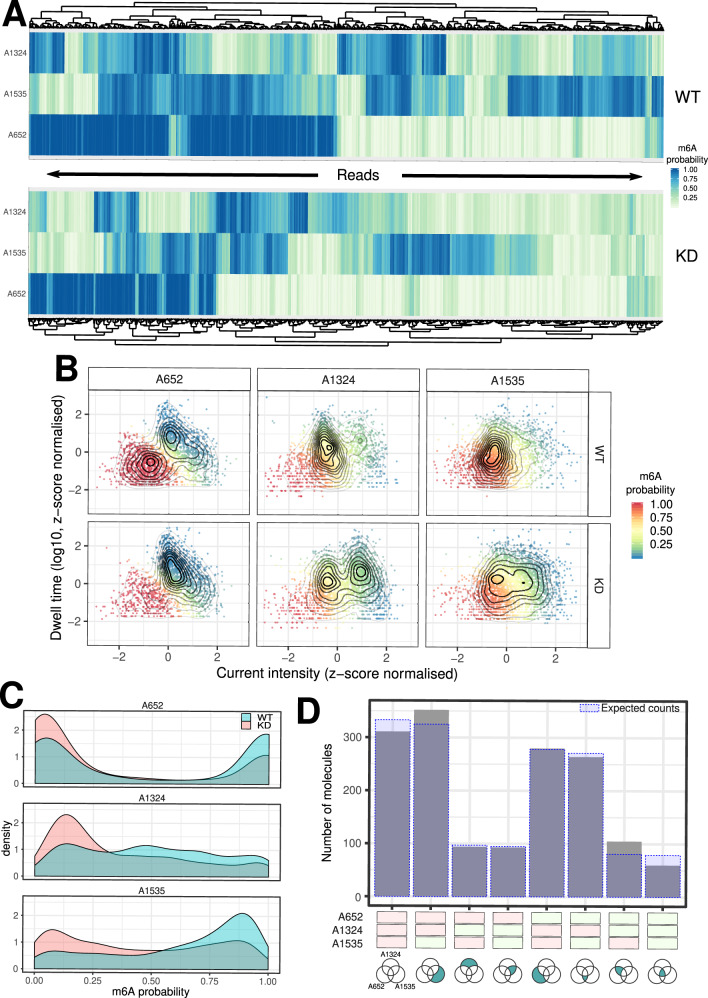
RNA molecules undergo a vast array of chemical post-transcriptional modifications (PTMs) that can affect their structure and interaction properties. In recent years, a growing number of PTMs have been successfully mapped to the transcriptome using experimental approaches relying on high-throughput sequencing. Oxford Nanopore direct-RNA sequencing has been shown to be sensitive to RNA modifications. We developed and validated Nanocompore, a robust analytical framework that identifies modifications from these data. Our strategy compares an RNA sample of interest against a non-modified control sample, not requiring a training set and allowing the use of replicates. We show that Nanocompore can detect different RNA modifications with position accuracy in vitro, and we apply it to profile mA in vivo in yeast and human RNAs, as well as in targeted non-coding RNAs. We confirm our results with orthogonal methods and provide novel insights on the co-occurrence of multiple modified residues on individual RNA molecules.
RNA 分子经历了大量的化学转录后修饰 (PTMs),这些修饰可以影响它们的结构和相互作用特性。近年来,越来越多的 PTM 通过依赖于高通量测序的实验方法成功地映射到转录组上。Oxford Nanopore 直接 RNA 测序已被证明对 RNA 修饰敏感。我们开发并验证了 Nanocompore,这是一种强大的分析框架,可以从这些数据中识别修饰。我们的策略是将感兴趣的 RNA 样本与非修饰对照样本进行比较,不需要训练集,并且允许使用重复样本。我们表明,Nanocompore 可以在体外以位置精度检测不同的 RNA 修饰,并将其应用于酵母和人类 RNA 中 mA 的体内分析,以及靶向非编码 RNA 中。我们使用正交方法验证了我们的结果,并提供了关于单个 RNA 分子上多个修饰残基共存的新见解。