Long Jiali, Zeng Benhua, Li Jia, Zhang Juan, Deng Guohong
Department of Infectious Diseases, Southwest Hospital, Third Military Medical University (Army Medical University), Chongqing, China.
Chongqing Key Laboratory of Viral Infectious Diseases, Chongqing, China.
Front Med (Lausanne). 2025 Jul 23;12:1610063. doi: 10.3389/fmed.2025.1610063. eCollection 2025.
This study aimed to comprehensively analyze the global landscape, trends, and research focus of nanopore sequencing technology in the field of pathogenic microorganism diagnosis using bibliometric analysis.
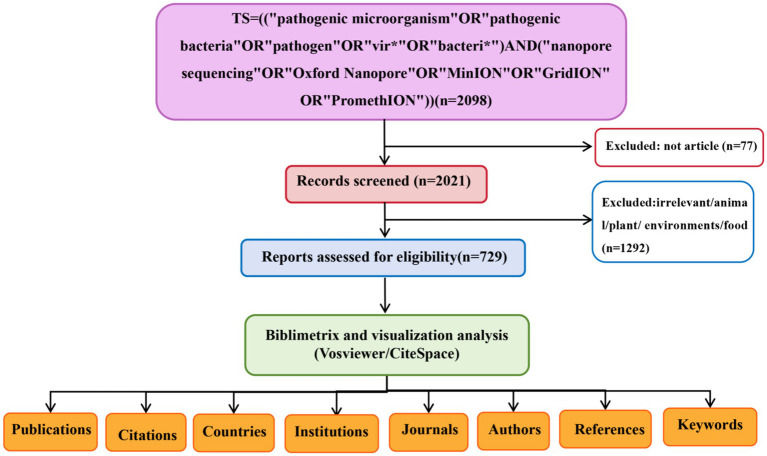
Literature published between January 2014, and December 2024, was retrieved from the Web of Science Core Collection. A cross-sectional bibliometric analysis was conducted using VOSviewer, CiteSpace, Origin 2024, and R software to extract and evaluate metrics. Publications were categorized by country, institution, author, journal, highly cited papers, and keywords. Variables were compared based on publication output and academic impact, which included citation counts, citation impact, H-index, journal impact factor, total link strength, major pathogens, and research directions.
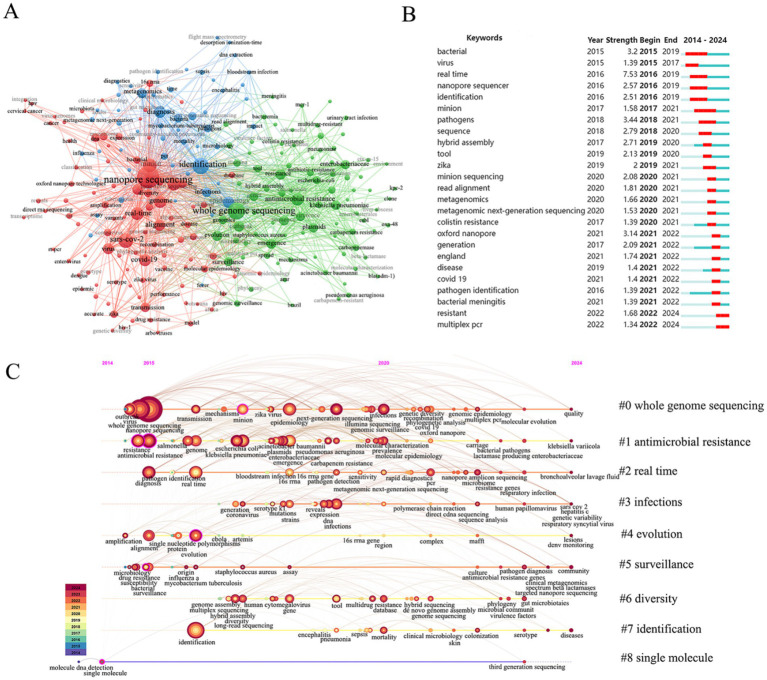
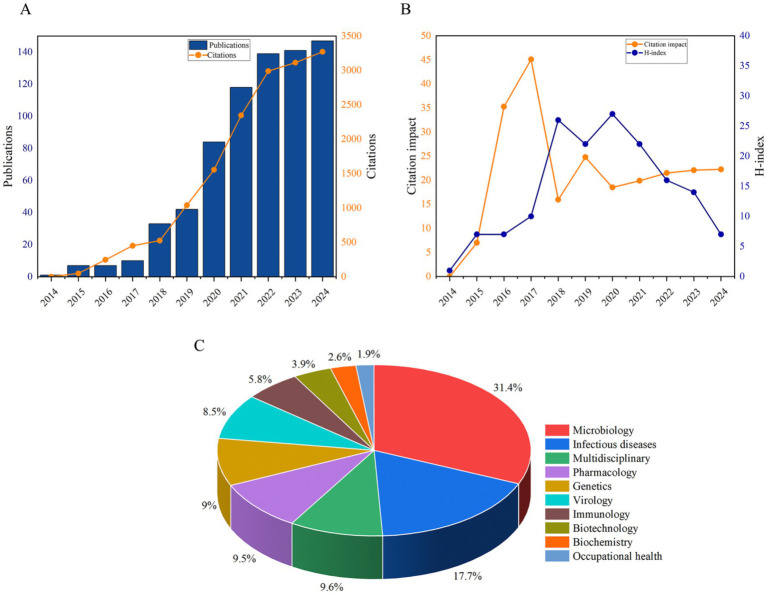
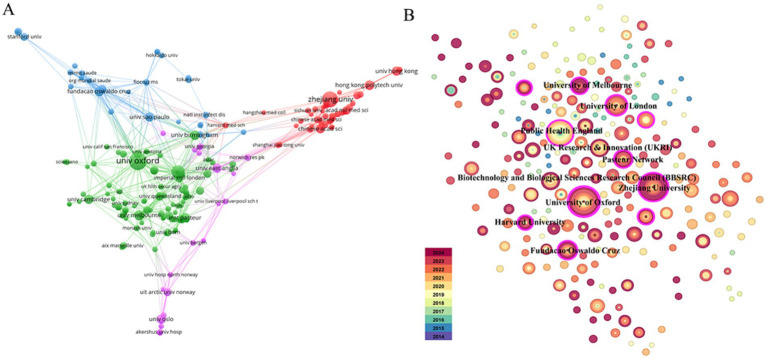
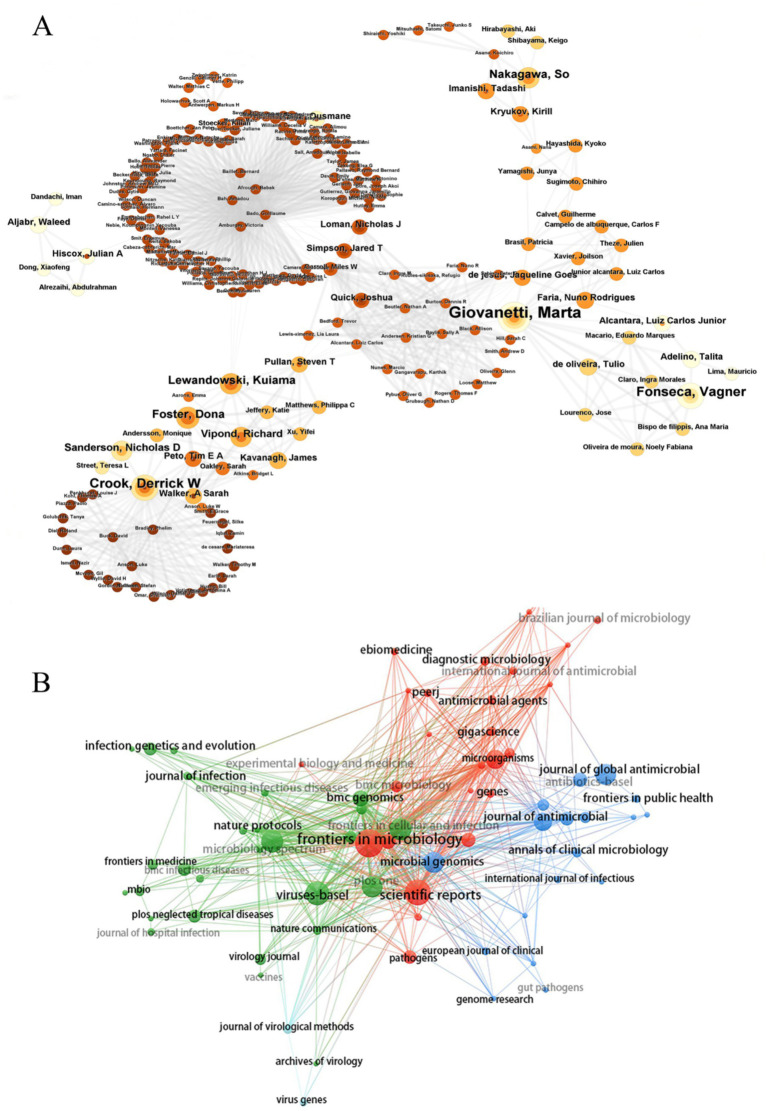
Initial searches identified 2,098 articles related to nanopore sequencing and pathogenic microorganisms, of which 729 were ultimately included in the analysis. Among the 104 participating countries, the United Kingdom, the United States, and China have led in publication output, citations, and academic influence. The most versatile institution was the University of Oxford, followed by Zhejiang University. The most productive scholars and journals were Crook, Derrick W., and Frontiers in Microbiology, respectively. Keyword analysis revealed that the primary advantages of nanopore sequencing include portability, long-read capabilities, and real-time analysis. Current research hotspots focus on real-time pathogen identification, viral genomic surveillance, and antimicrobial resistance profiling.
Presently, nanopore sequencing is rapidly transitioning from laboratory research to on-site sequencing and public health emergency scenarios. To our knowledge, this study is the first bibliometric analysis to comprehensively delineate the latest developments in nanopore sequencing in pathogenic microorganism diagnosis. It provides researchers with an understanding of the current situation, identifies knowledge gaps, and points out future research directions.
本研究旨在通过文献计量分析全面剖析纳米孔测序技术在病原微生物诊断领域的全球格局、趋势及研究重点。
从科学网核心合集检索2014年1月至2024年12月发表的文献。使用VOSviewer、CiteSpace、Origin 2024和R软件进行横断面文献计量分析,以提取和评估各项指标。出版物按国家、机构、作者、期刊、高被引论文和关键词进行分类。基于发表量和学术影响力对变量进行比较,学术影响力包括被引频次、引用影响力、H指数、期刊影响因子、总链接强度、主要病原体和研究方向。
初步检索到2098篇与纳米孔测序和病原微生物相关的文章,最终729篇纳入分析。在104个参与国家中,英国、美国和中国在发表量、引用量和学术影响力方面领先。最具综合性的机构是牛津大学,其次是浙江大学。发文量最多的学者和期刊分别是克鲁克、德里克·W.以及《微生物学前沿》。关键词分析表明,纳米孔测序的主要优势包括便携性、长读长能力和实时分析。当前研究热点集中在实时病原体鉴定、病毒基因组监测和抗菌药物耐药性分析。
目前,纳米孔测序正迅速从实验室研究转向现场测序和公共卫生应急场景。据我们所知,本研究是首次全面描绘纳米孔测序在病原微生物诊断领域最新进展的文献计量分析。它为研究人员提供了对当前状况的了解,识别了知识空白,并指出了未来的研究方向。