Luo Wei, Wang Jinqiu, Wang Yi, Tang Jie, Ren Yuanhang, Geng Fang
Institute for Egg Science and Technology, School of Food and Biological Engineering, Chengdu University, No. 2025 Chengluo Avenue, Chengdu 610106, China.
Key Laboratory of Coarse Cereal Processing (Ministry of Agriculture and Rural Affairs), Sichuan Engineering & Technology Research Center of Coarse Cereal Industrialization, School of Food and Biological Engineering, Chengdu University, No. 2025 Chengluo Avenue, Chengdu 610106, China.
Ultrason Sonochem. 2021 Dec;81:105862. doi: 10.1016/j.ultsonch.2021.105862. Epub 2021 Dec 7.
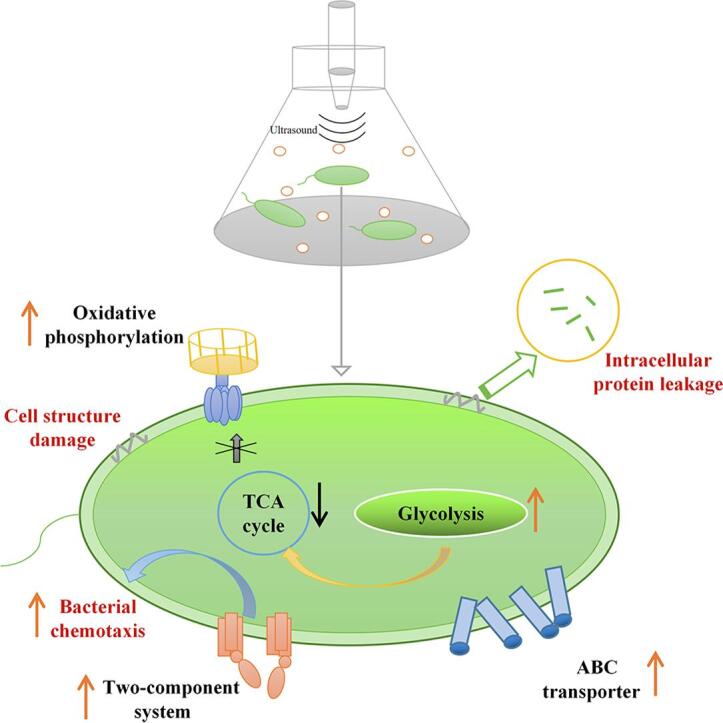
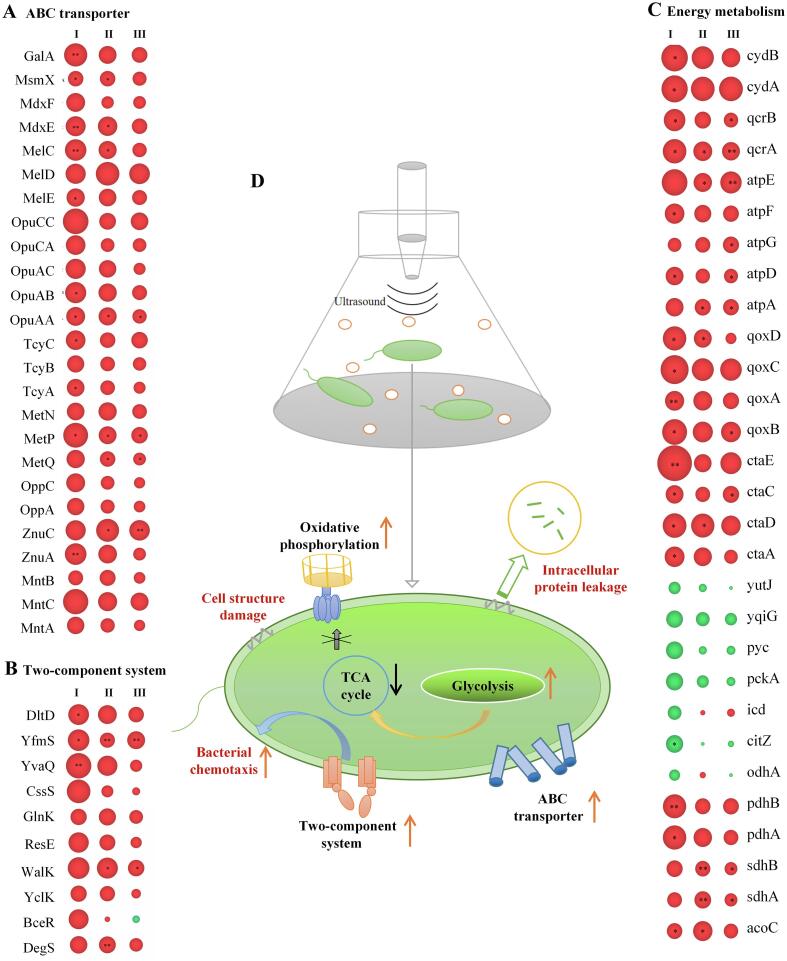
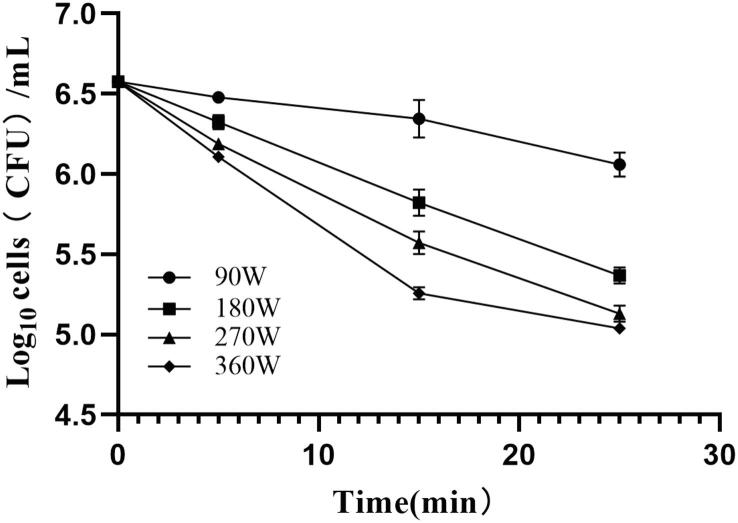
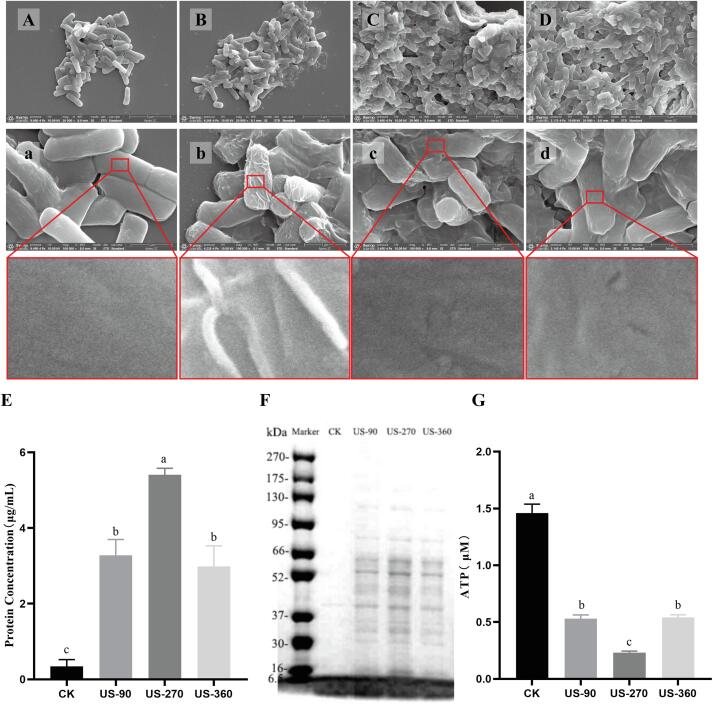
The bacteriostatic effects of high-intensity ultrasonic treatment (HIU) on Bacillus subtilis vegetative cells were evaluated, and the related mechanisms were explored using quantitative proteomics. The bacteriostatic effect of HIU on B. subtilis was proportional to the ultrasound treatment time and power, and the number of cultivable B. subtilis cells was decreased by approximately one log (at 270 W for 15 min) or half log (at 90 W for 25 min or 360 W for 5 min). Scanning electron microscopy images and gel electrophoresis results showed that HIU caused the destruction of the cell structure and intracellular protein leakage. In addition, HIU treatment at 270 W for 15 min resulted in the greatest decrease (84.22%) in intracellular adenosine triphosphate (ATP) content. The quantitative proteomic analysis showed that B. subtilis resisted the stress of HIU treatment by regulating the key proteins in physiological activities related to membrane transport (ATP-binding cassette [ABC] transporter), signal transduction (the two-component system), and energy metabolism (the tricarboxylic acid [TCA] cycle). HIU-induced physical damage, stress, and metabolic disorders were the main causes of the bacteriostatic effects on B. subtilis. These findings provide a foundation for the subsequent optimization and potential applications of HIU inactivation of B. subtilis.
评估了高强度超声处理(HIU)对枯草芽孢杆菌营养细胞的抑菌作用,并采用定量蛋白质组学方法探究了相关机制。HIU对枯草芽孢杆菌的抑菌作用与超声处理时间和功率成正比,可培养的枯草芽孢杆菌细胞数量减少了约一个对数(270 W处理15分钟)或半个对数(90 W处理25分钟或360 W处理5分钟)。扫描电子显微镜图像和凝胶电泳结果表明,HIU导致细胞结构破坏和细胞内蛋白质泄漏。此外,270 W处理15分钟导致细胞内三磷酸腺苷(ATP)含量下降幅度最大(84.22%)。定量蛋白质组学分析表明,枯草芽孢杆菌通过调节与膜转运(ATP结合盒[ABC]转运蛋白)、信号转导(双组分系统)和能量代谢(三羧酸[TCA]循环)相关的生理活动中的关键蛋白来抵抗HIU处理的应激。HIU引起的物理损伤、应激和代谢紊乱是对枯草芽孢杆菌产生抑菌作用的主要原因。这些发现为后续优化HIU灭活枯草芽孢杆菌及其潜在应用奠定了基础。