Institute of Tropical Medicine and International Health, Charité - Universitätsmedizin Berlin, Berlin, Germany.
Department of Infectious Disease Epidemiology, Robert Koch Institute, Berlin, Germany.
BMC Infect Dis. 2021 Dec 11;21(1):1241. doi: 10.1186/s12879-021-06945-4.
Living conditions in homeless shelters facilitate the transmission of COVID-19. Social determinants and pre-existing health conditions place homeless people at increased risk of severe disease. Described outbreaks in homeless shelters resulted in high proportions of infected residents and staff members. In addition to other infection prevention strategies, regular shelter-wide (universal) testing for COVID-19 may be valuable, depending on the level of community transmission and when resources permit.
This was a prospective feasibility cohort study to evaluate universal testing for COVID-19 at a homeless shelter with 106 beds in Berlin, Germany. Co-researchers were recruited from the shelter staff. A PCR analysis of saliva or self-collected nasal/oral swab was performed weekly over a period of 3 weeks in July 2020. Acceptability and implementation barriers were analyzed by process evaluation using mixed methods including evaluation sheets, focus group discussion and a structured questionnaire.
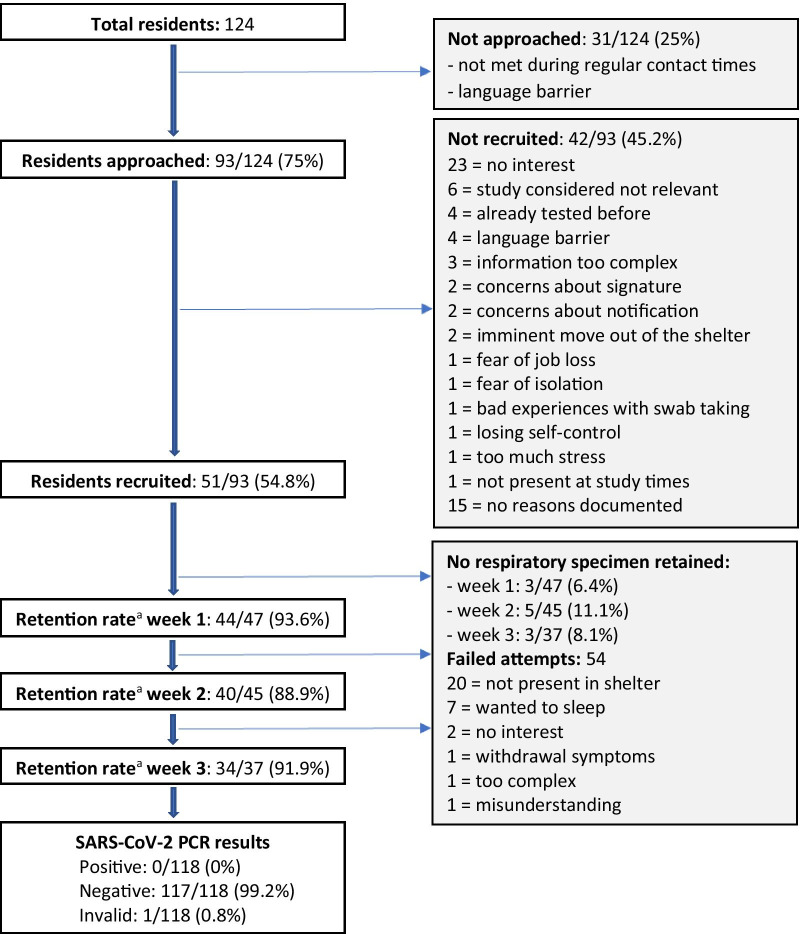
Ninety-three out of 124 (75%) residents were approached to participate in the study. Fifty-one out of the 93 residents (54.8%) gave written informed consent; thus 41.1% (51 out of 124) of all residents were included in the study. Among these, high retention rates (88.9-93.6%) of a weekly respiratory specimen were reached, but repeated collection attempts, as well as assistance were required. Around 48 person-hours were necessary for the sample collection including the preparation of materials. A self-collected nasal/oral swab was considered easier and more hygienic to collect than a saliva specimen. No resident was tested positive by RT-PCR. Language barriers were the main reason for non-participation. Flexibility of sample collection schedules, the use of video and audio materials, and concise written information were the main recommendations of the co-researchers for future implementation.
Voluntary universal testing for COVID-19 is feasible in homeless shelters. Universal testing of high-risk facilities will require flexible approaches, considering the level of the community transmission, the available resources, and the local recommendations. Lack of human resources and laboratory capacity may be a major barrier for implementation of universal testing, requiring adapted approaches compared to standard individual testing. Assisted self-collection of specimens and barrier free communication may facilitate implementation in homeless shelters. Program planning must consider homeless people's needs and life situation, and guarantee confidentiality and autonomy.
无家可归者收容所的居住条件有利于 COVID-19 的传播。社会决定因素和预先存在的健康状况使无家可归者患重病的风险增加。描述的无家可归者收容所爆发导致受感染的居民和工作人员比例很高。除了其他感染预防策略外,根据社区传播程度和资源允许情况,定期对整个收容所(普遍)进行 COVID-19 检测可能具有价值。
这是一项在德国柏林的一个有 106 张床位的无家可归者收容所进行的 COVID-19 普遍检测的前瞻性可行性队列研究。共同研究人员是从收容所工作人员中招募的。在 2020 年 7 月的三周内,每周对唾液或自我采集的鼻/咽拭子进行一次 PCR 分析。通过使用混合方法(包括评估表、焦点小组讨论和结构化问卷)进行过程评估,分析可接受性和实施障碍。
124 名居民中有 93 名(75%)被邀请参加研究。93 名居民中有 51 名(54.8%)书面同意;因此,共有 41.1%(124 名居民中有 51 名)居民参加了该研究。其中,每周呼吸道标本的高保留率(88.9-93.6%)达到,但需要重复采集尝试和协助。收集样本大约需要 48 个人小时,包括材料准备。自我采集的鼻/咽拭子被认为比唾液标本更容易和更卫生。没有居民通过 RT-PCR 检测呈阳性。语言障碍是不参与的主要原因。共同研究人员的主要建议是为未来的实施提供灵活的样本采集计划、使用视频和音频材料以及简明的书面信息。
在无家可归者收容所自愿进行 COVID-19 普遍检测是可行的。对高风险设施的普遍检测需要根据社区传播程度、可用资源和当地建议采用灵活的方法。人力资源和实验室能力的缺乏可能是普遍检测实施的主要障碍,需要与标准的个体检测相比采用适应的方法。辅助自我采集样本和无障碍沟通可能有助于在无家可归者收容所实施。方案规划必须考虑无家可归者的需求和生活状况,并保证保密性和自主性。