West Shoa Zone Health Bureau, Oromia Region, Ethiopia.
Department of Public Health, Institute of Health Sciences, Wollega University, Nekemte, Ethiopia.
BMC Pediatr. 2021 Dec 11;21(1):565. doi: 10.1186/s12887-021-03040-0.
Although minimum dietary diversity (MDD) is one of the core indicators of a high-quality diet for infants and young children, meeting this dietary diversity standard remains a challenge in Ethiopia. Therefore, adequate information on the status and factors affecting minimum dietary diversity is essential to identify potential strategic interventions. This study to study is to assess DD and associated factors among children aged 6 to 23 months in Chelia District, Ethiopia.
A community-based cross-sectional study was conducted in the seven kebeles of Chelia District from 12th April to April 30th, 2020. Kebele is the smallest administrative unit in Ethiopia. Multistage sampling was used to select 631 participants who had a child aged 6 to 23 months. Data was entered into the Epi data version 3.1 and analyzed using Statistical Package for Social Science (SPSS) version 24. A binary logistic regression was fitted to identify significant factors associated with met MDD at 95% CI and a p-value < 0.05.
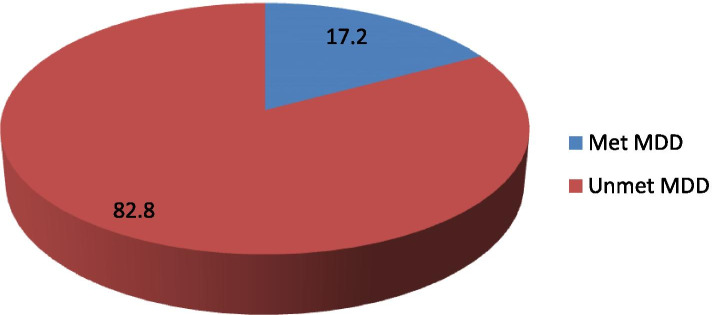
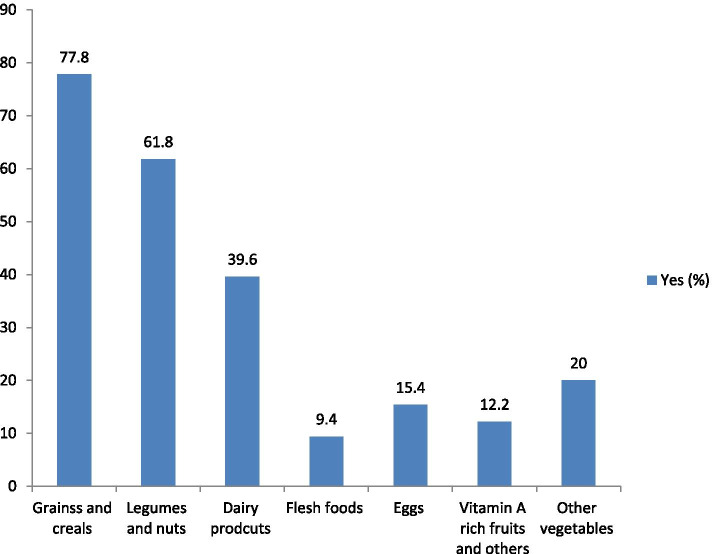
Less than one-quarter (17.32%) of infants and young children aged 6 to 23 months had met MDD. The dominant group of foods consumed was composed of grains, roots, and tubers. Children aged18-23 months (AOR = 3.26, 1.36-7.79), mothers aged 35-44 years (AOR = 3.25, 1.38-7.45), housewives as household heads (AOR = 3.41, 1.56-2.37), children of smaller family size (AOR = 3.89, 1.18-12.78), and caregivers who studied grade 9-12 (AOR = 9.98, 5.66-17.10), who received information about food diversity during ANC (AOR = 1.48, 2.21-11.23) and PNC (AOR = 3.94, 2.04-7.63) visit, who travels less than one hour to reach the market (AOR = 2.94, 1.24-6.91) and who had high family income (AOR = 4.12, 1.90-8.19) were significantly associated with meeting MDD.
Dietary diversity among children aged 6 to 23 months in Chelia District is low. It is proposed that caregivers on MDD be educated/trained and encouraged to share information during health service in order to increase the diverse diet and achieve a better dietary diversity score for infants and younger children.
尽管最低饮食多样性(MDD)是婴儿和幼儿高质量饮食的核心指标之一,但在埃塞俄比亚,达到这一饮食多样性标准仍然是一项挑战。因此,充分了解饮食多样性的现状和影响因素对于确定潜在的战略干预措施至关重要。本研究旨在评估切尔亚地区 6 至 23 个月儿童的 DD 及其相关因素。
这是一项于 2020 年 4 月 12 日至 4 月 30 日在切尔亚区七个 kebeles 进行的基于社区的横断面研究。kebele 是埃塞俄比亚最小的行政单位。采用多阶段抽样方法选择了 631 名 6 至 23 个月大的儿童的看护人作为参与者。数据输入到 Epi Data 版本 3.1 并使用 Statistical Package for Social Science(SPSS)版本 24 进行分析。使用二项逻辑回归确定与满足 MDD 相关的显著因素,并在 95%CI 和 p 值<0.05 下进行分析。
只有不到四分之一(17.32%)的 6 至 23 个月大的婴儿和幼儿达到了 MDD。食用的主要食物组是谷物、根茎和块茎。18-23 个月大的儿童(AOR=3.26,1.36-7.79)、35-44 岁的母亲(AOR=3.25,1.38-7.45)、家庭主妇作为家庭主妇(AOR=3.41,1.56-2.37)、家庭规模较小的儿童(AOR=3.89,1.18-12.78)、以及接受过 ANC(AOR=1.48,2.21-11.23)和 PNC(AOR=3.94,2.04-7.63)期间关于食物多样性信息的照顾者和接受过 9-12 年级教育的照顾者(AOR=9.98,5.66-17.10)、前往市场的时间少于 1 小时(AOR=2.94,1.24-6.91)和家庭收入较高(AOR=4.12,1.90-8.19)与满足 MDD 显著相关。
切尔亚地区 6 至 23 个月儿童的饮食多样性较低。建议对满足 MDD 的看护人进行教育/培训,并鼓励他们在卫生服务期间分享信息,以增加饮食的多样性,并为婴儿和幼儿实现更好的饮食多样性评分。