Zakeri Mohammad Ali, Rahiminezhad Elham, Salehi Farzaneh, Ganjeh Hamid, Dehghan Mahlagha
Non-communicable Diseases Research Center, Rafsanjan University of Medical Sciences, Rafsanjan, Iran.
Determinants of Health Research Centre, Rafsanjan University of Medical Sciences, Rafsanjan, Iran.
Front Psychol. 2021 Nov 25;12:789737. doi: 10.3389/fpsyg.2021.789737. eCollection 2021.
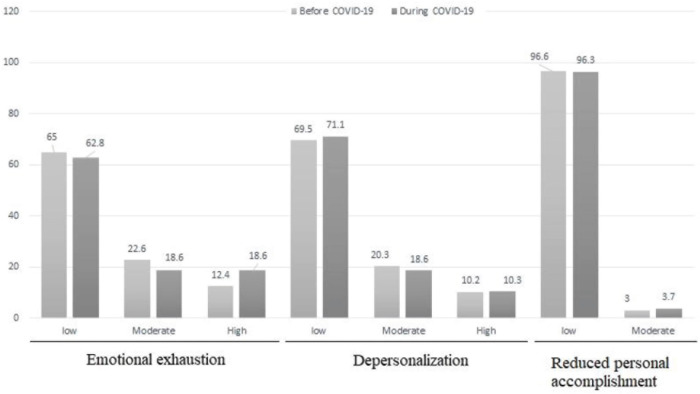
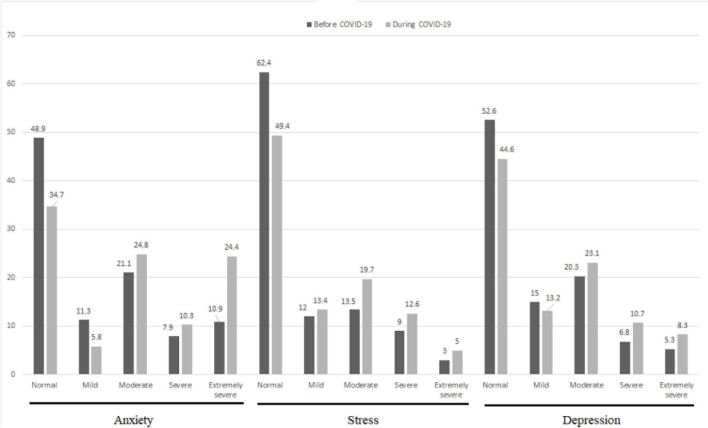
Nurses are the major healthcare workforce in an epidemic and have the most contact with patients. Frontline nurses face many health challenges during the COVID-19 epidemic, are directly at risk when treating and caring for COVID-19 patients, and thus experience severe stress and problems in the workplace leading to physical, mental, and social disorders, as well as burnout, anxiety, stress, and depression. The purpose of this study was to compare burnout, anxiety, stress, and depression in nurses before and during the first wave of the COVID-19 pandemic. This was a cross sectional study. We assessed 266 frontline nurses before and 242 frontline nurses during the first wave of the COVID-19 pandemic with one year apart in 2019 and 2020 (two-stage sampling). The data were collected using demographic questionnaire, Maslach Burnout Questionnaire and Depression, Anxiety and Stress Scale (DASS-21) in public hospitals in Southern Iran. There were no significant differences between groups in subscales of burnout ( > 0.05). Anxiety, stress and depression scores significantly increased during the first wave of the COVID-19 pandemic compared with before the COVID-19 outbreak ( < 0.05). There were significant differences between groups in level of anxiety ( < 0.001) and stress ( = 0.04). Before the COVID-19 outbreak, burnout predicted 11, 15, and 13% of the variance of anxiety, stress and depression, respectively. In addition, stress, monthly working hours and shift were variables that predicted 16% of the variance of burnout before COVID-19. The results of the present study showed that burnout during the first wave of the COVID-19 pandemic did not change significantly compared with before COVID-19. Anxiety, stress and depression increased significantly first wave of the COVID-19 pandemic.
护士是疫情期间主要的医疗保健力量,与患者接触最为频繁。在新冠疫情期间,一线护士面临诸多健康挑战,在治疗和护理新冠患者时直接面临风险,因此在工作场所会经历严重的压力和问题,导致身体、心理和社会紊乱,以及职业倦怠、焦虑、压力和抑郁。本研究的目的是比较新冠疫情第一波期间及之前护士的职业倦怠、焦虑、压力和抑郁情况。这是一项横断面研究。我们在2019年和2020年相隔一年的时间里,对266名新冠疫情第一波之前的一线护士和242名第一波期间的一线护士进行了评估(两阶段抽样)。在伊朗南部的公立医院,使用人口统计学问卷、马氏职业倦怠问卷和抑郁、焦虑和压力量表(DASS-21)收集数据。两组在职业倦怠分量表上无显著差异(>0.05)。与新冠疫情爆发前相比,在新冠疫情第一波期间,焦虑、压力和抑郁得分显著增加(<0.05)。两组在焦虑水平(<0.001)和压力水平(=0.04)上存在显著差异。在新冠疫情爆发前,职业倦怠分别预测了焦虑、压力和抑郁变异的11%、15%和13%。此外,压力、每月工作时长和轮班是在新冠疫情之前预测职业倦怠变异16%的变量。本研究结果表明,与新冠疫情之前相比,新冠疫情第一波期间的职业倦怠没有显著变化。焦虑、压力和抑郁在新冠疫情第一波期间显著增加。