Department of Midwifery, College of Health Science, Debre Markos University, Debre Markos, Ethiopia.
Department of Human Nutrition and Food Science, College of Health Science, Debre Markos University, Debre Markos, Ethiopia.
Biomed Res Int. 2021 Dec 1;2021:6551526. doi: 10.1155/2021/6551526. eCollection 2021.
Urinary tract infection (UTI) is the most common bacterial infections during pregnancy. It is associated with different maternal and neonatal adverse outcomes such as low birth weight, preterm birth, still birth, preeclampsia, maternal anemia, sepsis, and amnionitis, even when the infection is asymptomatic. However, in Ethiopia, it is represented with fragmented and inconclusive pocket studies. Therefore, this systematic review and meta-analysis is aimed at estimating the pooled prevalence of UTI and its associated factors among pregnant women in Ethiopia.
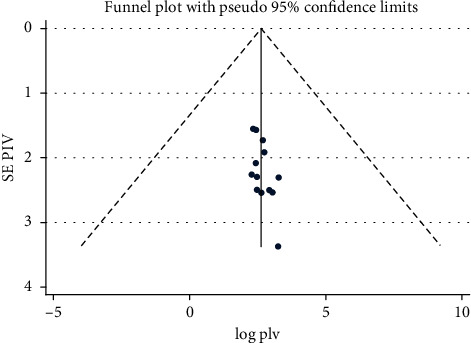
PubMed/Medline, Embase, Cochrane Library, Google Scholar, and local sources were used to access eligible studies. Joanna Briggs Institute Meta-Analysis of Statistics Assessment and Review Instrument was applied for critical appraisal. Heterogeneity and publication bias were evaluated using statistic, funnel plot asymmetry, and Egger's tests. Random effect model was employed to estimate the pooled burden of UTI and its associated factors among pregnant women with its corresponding odds ratio (OR) and 95% confidence interval (CI).
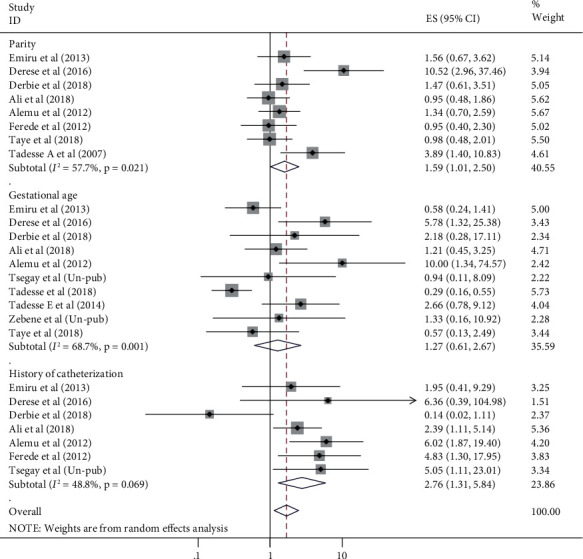
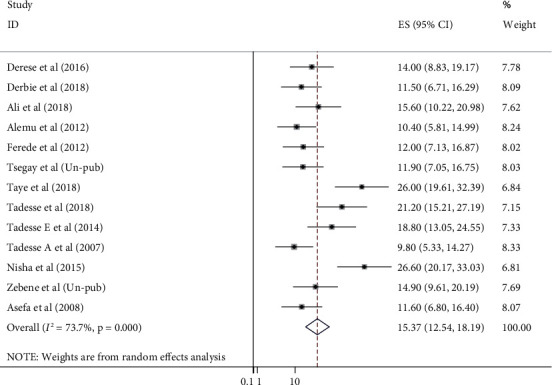
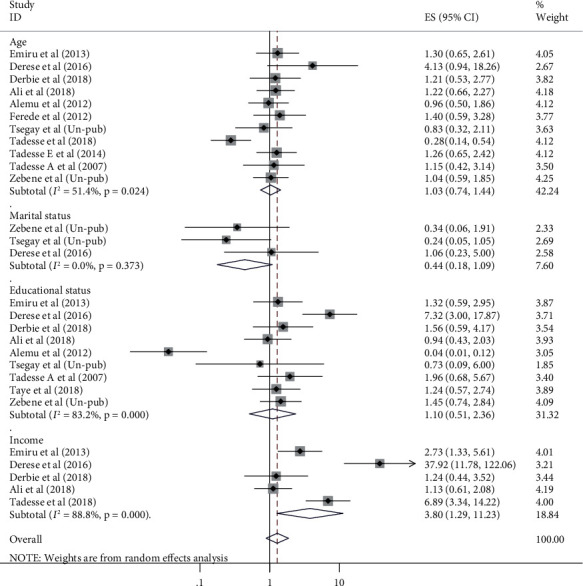
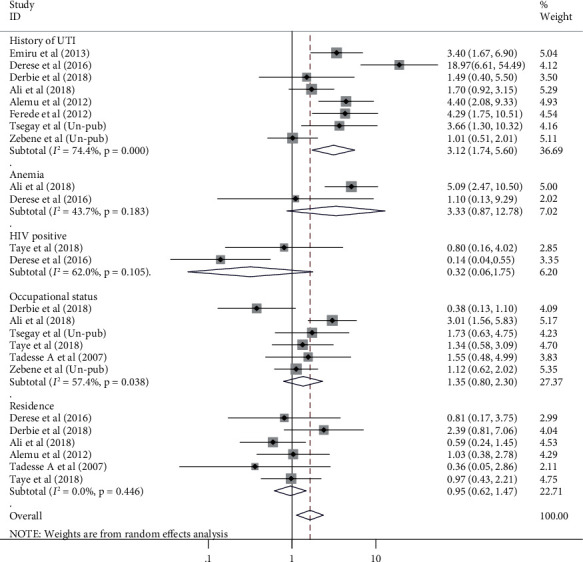
From all systematically searched articles, 14 studies were eligible for this analysis. The overall pooled prevalence of UTI among pregnant women in Ethiopia was 15.37% (95% CI: 12.54, 18.19). Family monthly income (OR = 3.8 and 95% CI: 1.29, 11.23), parity (OR = 1.59 and 95% CI: 1.01, 2.50), history of catheterization (OR = 2.76 and 95% CI: 1.31, 5.84), and history of UTI (OR = 3.12 and 95% CI: 1.74, 5.60) were factors significantly associated with UTI among pregnant women in Ethiopia.
The overall pooled estimate of UTI among pregnant women in Ethiopia was higher compared with CDC estimation which was 8%. Family monthly income < 1000ETB, multipara, previous history of catheterization, and history of UTI were factors increased burden of UTI during pregnancy. So, strategies targeting in economic reforms, universal access of family planning, and standardized prenatal care service should be addressed to alleviate this high prevalence of UTI during pregnancy.
尿路感染(UTI)是孕妇中最常见的细菌感染。它与不同的母婴不良结局有关,如低出生体重、早产、死产、子痫前期、母体贫血、败血症和羊膜炎,即使感染是无症状的。然而,在埃塞俄比亚,它的表现形式是零碎的、没有定论的口袋研究。因此,本系统评价和荟萃分析旨在估计埃塞俄比亚孕妇中 UTI 的总患病率及其相关因素。
使用 PubMed/Medline、Embase、Cochrane 图书馆、Google Scholar 和当地资源来获取合格的研究。应用 Joanna Briggs 研究所统计评估和审查工具对批判性评价进行评估。使用 统计、漏斗图不对称和 Egger 检验评估异质性和发表偏倚。使用随机效应模型估计 UTI 及其相关因素在孕妇中的总负担,以及相应的比值比(OR)和 95%置信区间(CI)。
从所有系统搜索的文章中,有 14 项研究符合本分析的条件。埃塞俄比亚孕妇 UTI 的总体总患病率为 15.37%(95%CI:12.54,18.19)。家庭月收入(OR=3.8 和 95%CI:1.29,11.23)、产次(OR=1.59 和 95%CI:1.01,2.50)、导尿管使用史(OR=2.76 和 95%CI:1.31,5.84)和 UTI 史(OR=3.12 和 95%CI:1.74,5.60)是与埃塞俄比亚孕妇 UTI 相关的显著因素。
与 CDC 估计的 8%相比,埃塞俄比亚孕妇 UTI 的总估计值较高。家庭月收入<1000ETB、多胎妊娠、既往导尿管使用史和 UTI 史是增加妊娠期间 UTI 负担的因素。因此,应针对经济改革、普遍计划生育和标准化产前保健服务制定策略,以减轻妊娠期间 UTI 的高患病率。