Modeling in Health Research Center, Shahrekord University of Medical Sciences, P.O. Box: 881-55383, Shahrekord, Iran.
Department of Epidemiology and Biostatistics, School of Public Health, Shahrekord University of Medical Sciences, P.O. Box: 881-55383, Shahrekord, Iran.
BMC Public Health. 2021 Dec 13;21(1):2275. doi: 10.1186/s12889-021-12326-y.
Critical inter-provincial differences within Iran in the pattern of non-communicable diseases (NCDs) and difficulties inherent to identifying prevention methods to reduce mortality from NCDs have challenged the implementation of the provincial health system plan. The Shahrekord Cohort Study (SCS) was designed to address these gaps in Chaharmahal and Bakhtiari, a province of high altitude in the southwest of Iran, characterized by its large Bakhtiari population, along with Fars and Turk ethnicity groups.
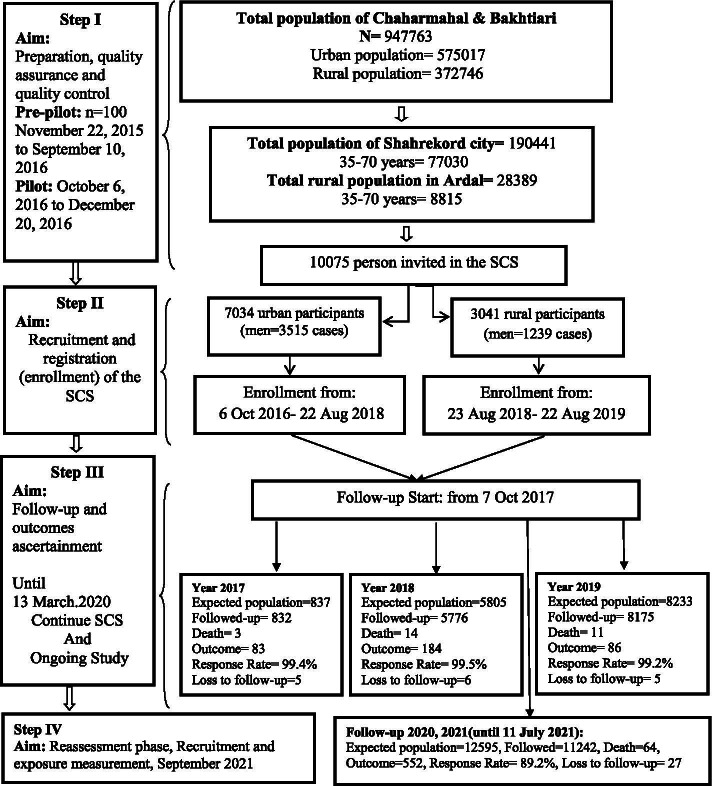
This ongoing cohort, a prospective, large-scale longitudinal study, includes a unique, rich biobank and was conducted for the first time in Chaharmahal and Bakhtiari Province in Iran. SCS is a part of the PERSIAN (Prospective Epidemiological Research Studies in IrAN) cohort. The study began in 2015, recruited 10075 participants (52.8% female, 47.2% male) from both urban (n=7034) and rural (n=3041) areas, and participants will be annually followed up for at least 15 years. A cross-sectional analysis was conducted using baseline data from the SCS, using descriptive statistics and logistic regression. Data analysis was performed using Stata software.
The prevalence of NCDs was 9.8% for type 2 diabetes, 17.1% for hypertension, 11.6% for thyroid disease, 0.2% for multiple sclerosis and 5.7, 0.9 and 1.3% for ischemic heart disease, stroke and myocardial infarction, respectively. The prevalence of multimorbidity (≥2 NCDs) was higher in women (39.1%) than men (24.9%). The means (standard deviations) of age, BMI, systolic blood pressure and fasting blood glucose were 49.5 (9) years, 27.6 (4.6) kg/m, 115.4 (17.3) mmHg and 96.7 (27.3) mg/dL, respectively. Logistic regression models showed that older age, female gender, living in an urban area, non-native ethnicity, high wealth index, unemployment, obesity, low physical activity, hypertriglyceridemia, high fasting blood sugar, alkaline urine pH and high systolic and diastolic blood pressure were associated with increased prevalence of NCDs.
The SCS provides a platform for epidemiological studies that will be useful to better control NCDs in the southwest of Iran and to foster research collaboration. The SCS will be an essential resource for identifying NCD risk factors in this region and designing relevant public health interventions.
伊朗省内非传染性疾病(NCD)模式存在显著差异,且确定降低 NCD 死亡率的预防方法存在固有困难,这对省级卫生系统计划的实施提出了挑战。沙赫里科德队列研究(SCS)旨在解决伊朗西南部高海拔查哈马哈尔和巴赫蒂亚里省(以其庞大的巴赫蒂阿里人群以及法尔斯和土库曼族群为特色)的这些差距。
本研究是一项正在进行的、大规模的前瞻性队列研究,包括独特且丰富的生物库,这是在伊朗查哈马哈尔和巴赫蒂亚里省首次进行的研究。SCS 是 PERSIAN(伊朗前瞻性流行病学研究)队列的一部分。该研究于 2015 年开始,从城市(n=7034)和农村(n=3041)地区招募了 10075 名参与者(52.8%为女性,47.2%为男性),并将至少对参与者进行 15 年的年度随访。使用 SCS 的基线数据进行了横断面分析,使用描述性统计和逻辑回归。数据分析使用 Stata 软件进行。
2 型糖尿病的患病率为 9.8%,高血压为 17.1%,甲状腺疾病为 11.6%,多发性硬化症为 0.2%,缺血性心脏病、中风和心肌梗死的患病率分别为 5.7%、0.9%和 1.3%。女性(39.1%)的多种合并症(≥2 种 NCD)患病率高于男性(24.9%)。年龄、BMI、收缩压和空腹血糖的平均值(标准差)分别为 49.5(9)岁、27.6(4.6)kg/m、115.4(17.3)mmHg 和 96.7(27.3)mg/dL。逻辑回归模型显示,年龄较大、女性、居住在城市地区、非本地族裔、较高的财富指数、失业、肥胖、低体力活动、高甘油三酯血症、高空腹血糖、碱性尿液 pH 值以及较高的收缩压和舒张压与 NCD 患病率增加相关。
SCS 为流行病学研究提供了一个平台,这将有助于更好地控制伊朗西南部的 NCD,并促进研究合作。SCS 将成为识别该地区 NCD 风险因素和设计相关公共卫生干预措施的重要资源。