University of Vienna, Department of Behavioral and Cognitive Biology, 1030 Vienna, Austria.
Ludwig-Maximilians-University Munich (LMU), Department Biology II, Planegg-Martinsried, 82152Germany.
J Exp Biol. 2022 Jan 1;225(1). doi: 10.1242/jeb.243614. Epub 2022 Jan 4.
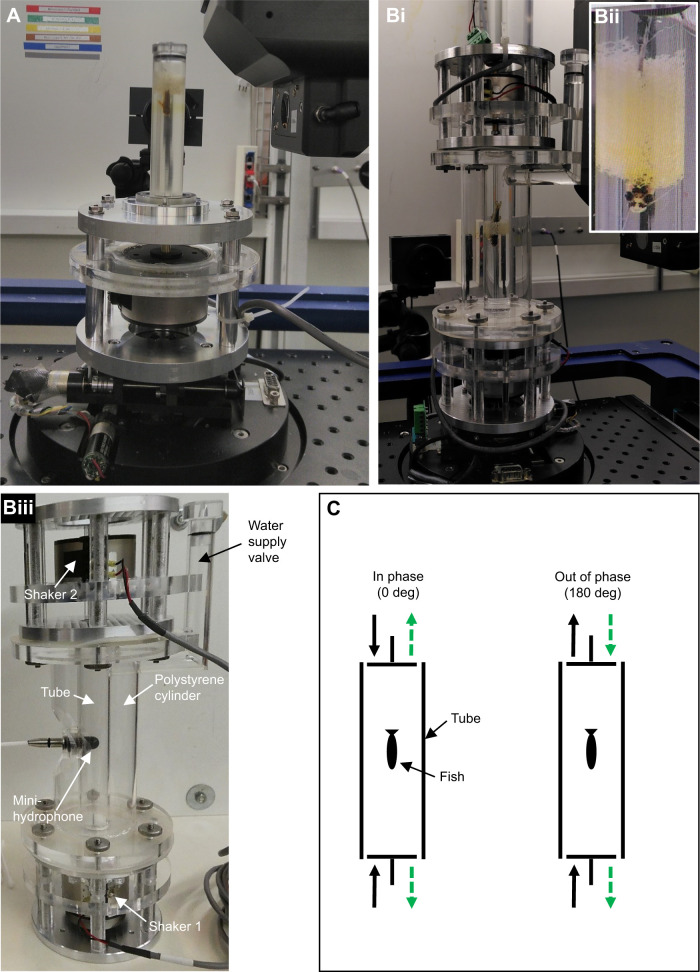
Modern bony fishes possess a high morphological diversity in their auditory structures and auditory capabilities. Yet, how auditory structures such as the otoliths in the inner ears and the swim bladder work together remains elusive. Gathering experimental evidence on the in situ motion of fish auditory structures while avoiding artifacts caused by surgical exposure of the structures has been challenging for decades. Synchrotron radiation-based tomography with high spatio-temporal resolution allows the study of morphofunctional issues non-invasively in an unprecedented way. We therefore aimed to develop an approach that characterizes the moving structures in 4D (=three spatial dimensions+time). We designed a miniature standing wave tube-like setup to meet both the requirements of tomography and those of tank acoustics. With this new setup, we successfully visualized the motion of isolated otoliths and the auditory structures in zebrafish (Danio rerio) and glass catfish (Kryptopterus vitreolus).
现代硬骨鱼类在听觉结构和听觉能力方面具有高度的形态多样性。然而,内耳中的耳石和鳔等听觉结构如何协同工作仍然难以捉摸。几十年来,人们一直在努力寻找一种方法,在不暴露结构的情况下,通过实验证据收集鱼类听觉结构的原位运动情况,以避免手术暴露结构造成的伪影。具有高时空分辨率的同步辐射断层扫描技术以前所未有的方式允许对形态功能问题进行非侵入性研究。因此,我们旨在开发一种能够在 4D(=三个空间维度+时间)中描述运动结构的方法。我们设计了一种微型驻波管状装置,以满足断层扫描和水槽声学的要求。有了这个新装置,我们成功地可视化了斑马鱼(Danio rerio)和玻璃猫鱼(Kryptopterus vitreolus)的孤立耳石和听觉结构的运动。