Schulz-Mirbach Tanja, Olbinado Margie, Rack Alexander, Mittone Alberto, Bravin Alberto, Melzer Roland R, Ladich Friedrich, Heß Martin
Ludwig-Maximilians-University Munich, Department Biology II, Zoology, Großhaderner Straße 2, 82152, Planegg-Martinsried, Germany.
European Synchrotron Radiation Facility (ESRF, ID19), 71 Avenue des Martyrs, 38000, Grenoble, France.
Sci Rep. 2018 Feb 15;8(1):3121. doi: 10.1038/s41598-018-21367-0.
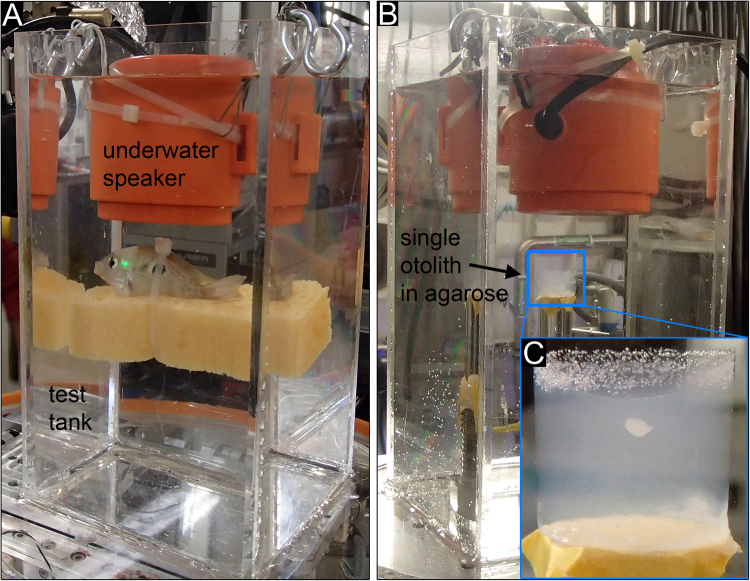
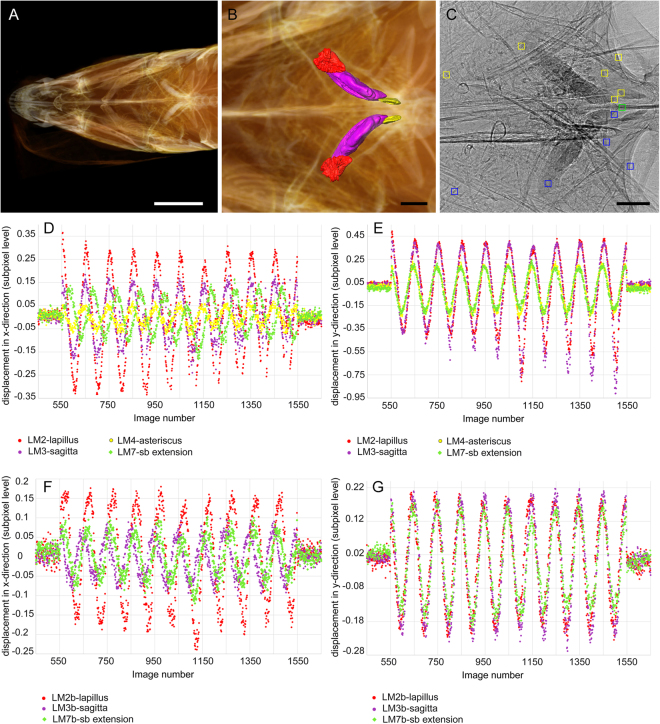
Regarding the basics of ear structure-function relationships in fish, the actual motion of the solid otolith relative to the underlying sensory epithelium has rarely been investigated. Otolith motion has been characterized based on a few experimental studies and on approaches using mathematical modeling, which have yielded partially conflicting results. Those studies either predicted a simple back-and-forth motion of the otolith or a shape-dependent, more complex motion. Our study was designed to develop and test a new set-up to generate experimental data on fish otolith motion in-situ. Investigating the basic parameters of otolith motion requires an approach with high spatial and temporal resolution. We therefore used hard X-ray phase contrast imaging (XPCI). We compared two anatomically well-studied cichlid species, Steatocranus tinanti and Etroplus maculatus, which, among other features, differ in the 3D shape of their otoliths. In a water-filled tank, we presented a pure tone of 200 Hz to 1) isolated otoliths embedded in agarose serving as a simple model or 2) to a fish (otoliths in-situ). Our new set-up successfully visualized the motion of otoliths in-situ and therefore paves the way for future studies evaluating the principles of otolith motion.
关于鱼类耳结构与功能关系的基础知识,固体耳石相对于其下方感觉上皮的实际运动很少被研究。耳石运动已根据一些实验研究和使用数学建模的方法进行了表征,这些研究得出了部分相互矛盾的结果。这些研究要么预测耳石的简单来回运动,要么预测形状依赖的更复杂运动。我们的研究旨在开发和测试一种新装置,以生成鱼类耳石原位运动的实验数据。研究耳石运动的基本参数需要一种具有高空间和时间分辨率的方法。因此,我们使用了硬X射线相衬成像(XPCI)。我们比较了两种在解剖学上研究充分的丽鱼科鱼类,即蒂氏肥头丽鱼和黄斑副丽鱼,它们在耳石的三维形状等特征上存在差异。在一个装满水的水箱中,我们向1)嵌入琼脂糖中的孤立耳石(作为一个简单模型)或2)向一条鱼(原位耳石)呈现200Hz的纯音。我们的新装置成功地可视化了原位耳石的运动,因此为未来评估耳石运动原理的研究铺平了道路。