Department of Orthopaedic Surgery and Biomedical Engineering, University of Tennessee Health Science Center, Memphis, TN 38163, USA.
Department of Orthopaedic Surgery and Biomedical Engineering, University of Tennessee Health Science Center, Memphis, TN 38163, USA; Campbell Clinic, Memphis, TN 38126, USA.
Am J Hum Genet. 2022 Jan 6;109(1):97-115. doi: 10.1016/j.ajhg.2021.11.018. Epub 2021 Dec 13.
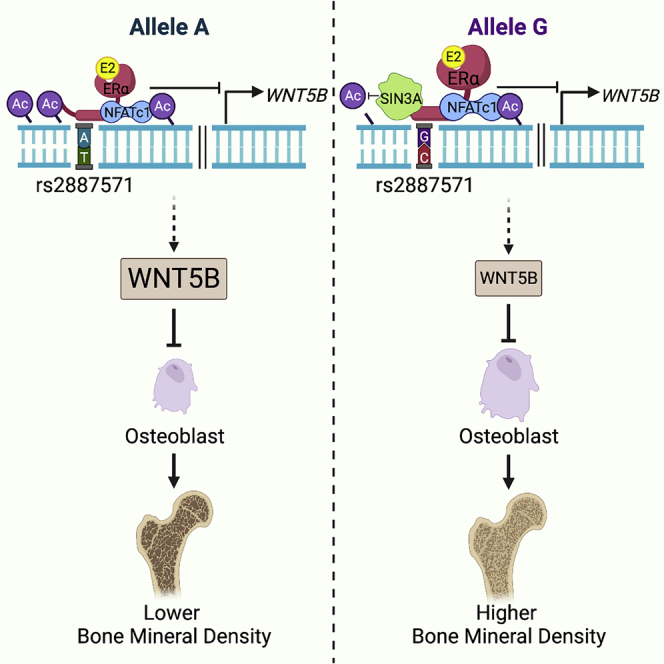
Genetic factors and estrogen deficiency contribute to the development of osteoporosis. The single-nucleotide polymorphism (SNP) rs2887571 is predicted from genome-wide association studies (GWASs) to associate with osteoporosis but has had an unknown mechanism. Analysis of osteoblasts from 110 different individuals who underwent joint replacement revealed that the genotype of rs2887571 correlates with WNT5B expression. Analysis of our ChIP-sequencing data revealed that SNP rs2887571 overlaps with an estrogen receptor alpha (ERα) binding site. Here we show that 17β-estradiol (E2) suppresses WNT5B expression and further demonstrate the mechanism of ERα binding at the enhancer containing rs2887571 to suppress WNT5B expression differentially in each genotype. ERα interacts with NFATc1, which is predicted to bind directly at rs2887571. CRISPR-Cas9 and ChIP-qPCR experiments confirm differential regulation of WNT5B between each allele. Homozygous GG has a higher binding affinity for ERα than homozygous AA and results in greater suppression of WNT5B expression. Functionally, WNT5B represses alkaline phosphatase expression and activity, decreasing osteoblast differentiation and mineralization. Furthermore, WNT5B increases interleukin-6 expression and suppresses E2-induced expression of alkaline phosphatase during osteoblast differentiation. We show that WNT5B suppresses the differentiation of osteoblasts via receptor tyrosine kinase-like orphan receptor 1/2 (ROR1/2), which activates DVL2/3/RAC1/CDC42/JNK/SIN3A signaling and inhibits β-catenin activity. Together, our data provide mechanistic insight into how ERα and NFATc1 regulate the non-coding SNP rs2887571, as well as the function of WNT5B on osteoblasts, which could provide alternative therapeutic targets for osteoporosis.
遗传因素和雌激素缺乏导致骨质疏松症的发生。单核苷酸多态性(SNP)rs2887571 是通过全基因组关联研究(GWAS)预测与骨质疏松症相关的,但机制尚不清楚。对 110 名接受关节置换手术的个体的成骨细胞进行分析表明,rs2887571 的基因型与 WNT5B 表达相关。我们的 ChIP-seq 数据分析表明,SNP rs2887571 与雌激素受体 alpha(ERα)结合位点重叠。在这里,我们表明 17β-雌二醇(E2)抑制 WNT5B 的表达,并进一步证明了 ERα 在含有 rs2887571 的增强子上结合的机制,以不同的基因型差异抑制 WNT5B 的表达。ERα 与 NFATc1 相互作用,NFATc1 被预测可直接结合 rs2887571。CRISPR-Cas9 和 ChIP-qPCR 实验证实了每个等位基因之间 WNT5B 的差异调控。纯合 GG 对 ERα 的结合亲和力高于纯合 AA,导致 WNT5B 表达的抑制更强。功能上,WNT5B 抑制碱性磷酸酶的表达和活性,减少成骨细胞的分化和矿化。此外,WNT5B 增加白细胞介素-6 的表达,并抑制成骨细胞分化过程中 E2 诱导的碱性磷酸酶表达。我们表明,WNT5B 通过受体酪氨酸激酶样孤儿受体 1/2(ROR1/2)抑制成骨细胞的分化,该受体激活 DVL2/3/RAC1/CDC42/JNK/SIN3A 信号通路并抑制β-catenin 活性。总之,我们的数据提供了 ERα 和 NFATc1 如何调节非编码 SNP rs2887571 的机制见解,以及 WNT5B 对成骨细胞的功能,这可为骨质疏松症提供替代治疗靶点。