Institute of Science and Technology, 3400 Klosterneuburg, Austria.
Department of Biochemistry, Hector F. DeLuca Laboratories, University of Wisconsin-Madison, Madison, WI 53706.
Proc Natl Acad Sci U S A. 2021 Dec 21;118(51). doi: 10.1073/pnas.2113046118.
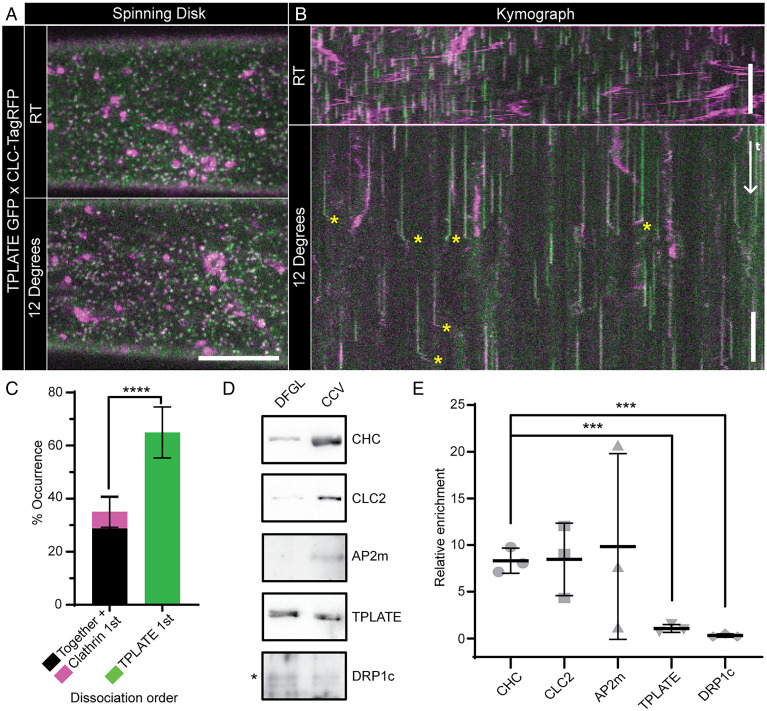
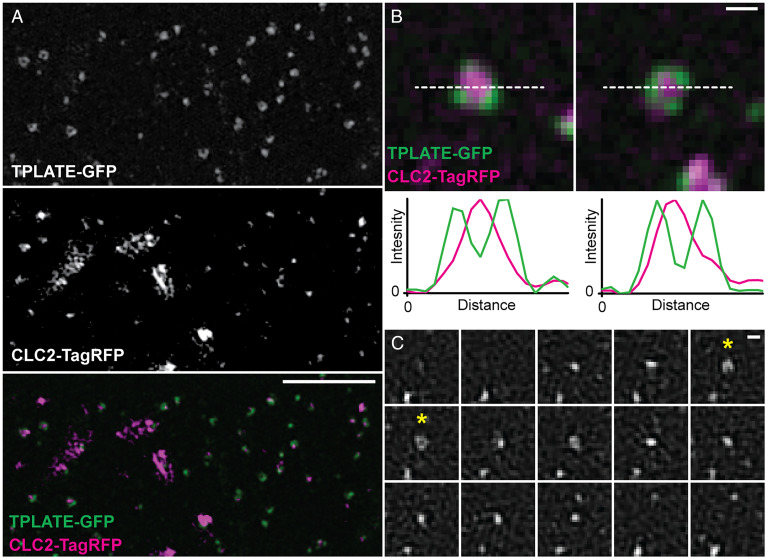
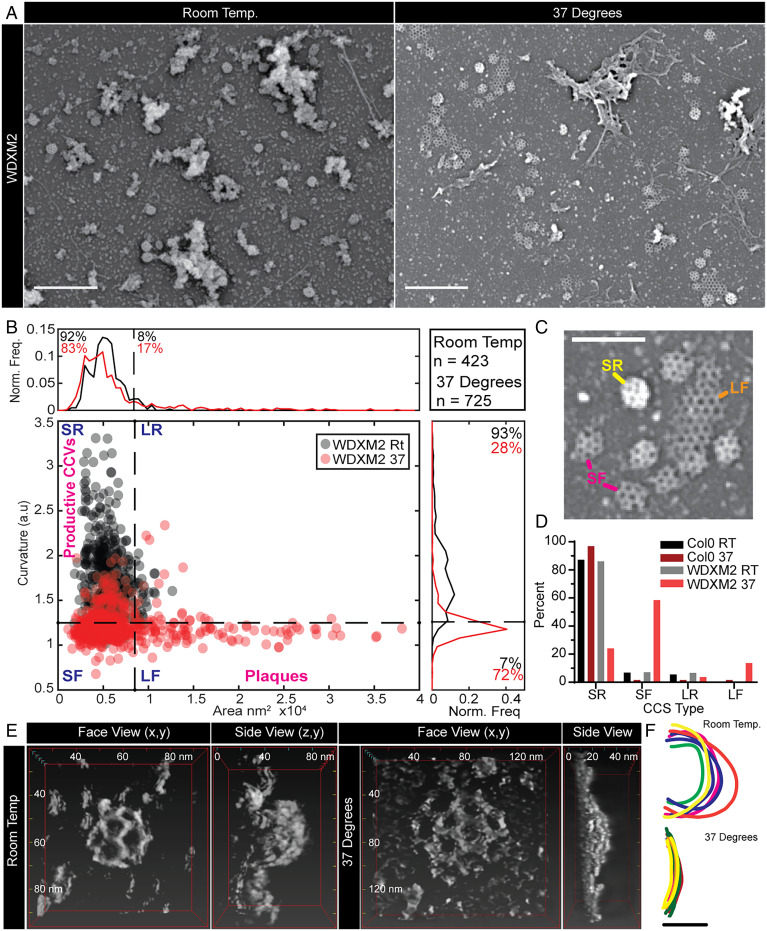
Clathrin-mediated endocytosis is the major route of entry of cargos into cells and thus underpins many physiological processes. During endocytosis, an area of flat membrane is remodeled by proteins to create a spherical vesicle against intracellular forces. The protein machinery which mediates this membrane bending in plants is unknown. However, it is known that plant endocytosis is actin independent, thus indicating that plants utilize a unique mechanism to mediate membrane bending against high-turgor pressure compared to other model systems. Here, we investigate the TPLATE complex, a plant-specific endocytosis protein complex. It has been thought to function as a classical adaptor functioning underneath the clathrin coat. However, by using biochemical and advanced live microscopy approaches, we found that TPLATE is peripherally associated with clathrin-coated vesicles and localizes at the rim of endocytosis events. As this localization is more fitting to the protein machinery involved in membrane bending during endocytosis, we examined cells in which the TPLATE complex was disrupted and found that the clathrin structures present as flat patches. This suggests a requirement of the TPLATE complex for membrane bending during plant clathrin-mediated endocytosis. Next, we used in vitro biophysical assays to confirm that the TPLATE complex possesses protein domains with intrinsic membrane remodeling activity. These results redefine the role of the TPLATE complex and implicate it as a key component of the evolutionarily distinct plant endocytosis mechanism, which mediates endocytic membrane bending against the high-turgor pressure in plant cells.
网格蛋白介导的内吞作用是货物进入细胞的主要途径,因此是许多生理过程的基础。在内吞作用过程中,蛋白质重塑扁平膜的区域,以产生一个对抗细胞内力量的球形囊泡。介导植物中这种膜弯曲的蛋白质机制尚不清楚。然而,已知植物内吞作用是肌动蛋白独立的,这表明与其他模型系统相比,植物利用独特的机制来介导高渗透压下的膜弯曲。在这里,我们研究了 TPLATE 复合物,这是一种植物特异性的内吞作用蛋白复合物。它被认为是作为一个经典的衔接子在网格蛋白衣下发挥作用。然而,通过使用生化和先进的活体显微镜方法,我们发现 TPLATE 与网格蛋白包被的囊泡周边相关,并定位于内吞作用事件的边缘。由于这种定位更适合于内吞作用过程中涉及膜弯曲的蛋白质机制,我们检查了 TPLATE 复合物被破坏的细胞,发现网格蛋白结构呈现为扁平斑块。这表明 TPLATE 复合物是植物网格蛋白介导的内吞作用过程中膜弯曲所必需的。接下来,我们使用体外生物物理测定法来证实 TPLATE 复合物具有内在的膜重塑活性的蛋白质结构域。这些结果重新定义了 TPLATE 复合物的作用,并暗示它是介导植物细胞内吞作用中高渗透压下内吞膜弯曲的进化上独特的植物内吞作用机制的关键组成部分。