Zhang Si-Yuan, Ren Jia-Yin, Yang Bo
State Key Laboratory of Oral Diseases and National Clinical Research Center for Oral Diseases, West China Hospital of Stomatology, Sichuan University, Chengdu 610041, Sichuan Province, China.
Department of Oral Radiology, West China Hospital of Stomatology, Sichuan University, Chengdu 610041, Sichuan Province, China.
World J Stem Cells. 2021 Nov 26;13(11):1625-1646. doi: 10.4252/wjsc.v13.i11.1625.
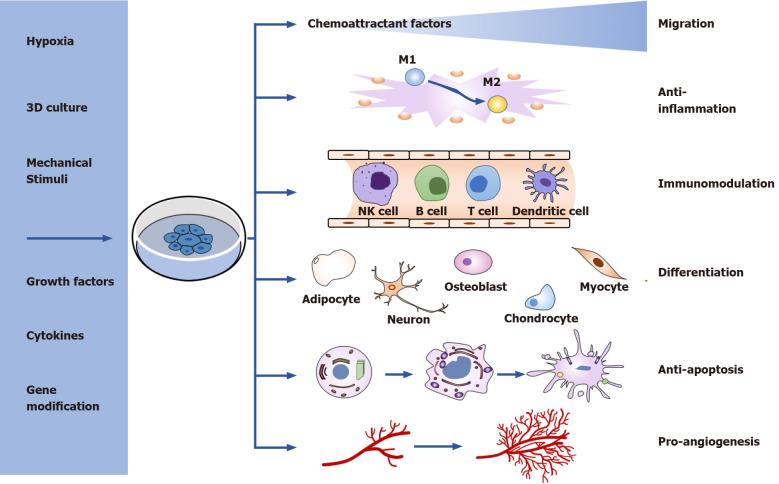
Mesenchymal stromal cells (MSCs) have attracted intense interest in the field of dental tissue regeneration. Dental tissue is a popular source of MSCs because MSCs can be obtained with minimally invasive procedures. MSCs possess distinct inherent properties of self-renewal, immunomodulation, proangiogenic potential, and multilineage potency, as well as being readily available and easy to culture. However, major issues, including poor engraftment and low survival rates , remain to be resolved before large-scale application is feasible in clinical treatments. Thus, some recent investigations have sought ways to optimize MSC functions and . Currently, priming culture conditions, pretreatment with mechanical and physical stimuli, preconditioning with cytokines and growth factors, and genetic modification of MSCs are considered to be the main strategies; all of which could contribute to improving MSC efficacy in dental regenerative medicine. Research in this field has made tremendous progress and continues to gather interest and stimulate innovation. In this review, we summarize the priming approaches for enhancing the intrinsic biological properties of MSCs such as migration, antiapoptotic effect, proangiogenic potential, and regenerative properties. Challenges in current approaches associated with MSC modification and possible future solutions are also indicated. We aim to outline the present understanding of priming approaches to improve the therapeutic effects of MSCs on dental tissue regeneration.
间充质基质细胞(MSCs)在牙组织再生领域引起了广泛关注。牙组织是MSCs的一个常见来源,因为可以通过微创程序获取MSCs。MSCs具有自我更新、免疫调节、促血管生成潜力和多向分化潜能等独特的固有特性,并且易于获取和培养。然而,在临床治疗中大规模应用之前,包括植入不佳和存活率低等主要问题仍有待解决。因此,最近一些研究寻求优化MSCs功能的方法。目前,引发培养条件、机械和物理刺激预处理、细胞因子和生长因子预处理以及MSCs的基因修饰被认为是主要策略;所有这些都有助于提高MSCs在牙再生医学中的疗效。该领域的研究取得了巨大进展,并继续受到关注和激发创新。在本综述中,我们总结了增强MSCs内在生物学特性(如迁移、抗凋亡作用、促血管生成潜力和再生特性)的引发方法。还指出了当前与MSCs修饰相关方法中的挑战以及可能的未来解决方案。我们旨在概述目前对引发方法的理解,以提高MSCs对牙组织再生的治疗效果。