Arefin Tanzil Mahmud, Lee Choong Heon, White Jordon D, Zhang Jiangyang, Kaffman Arie
Bernard Irene Schwartz Center for Biomedical Imaging, Department of Radiology, New York University Grossman School of Medicine, New York, USA.
Department of Psychiatry, Yale University School of Medicine, New Haven, Connecticut, USA.
Bio Protoc. 2021 Nov 20;11(22):e4221. doi: 10.21769/BioProtoc.4221.
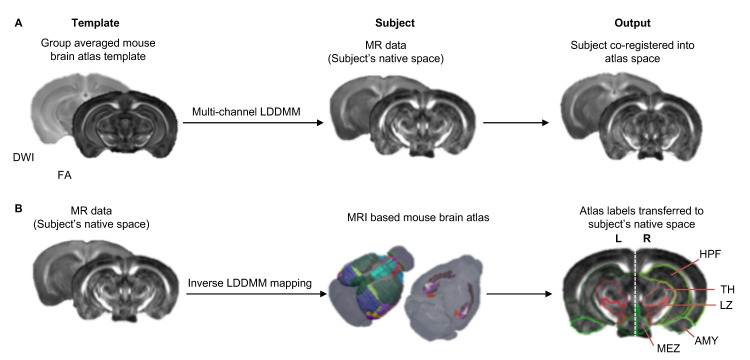
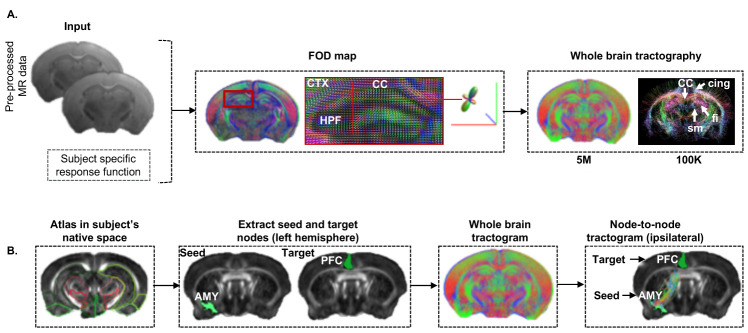
Translational work in rodents elucidates basic mechanisms that drive complex behaviors relevant to psychiatric and neurological conditions. Nonetheless, numerous promising studies in rodents later fail in clinical trials, highlighting the need for improving the translational utility of preclinical studies in rodents. Imaging of small rodents provides an important strategy to address this challenge, as it enables a whole-brain unbiased search for structural and dynamic changes that can be directly compared to human imaging. The functional significance of structural changes identified using imaging can then be further investigated using molecular and genetic tools available for the mouse. Here, we describe a pipeline for unbiased search and characterization of structural changes and network properties, based on diffusion MRI data covering the entire mouse brain at an isotropic resolution of 100 µm. We first used unbiased whole-brain voxel-based analyses to identify volumetric and microstructural alterations in the brain of adult mice exposed to unpredictable postnatal stress (UPS), which is a mouse model of complex early life stress (ELS). Brain regions showing structural abnormalities were used as nodes to generate a grid for assessing structural connectivity and network properties based on graph theory. The technique described here can be broadly applied to understand brain connectivity in other mouse models of human disorders, as well as in genetically modified mouse strains. Graphic abstract: Scale bar = 1 mm.
在啮齿动物身上开展的转化研究阐明了驱动与精神和神经疾病相关复杂行为的基本机制。尽管如此,许多在啮齿动物身上开展的前景看好的研究后来在临床试验中失败了,这凸显了提高啮齿动物临床前研究转化效用的必要性。对小型啮齿动物进行成像提供了应对这一挑战的重要策略,因为它能够对全脑进行无偏倚搜索,以寻找可直接与人类成像进行比较的结构和动态变化。然后,可以使用小鼠可用的分子和遗传工具进一步研究通过成像确定的结构变化的功能意义。在此,我们描述了一种基于扩散磁共振成像(MRI)数据的流程,用于对结构变化和网络特性进行无偏倚搜索和表征,该数据以100微米的各向同性分辨率覆盖整个小鼠大脑。我们首先使用无偏倚的基于全脑体素的分析方法,来识别暴露于不可预测的产后应激(UPS)的成年小鼠大脑中的体积和微观结构改变,UPS是一种复杂早期生活应激(ELS)的小鼠模型。将显示结构异常的脑区用作节点,以生成一个网格,用于基于图论评估结构连通性和网络特性。这里描述的技术可广泛应用于理解人类疾病的其他小鼠模型以及基因改造小鼠品系中的脑连通性。图形摘要:比例尺 = 1毫米。