Clinic and Research Center of Tuberculosis, Shanghai Institute of Infectious Disease and Biosecurity, Shanghai Key Laboratory of Tuberculosis, Shanghai Pulmonary Hospital, Institute for Advanced Study, Tongji University School of Medicine, Shanghai, China.
Key Laboratory of Medical Molecular Virology (Ministry of Education of the people's Republic of China (MOE)/National Health Commission of the people's Republic of China (NHC)/Chinese Academy of Medical Sciences (CAMS)), Department of Medical Microbiology and Parasitology, School of Basic Medical Sciences, Shanghai Medical College, Fudan University, Shanghai, China.
Front Immunol. 2021 Nov 29;12:739219. doi: 10.3389/fimmu.2021.739219. eCollection 2021.
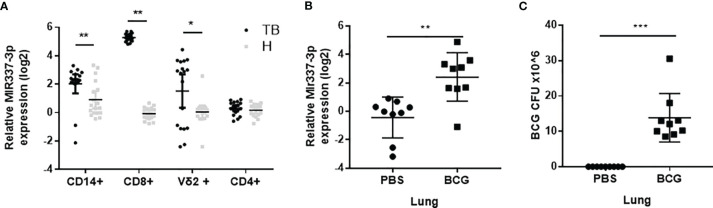
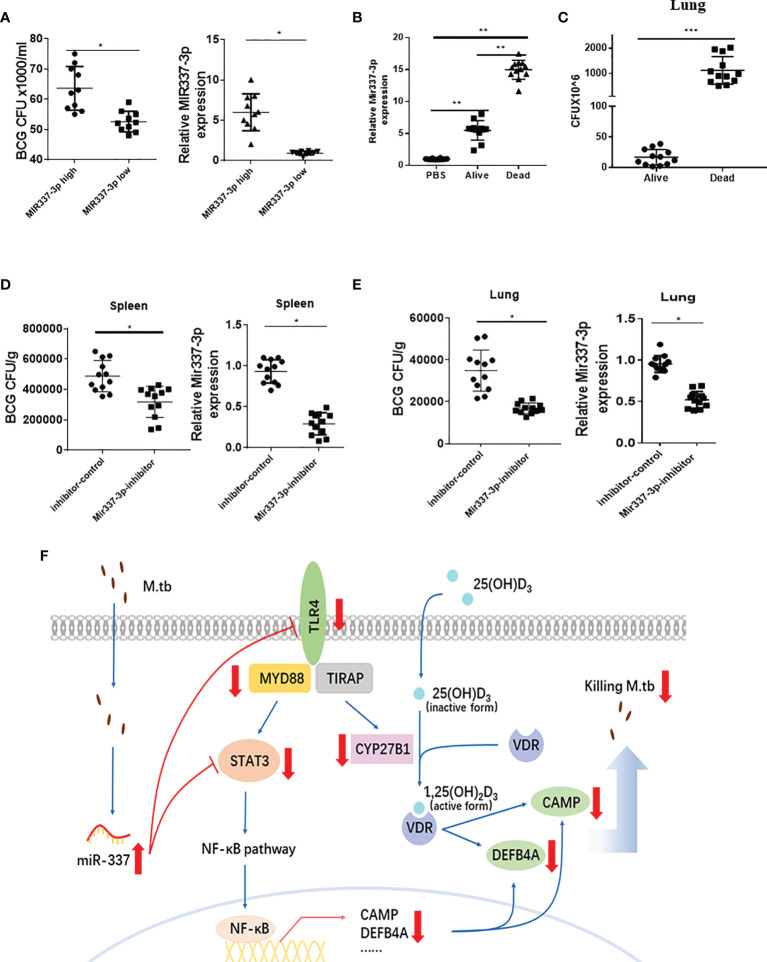
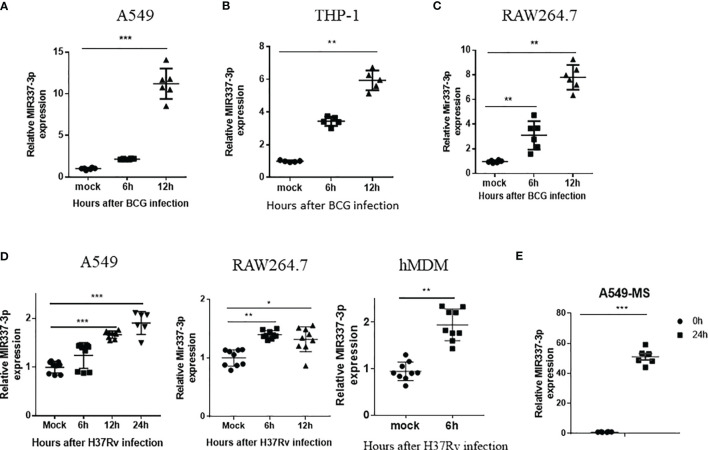
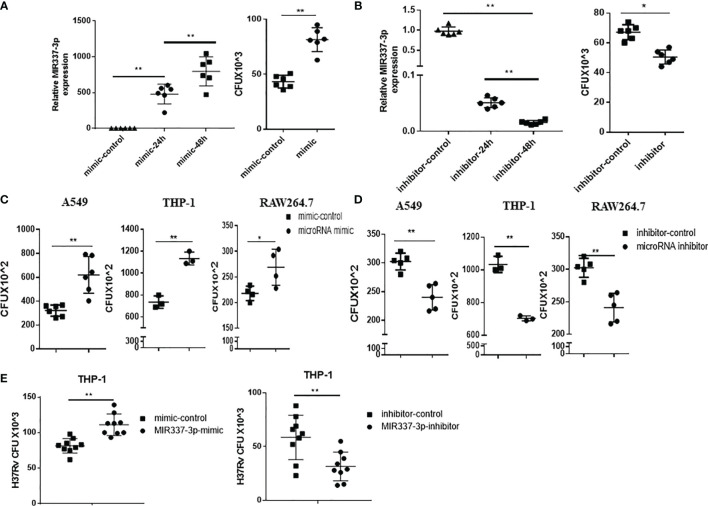
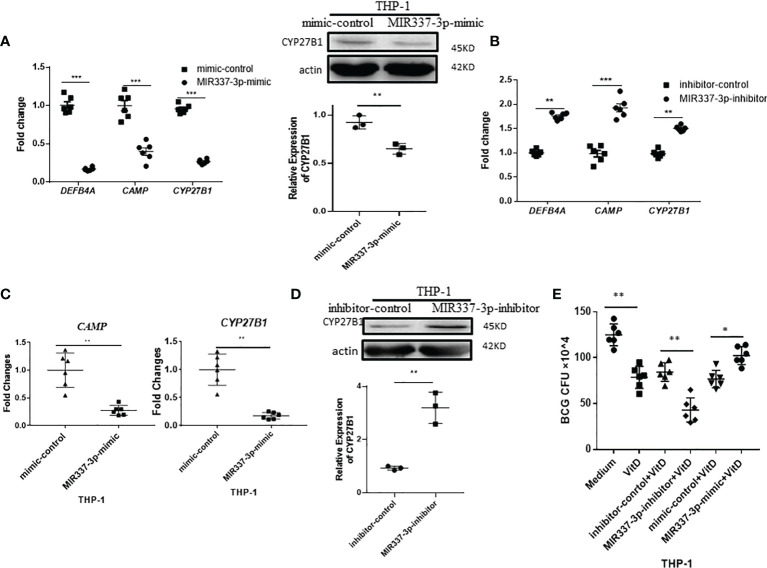
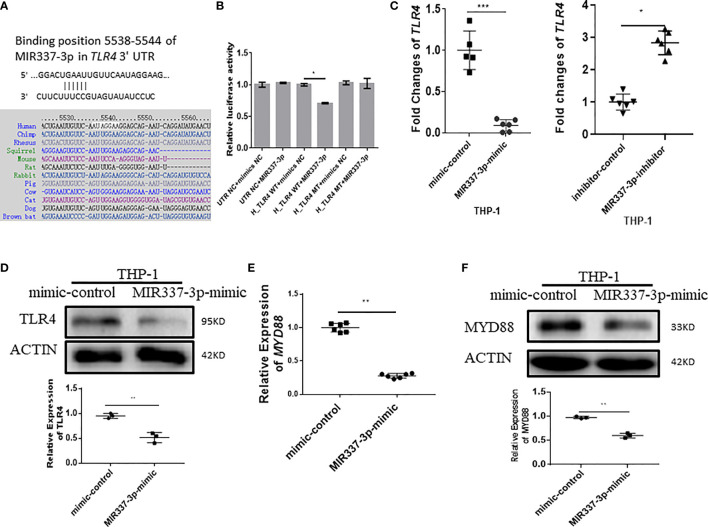
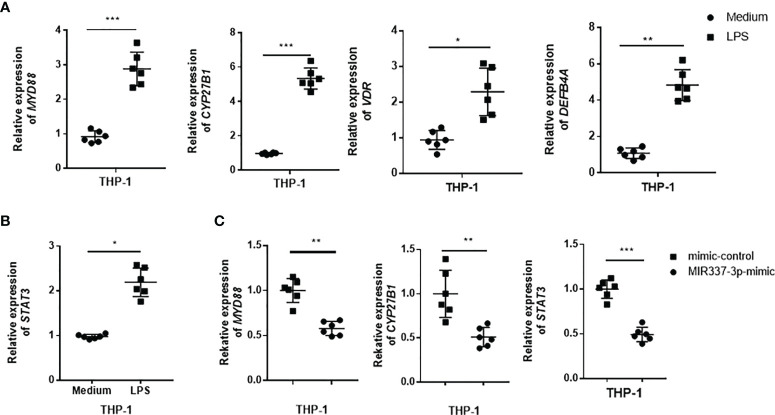
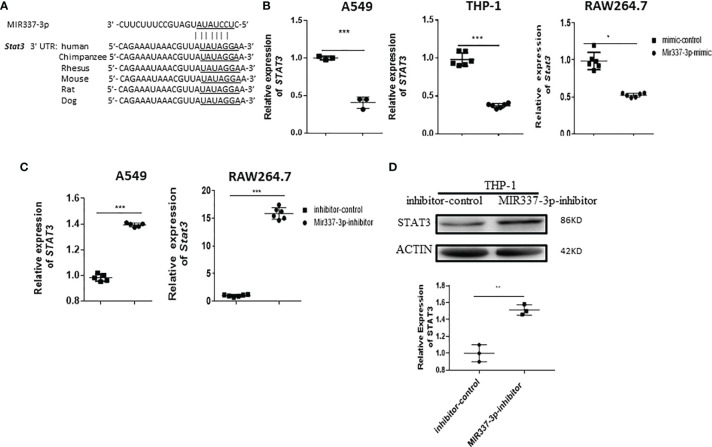
Active form of vitamin D (VitD) enhances human innate immunity against () infection. Our previous studies showed that MIR337-3p was highly expressed in lymphocytes of tuberculosis (TB) patients. Here, we identified the mechanism of MIR337-3p in the regulation of fast-acting anti-TB immunity by inhibiting VitD-dependent antimicrobial response pathways. While high-level MIR337-3p expression was induced by mycobacterial infection in cellular models and mice, TB patients exhibited significantly increased MIR337-3p in CD14 monocytes/macrophages, innate-like Vγ2 T cells, and CD8 lymphocytes containing natural killer (NK)/innate lymphoid cells. MIR337-3p promoted the mycobacterial entry/infection and replication/growth in host target cells: macrophages and lung epithelial cells. Such MIR337-3p-enhanced pathogenicity coincided with the MIR337-3p depression of VitD-dependent antimicrobial response of cytochrome P450, family 27, subfamily b, polypeptide 1 (CYP27B1)/Beta-defensin 4 (DEFB4A)/ cathelicidin antimicrobial peptide CAMP pathways. Surprisingly, single MIR337-3p species could specifically target both the () and () 3'-untranslated regions (UTRs) to depress the TLR4/MYD88 and STAT3 signals and impair either of the two signals inhibiting the VitD-dependent antimicrobial pathways in macrophages. Concurrently, human peripheral blood mononuclear cells (PBMCs) expressing high-level MIR337-3p exhibited a reduced ability of innate cell populations to mount fast-acting cellular immunity against intracellular mycobacterial infection. Furthermore, a higher expression of Mir337-3p after mycobacterial infection of mice coincided with much greater colony-forming unit (CFU) counts in lungs and even the death of infected animals, whereas Mir337-3p inhibitor treatment of infected mice reduced Mir337-3p levels and reversed Mir337-3p-mediated increases in CFU counts. Thus, TB-driven single MIR337-3p species could specifically target/impair both TLR4/MYD88 and STAT3 activation signals, inhibiting VitD-dependent antimicrobial response and fast-acting anti-TB immunity, leading to enhanced pathogenicity.
活性维生素 D(VitD)可增强人体对 ()感染的先天免疫。我们之前的研究表明,MIR337-3p 在结核分枝杆菌(TB)患者的淋巴细胞中高度表达。在这里,我们通过抑制 VitD 依赖性抗菌反应途径,确定了 MIR337-3p 在调节快速抗结核免疫中的机制。虽然在细胞模型和小鼠中,分枝杆菌感染会诱导高水平的 MIR337-3p 表达,但 TB 患者在 CD14 单核细胞/巨噬细胞、先天样 Vγ2 T 细胞和含有自然杀伤(NK)/固有淋巴细胞的 CD8 淋巴细胞中,MIR337-3p 表达显著增加。MIR337-3p 促进了宿主靶细胞(巨噬细胞和肺上皮细胞)中的分枝杆菌进入/感染以及复制/生长。这种 MIR337-3p 增强的致病性与 MIR337-3p 抑制 VitD 依赖性细胞色素 P450、家族 27、亚家族 b、多肽 1(CYP27B1)/β-防御素 4(DEFB4A)/抗菌肽 CAMP 途径的抗菌反应一致。令人惊讶的是,单一的 MIR337-3p 物种可以特异性地靶向 ()和 ()3'-非翻译区(UTR),以抑制 TLR4/MYD88 和 STAT3 信号,并抑制巨噬细胞中两种信号之一,从而抑制 VitD 依赖性抗菌途径。同时,高表达 MIR337-3p 的人外周血单核细胞(PBMC)表现出先天细胞群对细胞内分枝杆菌感染产生快速细胞免疫的能力降低。此外,在小鼠分枝杆菌感染后,MIR337-3p 的高表达与肺部的菌落形成单位(CFU)计数增加甚至感染动物的死亡有关,而 MIR337-3p 抑制剂处理感染小鼠可降低 MIR337-3p 水平并逆转 MIR337-3p 介导的 CFU 计数增加。因此,TB 驱动的单一 MIR337-3p 物种可以特异性地靶向/抑制 TLR4/MYD88 和 STAT3 激活信号,抑制 VitD 依赖性抗菌反应和快速抗结核免疫,从而导致致病性增强。