Department of Neurosurgery, Yongin Severance Hospital, Yonsei University School of Medicine, Yongin, Korea.
Department of Neurosurgery, International St. Mary's Hospital, Catholic Kwandong University College of Medicine, Incheon, Korea.
Yonsei Med J. 2022 Jan;63(1):72-81. doi: 10.3349/ymj.2022.63.1.72.
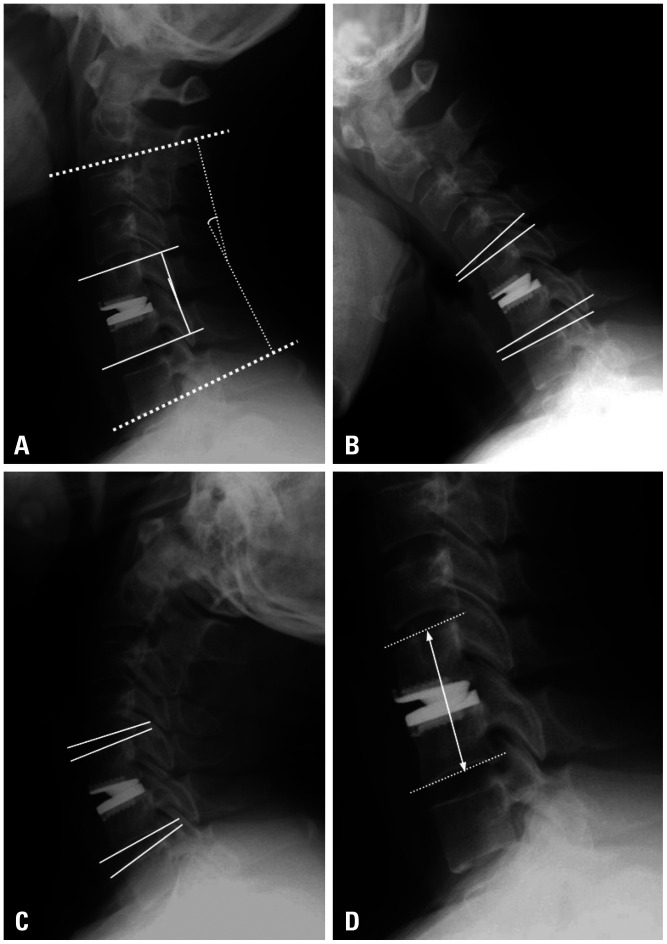
The purpose of this retrospective study was to evaluate radiological and clinical outcomes in patients undergoing cervical disc arthroplasty (CDA) for cervical degenerative disc disease. The results may assist in surgical decision-making and enable more effective and safer implementation of cervical arthroplasty.
A total of 125 patients who were treated with CDA between 2006 and 2019 were assessed. Radiological measurements and clinical outcomes included the visual analogue scale (VAS), the Neck Disability Index (NDI), and the Japanese Orthopaedic Association (JOA) myelopathy score assessment preoperatively and at ≥2 years of follow-up.
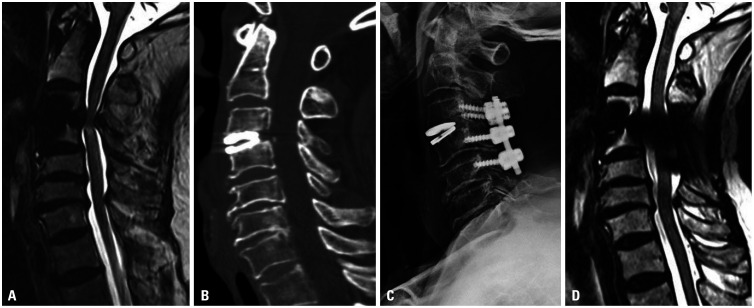
The mean follow-up period was 38 months (range, 25-114 months). Radiographic data demonstrated mobility at both the index and adjacent levels, with no signs of hypermobility at an adjacent level. There was a non-significant loss of cervical global motion and range of motion (ROM) of the functional spinal unit at the operated level, as well as the upper and lower adjacent disc levels, compared to preoperative status. The cervical global and segmental angle significantly increased. Postoperative neck VAS, NDI, and JOA scores showed meaningful improvements after one- and two-level CDA. We experienced a 29.60% incidence of heterotrophic ossification and a 3.20% reoperation rate due to cervical instability, implant subsidence, or osteolysis.
CDA is an effective surgical technique for optimizing clinical outcomes and radiological results. In particular, the preservation of cervical ROM with an artificial prosthesis at adjacent and index levels and improvement in cervical global alignment could reduce revision rates due to adjacent segment degeneration.
本回顾性研究旨在评估颈椎间盘置换术(CDA)治疗颈椎退行性疾病患者的影像学和临床结果。这些结果可能有助于手术决策,并使颈椎置换术的实施更加有效和安全。
评估了 2006 年至 2019 年间接受 CDA 治疗的 125 例患者。影像学测量和临床结果包括术前和至少 2 年随访时的视觉模拟评分(VAS)、颈部残疾指数(NDI)和日本矫形协会(JOA)脊髓病评分评估。
平均随访时间为 38 个月(范围 25-114 个月)。影像学资料显示指数节段和相邻节段的活动度,相邻节段无过度活动迹象。与术前相比,手术节段和上下相邻椎间盘水平的颈椎整体活动度和运动范围(ROM)均有非显著丢失。颈椎整体和节段角度显著增加。术后颈部 VAS、NDI 和 JOA 评分在单节段和双节段 CDA 后均有显著改善。我们经历了 29.60%的异位骨化发生率和 3.20%的因颈椎不稳、植入物下沉或骨溶解而再次手术的发生率。
CDA 是优化临床和影像学结果的有效手术技术。特别是在邻近和指数节段用人工假体保留颈椎 ROM 以及改善颈椎整体排列,可以降低因邻近节段退变而导致的翻修率。