
脊髓病对颈椎间盘置换术后早期临床改善的影响:一项本地患者队列和一个大型全国队列的研究。
Effect of Myelopathy on Early Clinical Improvement After Cervical Disc Replacement: A Study of a Local Patient Cohort and a Large National Cohort.
作者信息
Samuel Andre M, Moore Harold G, Vaishnav Avani S, McAnany Steven, Albert Todd, Iyer Sravisht, Katsuura Yoshihiro, Gang Catherine Himo, Qureshi Sheeraz A
机构信息
Hospital for Special Surgery, New York, NY, USA.
Weill Cornell Medical College, New York, NY, USA.
出版信息
Neurospine. 2019 Sep;16(3):563-573. doi: 10.14245/ns.1938220.110. Epub 2019 Sep 30.
OBJECTIVE
Cervical disc replacement (CDR) is an effective long-term treatment for both cervical radiculopathy and myelopathy. However, there may be unique differences in the early postoperative clinical improvement for patients with and without myelopathy. In addition, previous studies using CDR to treat cervical myelopathy were underpowered to determine risk factors for relatively postoperative medical complications.
METHODS
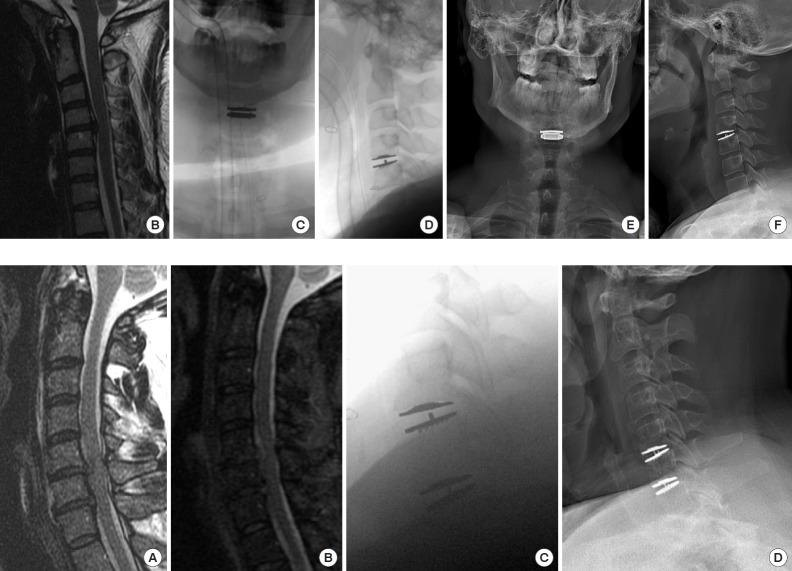
Two different cohorts were studied. A local cohort of patients undergoing CDR by a single surgeon was utilized to study the early postoperative course of clinical improvement. In addition, a national cohort of patients undergoing CDR in the 2015 and 2016 National Surgical Quality Improvement Program database was utilized to study differences in postoperative medical complications after CDR. Patients with a preoperative diagnosis of cervical myelopathy were identified in both cohorts, and perioperative outcomes and complications were compared to patients without myelopathy.
RESULTS
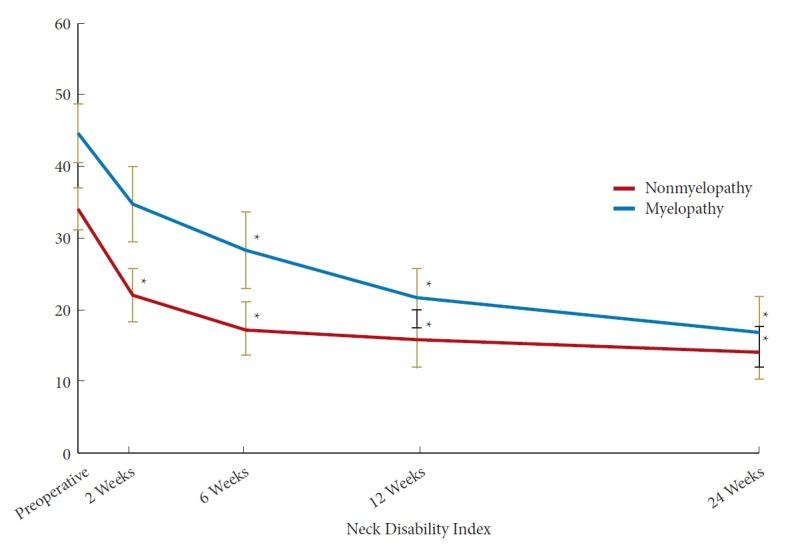
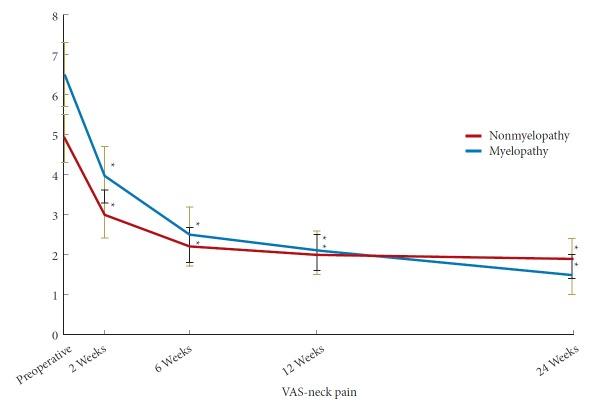
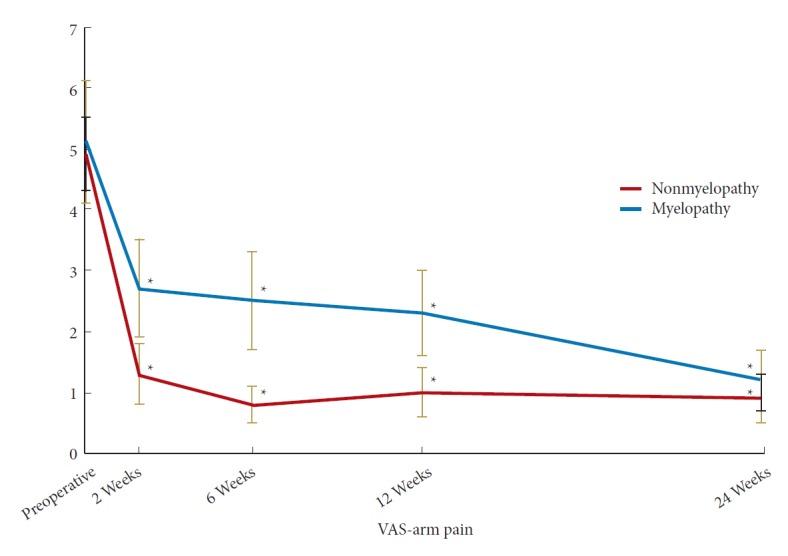
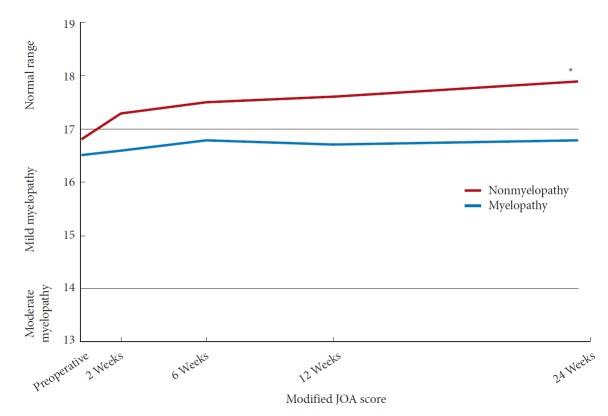
A total of 43 patients undergoing CDR were included in the institutional cohort, of those 16 patients (37% of cohort) had a preoperative diagnosis of cervical myelopathy. A total of 3,023 patients undergoing CDR were included in the national cohort, of those 411 (13% of cohort) had a preoperative diagnosis of cervical myelopathy. In the institutional cohort, the nonmyelopathy group had a lower initial Neck Disability Index (NDI) and saw a faster improvement in NDI by 2 weeks postoperative. However, at 24 weeks there was no significant difference between groups in terms of NDI. Interestingly, only the nonmyelopathy cohort had a significant improvement in modified Japanese Orthopaedic Association score by 6 weeks (p<0.05). In the national cohort, myelopathy was associated with longer operative time and length of stay (p<0.05). However, there was no significant difference in perioperative complications (p>0.05) between myelopathy and nonmyelopathy patients.
CONCLUSION
Significant improvements in NDI, visual analogue scale (VAS)-arm pain, and VAS-neck pain are seen in both myelopathy and nonmyelopathy populations undergoing CDR by 6 weeks postoperatively. However, nonmyelopathy populations improve faster by 2 weeks postoperatively. In the national cohort analysis, medical complications were similarly low in both myelopathy and nonmyelopathy groups.
目的
颈椎间盘置换术(CDR)是治疗神经根型颈椎病和脊髓型颈椎病的一种有效的长期治疗方法。然而,有脊髓病变和无脊髓病变患者术后早期临床改善情况可能存在独特差异。此外,以往使用CDR治疗脊髓型颈椎病的研究在确定术后相对医疗并发症的危险因素方面能力不足。
方法
研究了两个不同的队列。利用由一名外科医生进行CDR手术的当地患者队列来研究术后早期临床改善过程。此外,利用2015年和2016年国家外科质量改进计划数据库中接受CDR手术的全国患者队列来研究CDR术后医疗并发症的差异。在两个队列中均确定了术前诊断为脊髓型颈椎病的患者,并将围手术期结果和并发症与无脊髓病变的患者进行比较。
结果
机构队列中共有43例接受CDR手术的患者,其中16例(占队列的37%)术前诊断为脊髓型颈椎病。全国队列中共有3023例接受CDR手术的患者,其中411例(占队列的13%)术前诊断为脊髓型颈椎病。在机构队列中,无脊髓病变组的初始颈部残疾指数(NDI)较低,术后2周NDI改善更快。然而,在术后24周时,两组在NDI方面无显著差异。有趣的是,只有无脊髓病变队列在术后6周时改良日本骨科协会评分有显著改善(p<0.05)。在全国队列中,脊髓病变与手术时间延长和住院时间延长相关(p<0.05)。然而,脊髓病变患者和无脊髓病变患者在围手术期并发症方面无显著差异(p>0.05)。
结论
接受CDR手术的脊髓型颈椎病患者和无脊髓病变患者在术后6周时,NDI、视觉模拟量表(VAS)上肢疼痛和VAS颈部疼痛均有显著改善。然而,无脊髓病变患者在术后2周时改善更快。在全国队列分析中,脊髓型颈椎病组和无脊髓病变组的医疗并发症同样较低。
 Zotero 插件