School of Sciences, University of Southern Queensland, Toowoomba, Australia.
School of Business, University of Southern Queensland, Toowoomba, Australia.
PLoS One. 2021 Dec 16;16(12):e0261131. doi: 10.1371/journal.pone.0261131. eCollection 2021.
Mental health problems, such as depression in children have far-reaching negative effects on child, family and society as whole. It is necessary to identify the reasons that contribute to this mental illness. Detecting the appropriate signs to anticipate mental illness as depression in children and adolescents is vital in making an early and accurate diagnosis to avoid severe consequences in the future. There has been no research employing machine learning (ML) approaches for depression detection among children and adolescents aged 4-17 years in a precisely constructed high prediction dataset, such as Young Minds Matter (YMM). As a result, our objective is to 1) create a model that can predict depression in children and adolescents aged 4-17 years old, 2) evaluate the results of ML algorithms to determine which one outperforms the others and 3) associate with the related issues of family activities and socioeconomic difficulties that contribute to depression.
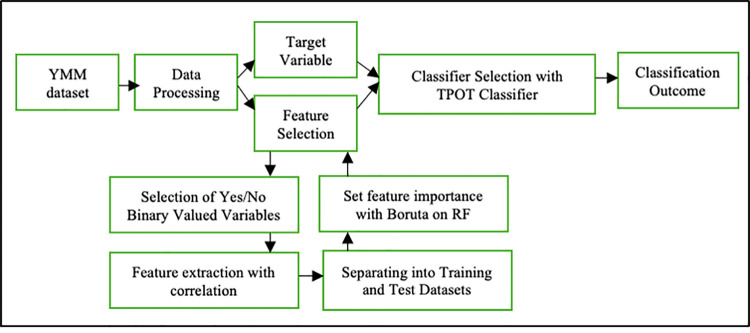
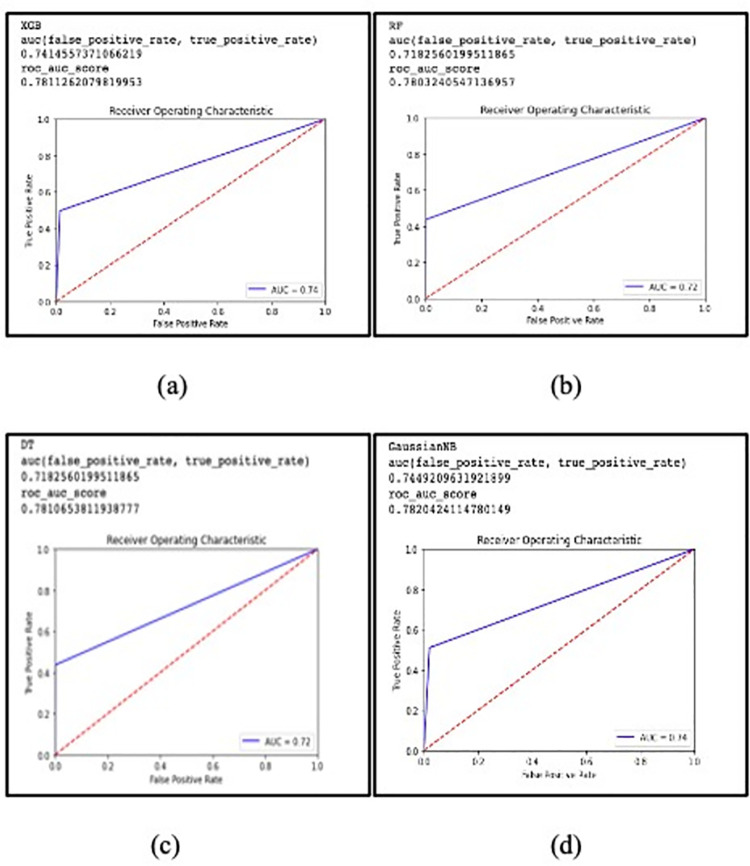
The YMM, the second Australian Child and Adolescent Survey of Mental Health and Wellbeing 2013-14 has been used as data source in this research. The variables of yes/no value of low correlation with the target variable (depression status) have been eliminated. The Boruta algorithm has been utilized in association with a Random Forest (RF) classifier to extract the most important features for depression detection among the high correlated variables with target variable. The Tree-based Pipeline Optimization Tool (TPOTclassifier) has been used to choose suitable supervised learning models. In the depression detection step, RF, XGBoost (XGB), Decision Tree (DT), and Gaussian Naive Bayes (GaussianNB) have been used.
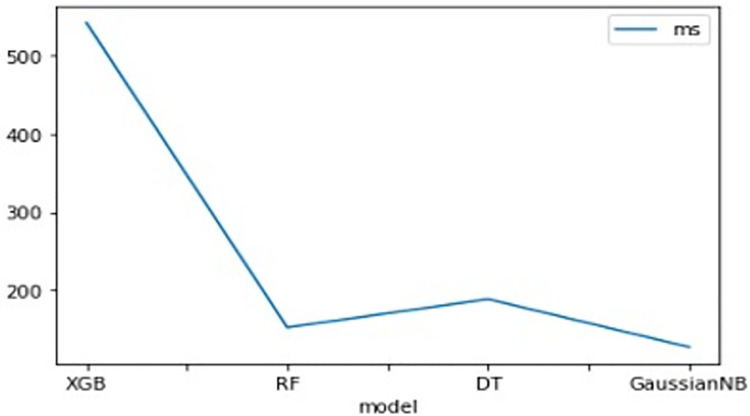
Unhappy, nothing fun, irritable mood, diminished interest, weight loss/gain, insomnia or hypersomnia, psychomotor agitation or retardation, fatigue, thinking or concentration problems or indecisiveness, suicide attempt or plan, presence of any of these five symptoms have been identified as 11 important features to detect depression among children and adolescents. Although model performance varied somewhat, RF outperformed all other algorithms in predicting depressed classes by 99% with 95% accuracy rate and 99% precision rate in 315 milliseconds (ms).
This RF-based prediction model is more accurate and informative in predicting child and adolescent depression that outperforms in all four confusion matrix performance measures as well as execution duration.
儿童心理健康问题,如抑郁症,对儿童、家庭和整个社会都有深远的负面影响。有必要找出导致这种精神疾病的原因。发现适当的迹象来预测儿童和青少年的抑郁症,对于做出早期和准确的诊断,避免未来的严重后果至关重要。在 Young Minds Matter (YMM) 等精心构建的高预测数据集中,尚未有研究采用机器学习 (ML) 方法来检测儿童和青少年的抑郁症。因此,我们的目标是 1) 创建一个可以预测 4-17 岁儿童和青少年抑郁症的模型,2) 评估 ML 算法的结果,以确定哪种算法表现更好,3) 并与导致抑郁的家庭活动和社会经济困难等相关问题相关联。
本研究使用 Young Minds Matter (YMM),即 2013-14 年澳大利亚儿童和青少年心理健康和幸福感第二次调查的数据作为数据源。已经消除了与目标变量(抑郁状况)相关性低的 yes/no 值变量。使用 Boruta 算法与随机森林 (RF) 分类器结合,从与目标变量高度相关的变量中提取用于检测抑郁的最重要特征。使用基于树的管道优化工具 (TPOTclassifier) 选择合适的监督学习模型。在抑郁检测步骤中,使用 RF、XGBoost (XGB)、决策树 (DT) 和高斯朴素贝叶斯 (GaussianNB)。
不开心、没乐趣、烦躁、兴趣减退、体重增减、失眠或嗜睡、精神运动兴奋或迟滞、疲劳、思维或注意力问题或优柔寡断、自杀企图或计划、出现这些五个症状中的任何一个,都被确定为 11 个重要特征,用于检测儿童和青少年的抑郁症。尽管模型性能有所不同,但 RF 在预测抑郁类别方面的表现优于其他所有算法,在 315 毫秒内准确率为 99%,准确率为 95%,精度为 99%。
与其他所有算法相比,基于 RF 的预测模型在预测儿童和青少年抑郁症方面更加准确和信息丰富,在所有四个混淆矩阵性能指标以及执行时间方面都表现出色。