Loy See Ling, Chan Daniel Wei Keong, Ku Chee Wai, Cheung Yin Bun, Godfrey Keith M, Tan Karen Mei Ling, Chong Yap-Seng, Shek Lynette Pei-Chi, Tan Kok Hian, Chan Shiao-Yng, Chan Jerry Kok Yen, Yap Fabian
Department of Reproductive Medicine, KK Women's and Children's Hospital, Singapore, Singapore; Duke-NUS Medical School, Singapore, Singapore.
Department of Pediatrics, KK Women's and Children's Hospital, Singapore, Singapore.
Am J Obstet Gynecol. 2022 May;226(5):714.e1-714.e16. doi: 10.1016/j.ajog.2021.11.1374. Epub 2021 Dec 16.
Obesity compromises metabolic health and female fertility, yet not all obese women are similar in metabolic status. The extent to which fecundability is influenced by the metabolic health status of women who are overweight or obese before conception is unknown.
This study aimed to: (1) determine the metabolic health status, and (2) examine the association between metabolic health status and fecundability of overweight and obese women trying to conceive in the Singapore PREconception Study of long-Term maternal and child Outcomes cohort study.
We conducted a prospective preconception cohort study of Asian women (Chinese, Malay, and Indian) aged 18 to 45 years trying to conceive who were treated from 2015 to 2017 in KK Women's and Children's Hospital in Singapore (n=834). We defined women to have metabolically unhealthy status if they: (1) met 3 or more modified Joint Interim Statement metabolic syndrome criteria; or (2) had homeostasis model assessment-insulin resistance index ≥2.5. Body mass index was categorized as normal (18.5-22.9 kg/m), overweight (23-27.4 kg/m), or obese (≥27.5 kg/m) on the basis of cutoff points for Asian populations. Fecundability was measured by time to pregnancy in menstrual cycles within a year of enrolment. Discrete-time proportional hazards models were used to estimate fecundability odds ratios, with adjustment for confounders and accounting for left truncation and right censoring.
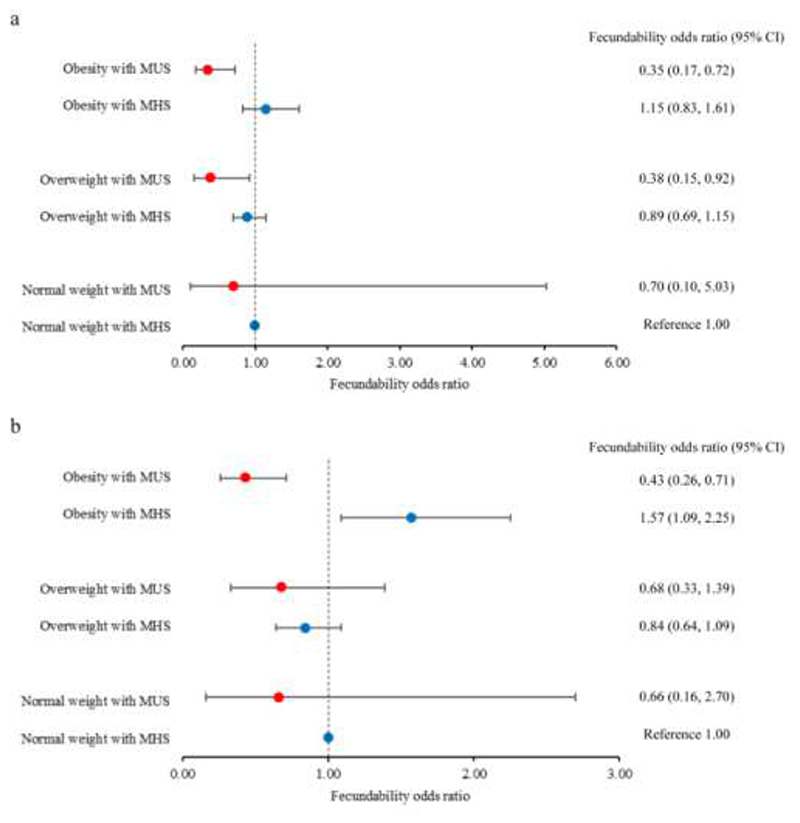
Of 232 overweight women, 28 (12.1%) and 25 (10.8%) were metabolically unhealthy by metabolic syndrome ≥3 criteria and homeostasis model assessment-insulin resistance ≥2.5, respectively. Of 175 obese women, 54 (30.9%) and 93 (53.1%) were metabolically unhealthy by metabolic syndrome ≥3 criteria and homeostasis model assessment-insulin resistance ≥2.5, respectively. Compared with metabolically healthy normal-weight women, lower fecundability was observed in metabolically unhealthy overweight women on the basis of metabolic syndrome criteria (fecundability odds ratios, 0.38 [95% confidence interval, 0.15-0.92]) and homeostasis model assessment-insulin resistance (fecundability odds ratios, 0.68 [95% confidence interval, 0.33-1.39]), with metabolic syndrome criteria showing a stronger association. Metabolically unhealthy obese women showed lower fecundability than the healthy normal-weight reference group by both metabolic syndrome (fecundability odds ratios, 0.35; 95% confidence interval, 0.17-0.72) and homeostasis model assessment-insulin resistance criteria (fecundability odds ratios, 0.43; 95% confidence interval, 0.26-0.71). Reduced fecundability was not observed in overweight or obese women who showed healthy metabolic profiles by either definition.
Overweight or obesity was not synonymous with having metabolic syndrome or insulin resistance. In our preconception cohort, metabolically unhealthy overweight and obese women showed reduced fecundability, unlike their counterparts who were metabolically healthy. These findings suggest that metabolic health status, rather than simply being overweight and obese per se, plays an important role in fecundability.
肥胖会损害代谢健康和女性生育能力,但并非所有肥胖女性的代谢状况都相似。孕前超重或肥胖女性的代谢健康状况对受孕能力的影响程度尚不清楚。
本研究旨在:(1)确定代谢健康状况,以及(2)在新加坡母婴长期结局队列研究的孕前研究中,检验超重和肥胖且正在尝试受孕的女性的代谢健康状况与受孕能力之间的关联。
我们对2015年至2017年在新加坡KK妇女儿童医院接受治疗的18至45岁、正在尝试受孕的亚洲女性(华裔、马来裔和印度裔)进行了一项前瞻性孕前队列研究(n = 834)。如果女性符合以下条件,我们将其定义为代谢不健康状态:(1)符合3项或更多项修改后的联合临时声明代谢综合征标准;或(2)稳态模型评估-胰岛素抵抗指数≥2.5。根据亚洲人群的切点,体重指数被分类为正常(18.5 - 22.9 kg/m²)、超重(23 - 27.4 kg/m²)或肥胖(≥27.5 kg/m²)。受孕能力通过入组后一年内月经周期的受孕时间来衡量。使用离散时间比例风险模型来估计受孕能力优势比,并对混杂因素进行调整,同时考虑左截断和右删失。
在232名超重女性中,分别有28名(12.1%)和25名(10.8%)根据代谢综合征≥3项标准和稳态模型评估-胰岛素抵抗≥2.5被判定为代谢不健康。在175名肥胖女性中,分别有54名(30.9%)和93名(53.1%)根据代谢综合征≥3项标准和稳态模型评估-胰岛素抵抗≥2.5被判定为代谢不健康。与代谢健康的正常体重女性相比,根据代谢综合征标准(受孕能力优势比,0.38 [95%置信区间,0.15 - 0.92])和稳态模型评估-胰岛素抵抗(受孕能力优势比,0.68 [95%置信区间,0.33 - 1.39]),代谢不健康的超重女性受孕能力较低,其中代谢综合征标准显示出更强的关联。根据代谢综合征(受孕能力优势比,0.35;95%置信区间,0.17 - 0.72)和稳态模型评估-胰岛素抵抗标准(受孕能力优势比,0.43;95%置信区间,0.26 - 0.71),代谢不健康的肥胖女性受孕能力均低于健康的正常体重参照组。无论依据哪种定义,代谢健康的超重或肥胖女性均未观察到受孕能力降低。
超重或肥胖并非代谢综合征或胰岛素抵抗的同义词。在我们的孕前队列中,代谢不健康的超重和肥胖女性受孕能力降低,而代谢健康的女性则不然。这些发现表明,代谢健康状况而非单纯的超重和肥胖本身,在受孕能力中起着重要作用。