Yang Fan, Weng Xin, Miao Yuehong, Wu Yuhui, Xie Hong, Lei Pinggui
School of Biology and Engineering, Guizhou Medical University, Guiyang, Guizhou Province, China.
Key Laboratory of Biology and Medical Engineering, Guizhou Medical University, Guiyang, Guizhou Province, China.
Insights Imaging. 2021 Dec 20;12(1):191. doi: 10.1186/s13244-021-01137-9.
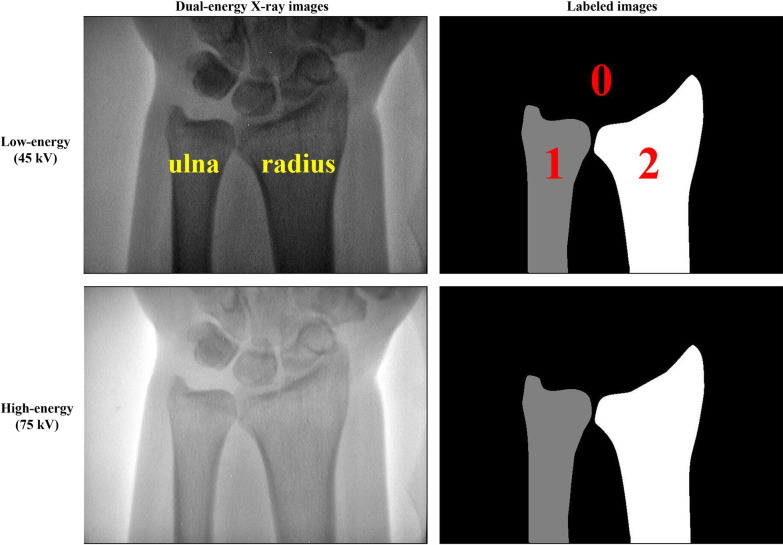
Segmentation of the ulna and radius is a crucial step for the measurement of bone mineral density (BMD) in dual-energy X-ray imaging in patients suspected of having osteoporosis.
This work aimed to propose a deep learning approach for the accurate automatic segmentation of the ulna and radius in dual-energy X-ray imaging.
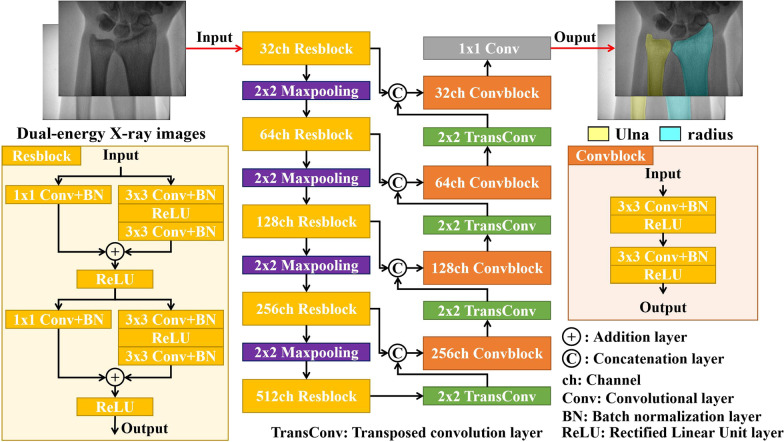
We developed a deep learning model with residual block (Resblock) for the segmentation of the ulna and radius. Three hundred and sixty subjects were included in the study, and five-fold cross-validation was used to evaluate the performance of the proposed network. The Dice coefficient and Jaccard index were calculated to evaluate the results of segmentation in this study.
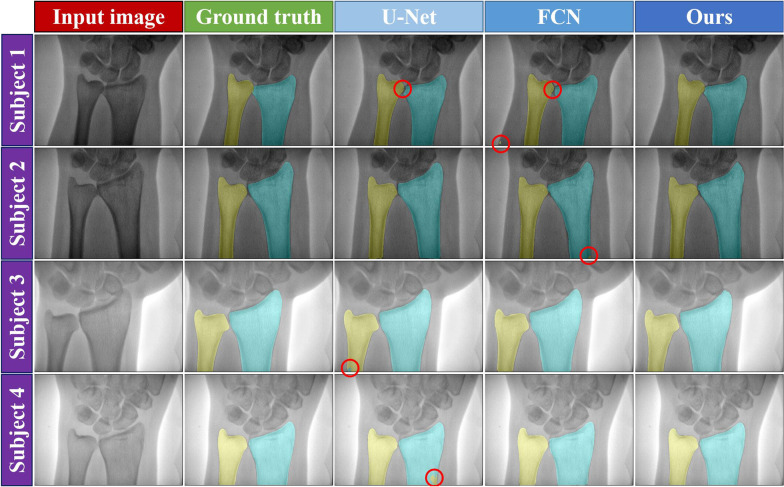
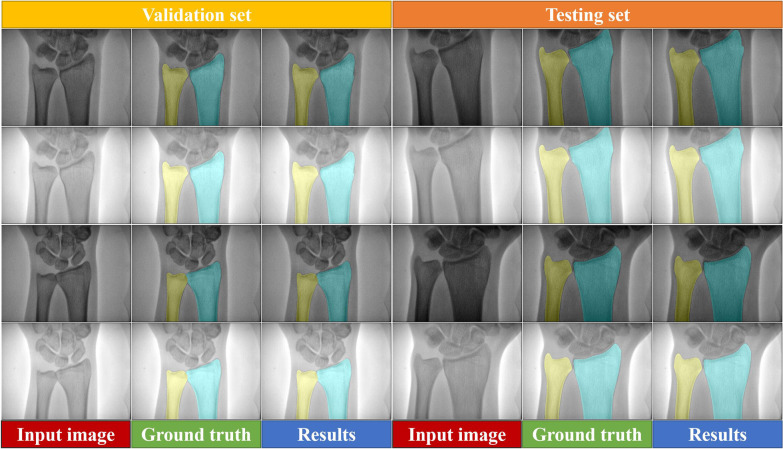
The proposed network model had a better segmentation performance than the previous deep learning-based methods with respect to the automatic segmentation of the ulna and radius. The evaluation results suggested that the average Dice coefficients of the ulna and radius were 0.9835 and 0.9874, with average Jaccard indexes of 0.9680 and 0.9751, respectively.
The deep learning-based method developed in this study improved the segmentation performance of the ulna and radius in dual-energy X-ray imaging.
对于疑似患有骨质疏松症的患者,在双能X线成像中对尺骨和桡骨进行分割是测量骨密度(BMD)的关键步骤。
本研究旨在提出一种深度学习方法,用于在双能X线成像中准确自动分割尺骨和桡骨。
我们开发了一种带有残差块(Resblock)的深度学习模型用于尺骨和桡骨的分割。本研究纳入了360名受试者,并采用五折交叉验证来评估所提网络的性能。计算Dice系数和Jaccard指数以评估本研究中的分割结果。
在所提网络模型对尺骨和桡骨的自动分割方面,其分割性能优于先前基于深度学习的方法。评估结果表明,尺骨和桡骨的平均Dice系数分别为0.9835和0.9874,平均Jaccard指数分别为0.9680和0.9751。
本研究中开发的基于深度学习的方法提高了双能X线成像中尺骨和桡骨的分割性能。