Australian Centre for Health Engagement Evidence and Values (ACHEEV), University of Wollongong, Wollongong, NSW, Australia.
Allied Health Services, Gold Coast University Hospital, Southport, QLD, Australia.
BMC Geriatr. 2021 Dec 20;21(1):729. doi: 10.1186/s12877-021-02680-2.
Overtreatment in advanced age i.e. aggressive interventions that do not improve survival and are potentially harmful, can impair quality of care near the end of life (EOL). As healthcare provider perspectives on care quality may differ from that of service users, the aim of this study was to explore the views of older patients near EOL or their caregivers about the quality of health care at the EOL based on their lived experience, and to identify healthcare service improvements.
Medline and backward citation searches were conducted for qualitative or quantitative studies reported on the views of patients and/or informal caregivers about EOL care quality. Thematic analysis was used to summarise qualitative data (primary analysis); narrative and tabulations were used to summarise quantitative data (secondary analysis).
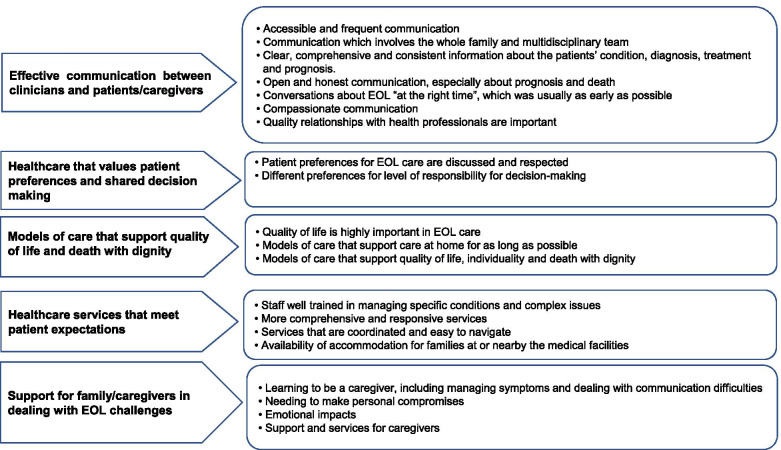
Thirty articles met the inclusion criteria. Five main qualitative themes regarding quality care emerged: (1) Effective communication between clinicians and patients/caregivers; (2) Healthcare that values patient preferences and shared decision making; (3) Models of care that support quality of life and death with dignity; (4) Healthcare services that meet patient expectations; and (5) Support for informal caregivers in dealing with EOL challenges. The quantitative articles supported various aspects of the thematic framework.
The findings of this study show that many of the issues highlighted by patients or bereaved relatives have persisted over the past two decades. There is an urgent need for comprehensive evaluation of care across the healthcare system and targeted redesign of existing EOL care pathways to ensure that care aligns with what patients and informal caregivers consider high-quality patient-centred care at the EOL.
过度治疗是指在高龄患者中进行的激进干预,这些干预并不能改善生存状况,而且可能有害,这会损害生命末期(EOL)的护理质量。由于医疗保健提供者对护理质量的看法可能与服务使用者不同,因此本研究旨在根据老年患者或其照顾者的生活体验,探讨他们对 EOL 护理质量的看法,并确定医疗保健服务的改进方向。
对定性或定量研究进行了 Medline 和回溯引文检索,这些研究报告了患者和/或非正式照顾者对 EOL 护理质量的看法。使用主题分析对定性数据进行总结(主要分析);使用叙述和表格对定量数据进行总结(次要分析)。
符合纳入标准的文章有 30 篇。有 5 个关于优质护理的主要定性主题:(1)临床医生与患者/照顾者之间的有效沟通;(2)重视患者偏好和共同决策的医疗保健;(3)支持生活质量和有尊严死亡的护理模式;(4)满足患者期望的医疗服务;(5)支持非正式照顾者应对 EOL 挑战。定量文章支持主题框架的各个方面。
本研究的结果表明,过去二十年来,患者或失去亲人的亲属强调的许多问题仍然存在。迫切需要对整个医疗体系的护理进行全面评估,并针对性地重新设计现有的 EOL 护理途径,以确保护理符合患者和非正式照顾者在 EOL 时认为的高质量以患者为中心的护理。