Department of Infectious Disease, Great Ormond Street Hospital for Children, London, WC1N 3JH, UK.
Department of Infectious Disease, Diresa Callao Jr, Colina #879, Bellavista, 07016, Lima, Peru.
BMC Infect Dis. 2021 Dec 20;21(1):1265. doi: 10.1186/s12879-021-06944-5.
The Tuberculosis (TB) burden in Peru is significant with respect to both disease morbidity and mortality. Furthermore the recent diversification of farming enterprise to include a wide range of animal species has necessitated the consideration of members of the Mycobacterium Tuberculosis Complex (MTBC) with the potential for zoonotic transmission. M. bovis and M. caprae, a lesser known member of the MTBC exhibit an exceptionally wide host spectrum in animals and are capable of causing disease in humans. M. bovis has a predictable resistance profile which includes resistance to pyrazinamide. Thus, failure to identify M. bovis as the causative agent in reported TB cases leads to higher levels of treatment failure and contributes to the transmission of drug-resistant TB.
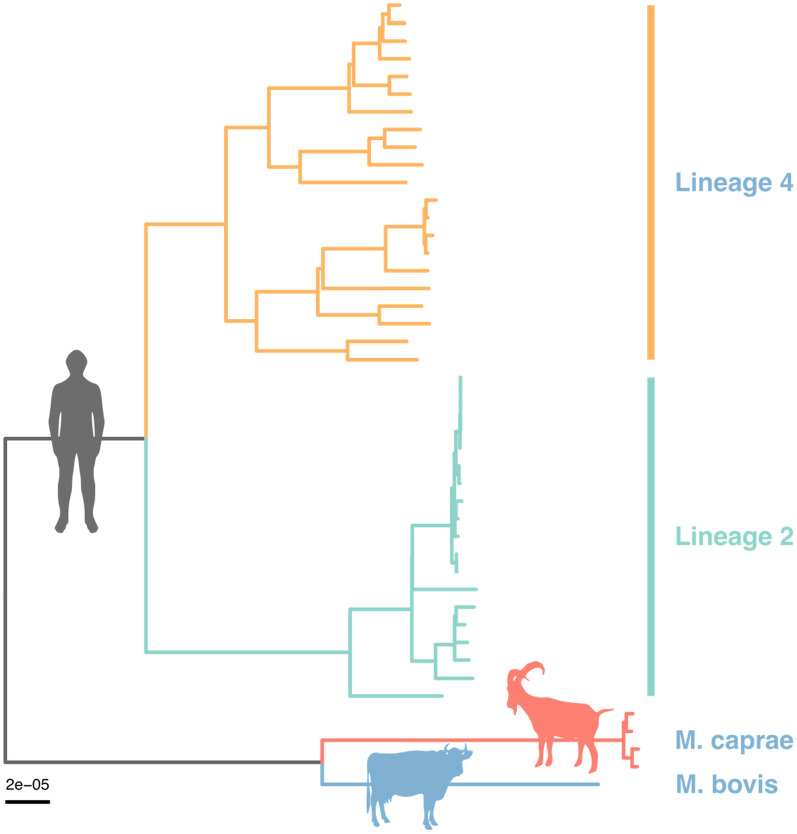
Reported here are the clinical presentations, investigations and treatment histories of two patients identified from a population level genotyping study in Lima, Peru that were at the time of treatment thought to be M. tuberculosis patients but in retrospect were spectated using whole genome sequencing as M. caprae and M. Bovis.
The cases reported here constitute convincing evidence that M. caprae and M. bovis are causative agents of TB infection in humans in Peru and underscore the importance of species-level MTBC member identification to effectively control and treat zoonotic TB. Furthermore these cases highlight the challenges of using clinical risk factors to identify cases of zoonotic TB in humans as their clinical presentation and transmission history is often difficult to distinguish from anthroponotic TB.
秘鲁的结核病(TB)负担在疾病发病率和死亡率方面都很严重。此外,最近农业企业的多样化,包括广泛的动物种类,需要考虑具有潜在人畜共患传播风险的分枝杆菌结核复合群(MTBC)成员。牛分枝杆菌和山羊分枝杆菌,是 MTBC 中较不为人知的成员,在动物中表现出异常广泛的宿主谱,并且能够在人类中引起疾病。牛分枝杆菌具有可预测的耐药谱,包括对吡嗪酰胺的耐药性。因此,如果未能将牛分枝杆菌鉴定为报告的结核病病例中的病原体,会导致更高水平的治疗失败,并导致耐药结核病的传播。
这里报告的是从秘鲁利马的人群水平基因分型研究中确定的两名患者的临床表现、检查和治疗史,在治疗时被认为是结核分枝杆菌患者,但回顾性地使用全基因组测序观察,发现他们是山羊分枝杆菌和牛分枝杆菌。
这里报告的病例构成了令人信服的证据,表明牛分枝杆菌和山羊分枝杆菌是秘鲁人类结核病感染的病原体,并强调了在有效控制和治疗人畜共患结核病方面进行 MTBC 成员种属鉴定的重要性。此外,这些病例突出了使用临床危险因素来识别人类人畜共患结核病病例的挑战,因为它们的临床表现和传播史往往难以与人间结核病区分开来。