Armauer Hansen Research Institute, Addis Ababa, Ethiopia.
Department of Biology, College of Natural Sciences, Arba Minch University, Arba Minch, Ethiopia.
Front Public Health. 2023 Sep 13;11:1204525. doi: 10.3389/fpubh.2023.1204525. eCollection 2023.
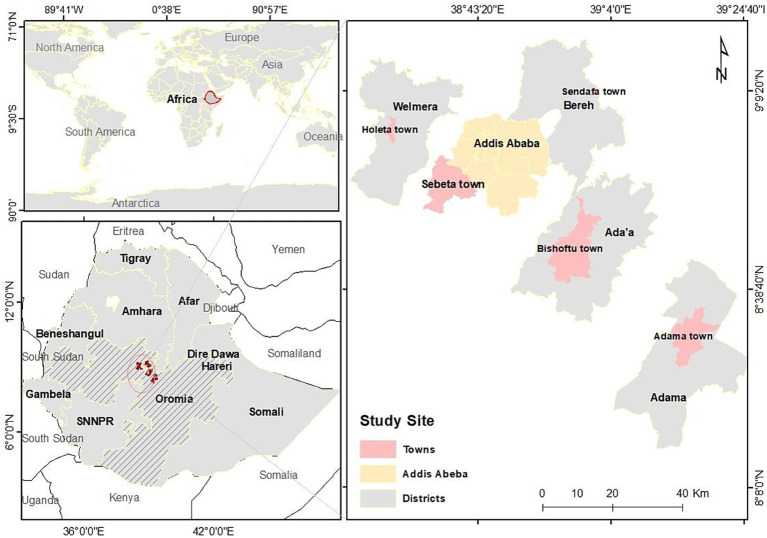
Tuberculosis (TB) is a major cause of ill health and one of the leading causes of death worldwide, caused by species of the complex (MTBC), with being the dominant pathogen in humans and in cattle. Zoonotic transmission of TB (zTB) to humans is frequent particularly where TB prevalence is high in cattle. In this study, we explored the prevalence of zTB in central Ethiopia, an area highly affected by bovine TB (bTB) in cattle.
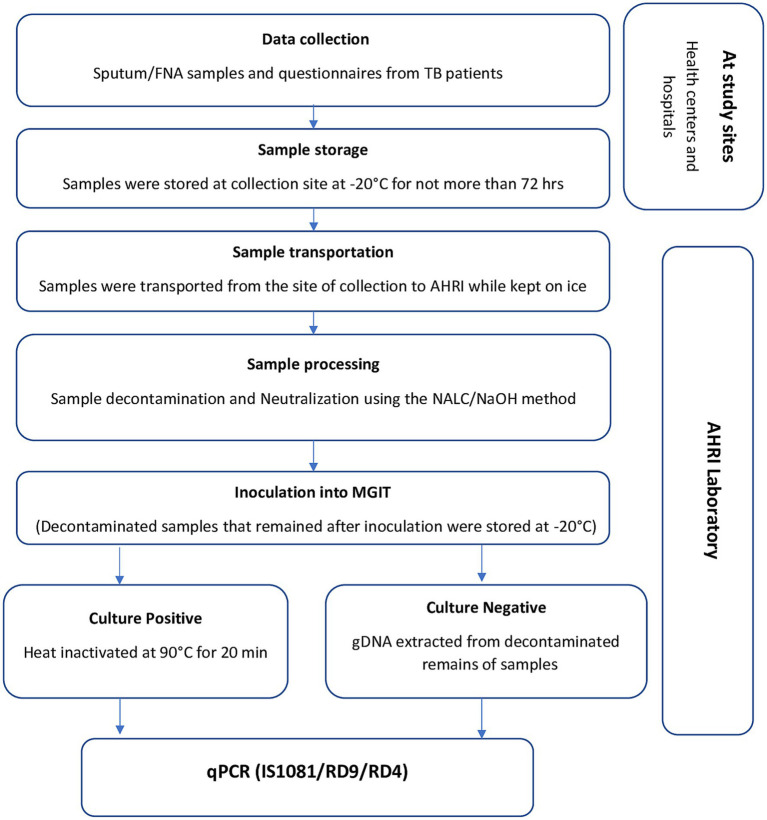
A convenient sample of 385 patients with pulmonary tuberculosis (PTB, = 287) and tuberculous lymphadenitis (TBLN, = 98) were included in this cross-sectional study in central Ethiopia. Sputum and fine needle aspirate (FNA) samples were obtained from patients with PTB and TBLN, respectively, and cultures were performed using BACTEC MGIT 960. All culture positive samples were subjected to quantitative PCR (qPCR) assays, targeting IS, RD9 and RD4 genomic regions for detection of MTBC, and , respectively.
Two hundred and fifty-five out of 385 sampled patients were culture positive and all were isolates identified as MTBC by being positive for the IS assay. Among them, 249 (97.6%) samples had also a positive RD9 result (intact RD9 locus) and were consequently classified as . The remaining six (2.4%) isolates were RD4 deficient and thereby classified as . Five out of these six strains originated from PTB patients whereas one was isolated from a TBLN patient. Occupational risk and the widespread consumption of raw animal products were identified as potential sources of infection in humans, and the isolation of from PTB patients suggests the possibility of human-to-human transmission, particularly in patients with no known contact history with animals.
The detected proportion of culture positive cases of 2.4% being from this region was higher zTB rate than previously reported for the general population of Ethiopia. Patients with infection are more likely to get less efficient TB treatment because is inherently resistant to pyrazinamide. MTBC species identification should be performed where is common in cattle, especially in patients who have a history of recurrence or treatment failure.
结核病(TB)是全球主要的致病原因之一,也是导致死亡的主要原因之一,由结核分枝杆菌复合群(MTBC)引起,其中 是人类的主要病原体, 是牛的主要病原体。结核病(zTB)从动物向人类的人畜共患传播很常见,特别是在牛结核病(bTB)流行率高的地区。在这项研究中,我们探讨了埃塞俄比亚中部地区的人畜共患结核病(zTB)流行率,该地区牛结核病(bTB)发病率很高。
在埃塞俄比亚中部进行了这项横断面研究,纳入了 385 名肺结核(PTB,n=287)和结核性淋巴结炎(TBLN,n=98)患者的方便样本。从 PTB 和 TBLN 患者中分别获得痰液和细针抽吸(FNA)样本,并使用 BACTEC MGIT 960 进行培养。所有培养阳性样本均进行定量 PCR(qPCR)检测,针对 IS、RD9 和 RD4 基因组区域检测 MTBC、 和 。
385 名采样患者中有 255 名培养阳性,所有培养阳性样本均通过 IS 检测鉴定为 MTBC。其中,249 名(97.6%)样本还具有阳性 RD9 结果(完整 RD9 基因座),因此被归类为 。其余 6 名(2.4%)分离株 RD4 缺失,因此被归类为 。这 6 株 中有 5 株来自 PTB 患者,1 株来自 TBLN 患者。职业风险和广泛食用生动物产品被确定为人类感染的潜在来源,从 PTB 患者中分离出 表明存在人与人之间传播的可能性,特别是在无已知动物接触史的患者中。
与此前报道的埃塞俄比亚一般人群相比,该地区检测到的 2.4%的培养阳性病例为 ,其比例更高,这是一个人畜共患结核病(zTB)的高发病率。感染 的患者更有可能接受不太有效的结核病治疗,因为 对吡嗪酰胺固有耐药。在牛中常见 的地区,特别是在有复发或治疗失败史的患者中,应进行 MTBC 种属鉴定。