Wang Hanwen, Xie Xiaoxia, Zhu Junyou, Qi Shaohai, Xie Julin
Department of Burn Surgery, The First Affiliated Hospital of Sun Yat-Sen University, Guangzhou, 510080, Guangdong, People's Republic of China.
Cancer Cell Int. 2021 Dec 20;21(1):694. doi: 10.1186/s12935-021-02409-6.
Skin cutaneous melanoma (SKCM) is the most common skin tumor with high mortality. The unfavorable outcome of SKCM urges the discovery of prognostic biomarkers for accurate therapy. The present study aimed to explore novel prognosis-related signatures of SKCM and determine the significance of immune cell infiltration in this pathology.
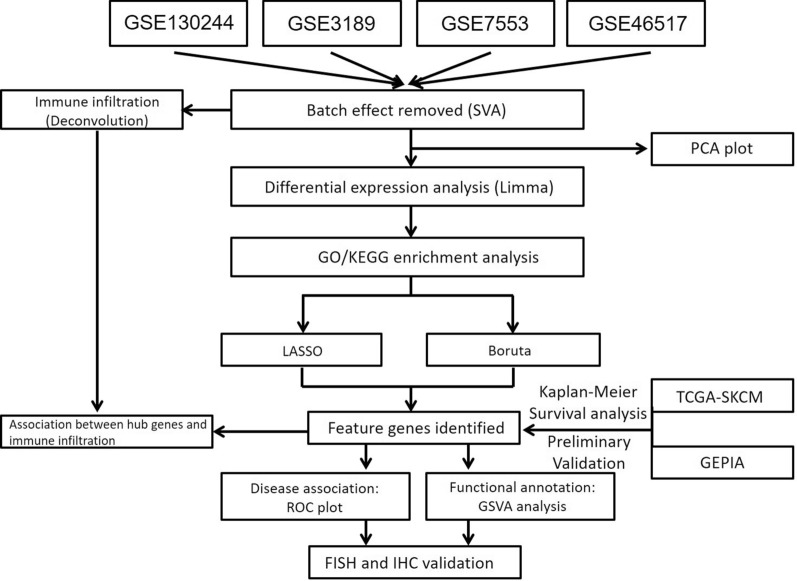
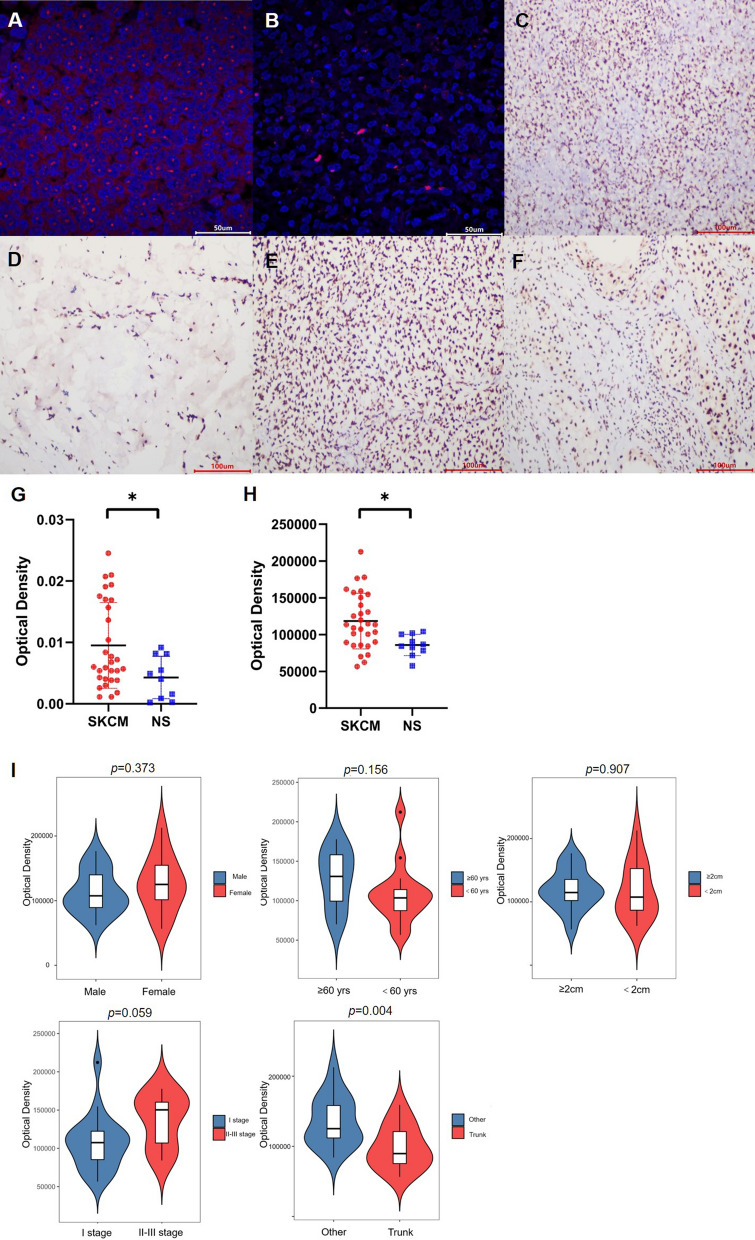
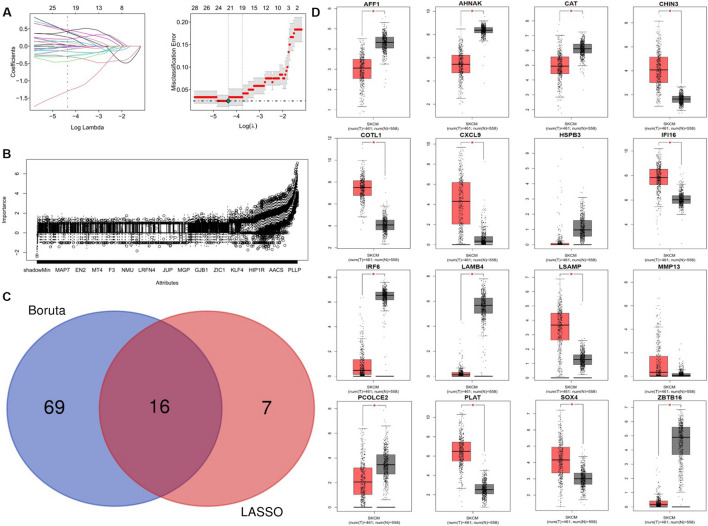
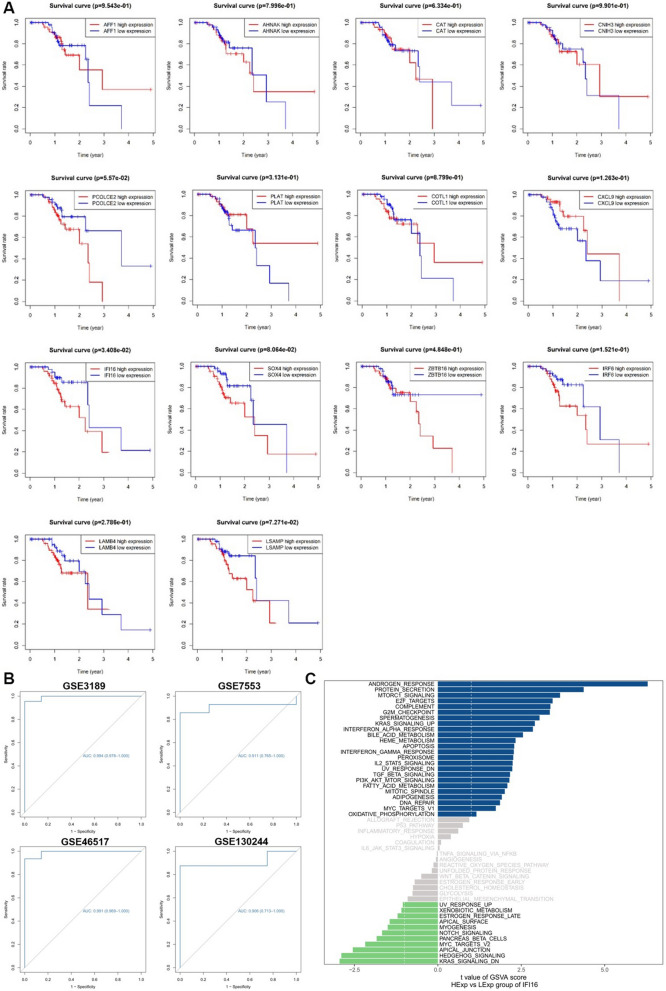
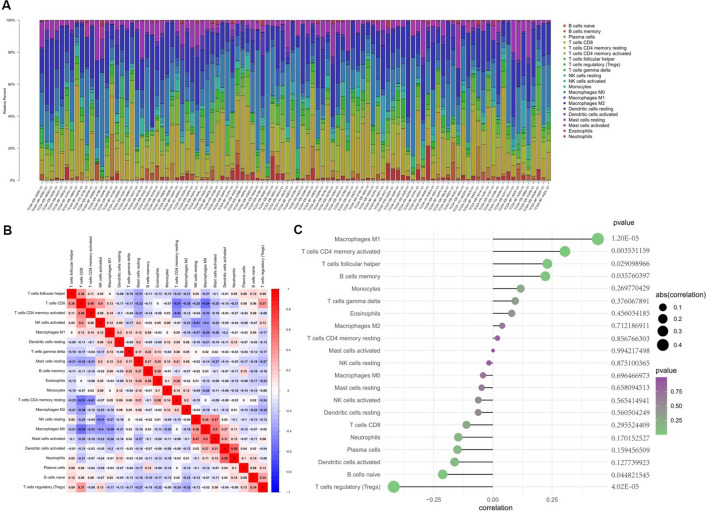
Four gene expression profiles (GSE130244, GSE3189, GSE7553 and GSE46517) of SKCM and normal skin samples were retrieved from the GEO database. Differentially expressed genes (DEGs) were then screened, and the feature genes were identified by the LASSO regression and Boruta algorithm. Survival analysis was performed to filter the potential prognostic signature, and GEPIA was used for preliminary validation. The area under the receiver operating characteristic curve (AUC) was obtained to evaluate discriminatory ability. The Gene Set Variation Analysis (GSVA) was performed, and the composition of the immune cell infiltration in SKCM was estimated using CIBERSORT. At last, paraffin-embedded specimens of primary SKCM and normal skin tissues were collected, and the signature was validated by fluorescence in situ hybridization (FISH) and immunohistochemistry (IHC).
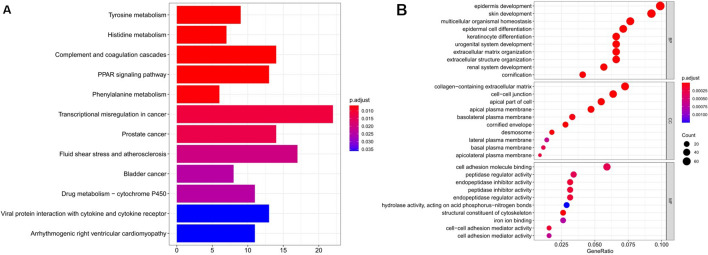
Totally 823 DEGs and 16 feature genes were screened. IFI16 was identified as the signature associated with overall survival of SKCM with a great discriminatory ability (AUC > 0.9 for all datasets). GSVA noticed that IFI16 might be involved in apoptosis and ultraviolet response in SKCM, and immune cell infiltration of IFI16 was evaluated. At last, FISH and IHC both validated the differential expression of IFI16 in SKCM.
In conclusion, our comprehensive analysis identified IFI16 as a signature associated with overall survival and immune infiltration of SKCM, which may play a critical role in the occurrence and development of SKCM.
皮肤黑色素瘤(SKCM)是最常见的皮肤肿瘤,死亡率高。SKCM的不良预后促使人们发现用于精确治疗的预后生物标志物。本研究旨在探索SKCM新的预后相关特征,并确定免疫细胞浸润在该病理过程中的意义。
从GEO数据库中检索SKCM和正常皮肤样本的四个基因表达谱(GSE130244、GSE3189、GSE7553和GSE46517)。然后筛选差异表达基因(DEG),并通过LASSO回归和Boruta算法鉴定特征基因。进行生存分析以筛选潜在的预后特征,并使用GEPIA进行初步验证。获得受试者工作特征曲线(AUC)下的面积以评估鉴别能力。进行基因集变异分析(GSVA),并使用CIBERSORT估计SKCM中免疫细胞浸润的组成。最后,收集原发性SKCM和正常皮肤组织的石蜡包埋标本,并通过荧光原位杂交(FISH)和免疫组织化学(IHC)验证该特征。
共筛选出823个DEG和16个特征基因。IFI16被鉴定为与SKCM总生存相关的特征,具有很强的鉴别能力(所有数据集的AUC均>0.9)。GSVA发现IFI16可能参与SKCM的细胞凋亡和紫外线反应,并评估了IFI16的免疫细胞浸润情况。最后,FISH和IHC均验证了IFI16在SKCM中的差异表达。
总之,我们的综合分析确定IFI16是与SKCM总生存和免疫浸润相关的特征,其可能在SKCM的发生发展中起关键作用。