Institute of Psychiatry, Psychology & Neuroscience, King's College London, London, UK.
Centre for Brain and Cognitive Development, Department of Psychology, Birkbeck College, University of London, London, UK.
Transl Psychiatry. 2021 Dec 20;11(1):644. doi: 10.1038/s41398-021-01698-9.
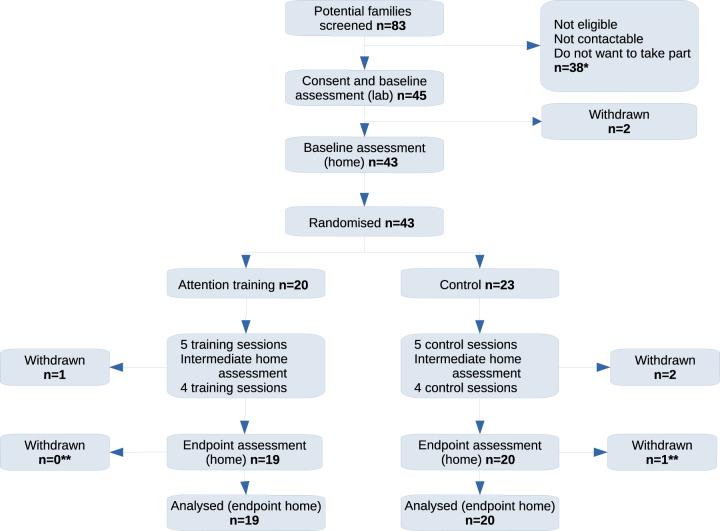
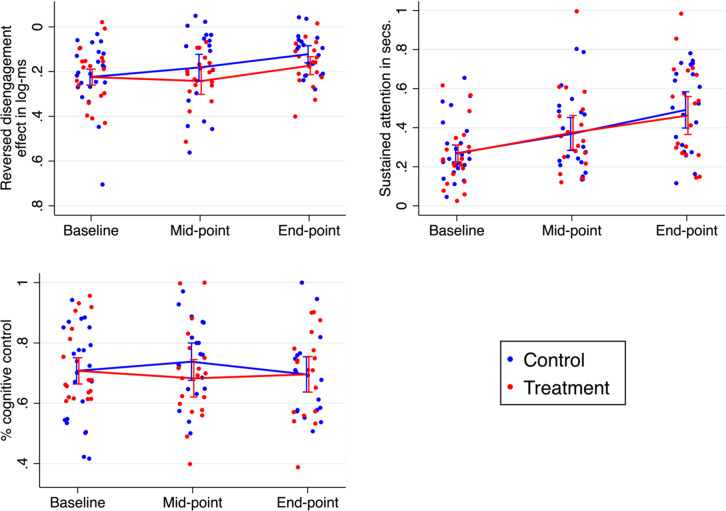
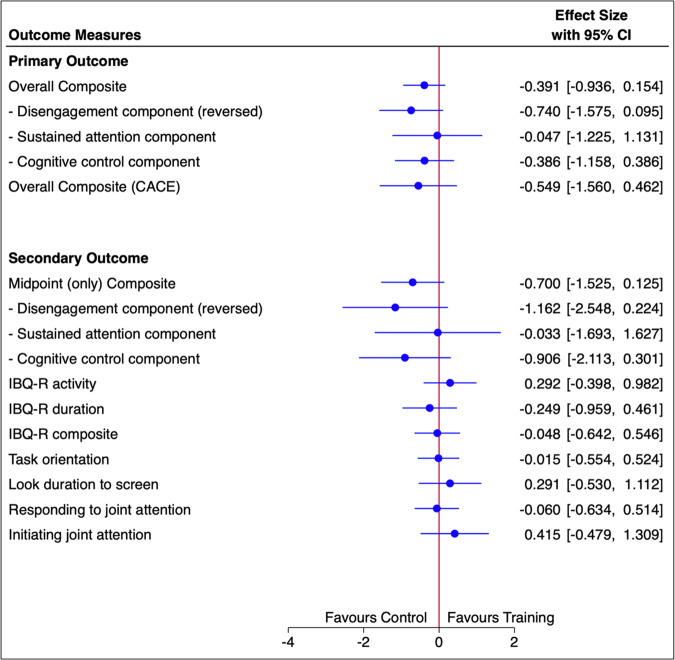
Attention-deficit/hyperactivity disorder (ADHD) is first diagnosed during middle childhood, when patterns of difficulty are often established. Pre-emptive approaches that strengthen developing cognitive systems could offer an alternative to post-diagnostic interventions. This proof-of-concept randomised controlled trial (RCT) tested whether computerised gaze-based attention training is feasible and improves attention in infants liable to develop ADHD. Forty-three 9- to 16-month-old infants with a first-degree relative with ADHD were recruited (11/2015-11/2018) at two UK sites and randomised with minimisation by site and sex to receive 9 weekly sessions of either (a) gaze-contingent attention training (intervention; n = 20); or (b) infant-friendly passive viewing of videos (control, n = 23). Sessions were delivered at home with blinded outcome assessments. The primary outcome was a composite of attention measures jointly analysed via a multivariate ANCOVA with a combined effect size (ES) from coefficients at baseline, midpoint and endpoint (Registration: ISRCTN37683928 ). Uptake and compliance was good but intention-to-treat analysis showed no significant differences between 20 intervention and 23 control infants on primary (ES -0.4, 95% CI -0.9 to 0.2; Complier-Average-Causal Effect ES -0.6, 95% CI -1.6 to 0.5) or secondary outcomes (behavioural attention). There were no adverse effects on sleep but a small increase in post-intervention session fussiness. Although feasible, there was no support for short-term effects of gaze-based attention training on attention skills in early ADHD. Longer-term outcomes remain to be assessed. The study highlights challenges and opportunities for pre-emptive intervention approaches to the management of ADHD.
注意缺陷多动障碍(ADHD)通常在儿童中期首次确诊,此时已经形成了一系列困难模式。预防措施可以强化发育中的认知系统,为ADHD 的诊断后干预提供替代方案。这项基于 RCT 的概念验证研究旨在测试基于注视的计算机注意力训练是否可行,以及是否能改善易患 ADHD 的婴儿的注意力。2015 年 11 月至 2018 年 11 月期间,在英国的两个地点招募了 43 名 9 至 16 个月大的、一级亲属有 ADHD 的婴儿(11/2015-11/2018),并根据地点和性别进行最小化随机分组,接受 9 周的(a)注视相关注意力训练(干预组,n=20);或(b)婴儿友好型视频被动观看(对照组,n=23)。这些课程是在家庭中进行的,结果评估是盲法进行的。主要结果是通过多元方差分析(ANCOVA)联合基线、中点和终点的系数进行综合分析的注意力测量结果(注册:ISRCTN37683928)。接受度和依从性都很好,但意向治疗分析显示,20 名干预组婴儿和 23 名对照组婴儿在主要(效应大小[ES]-0.4,95%置信区间[CI]-0.9 至 0.2;遵守者平均因果效应[ES]-0.6,95% CI-1.6 至 0.5)或次要(行为注意力)结局上没有显著差异。该研究没有发现睡眠方面的不良反应,但干预后课程烦躁程度略有增加。尽管可行,但基于注视的注意力训练对早期 ADHD 注意力技能的短期影响没有支持。长期结果仍有待评估。该研究凸显了 ADHD 管理中预防干预措施面临的挑战和机遇。