Department of Sociology, University of Oxford, Oxford OX1 1JD, UK.
Centre on Population Approaches for Non-Communicable Disease Prevention, Nuffield Department of Population Health, University of Oxford, Oxford OX3 7LF, UK.
Eur J Public Health. 2022 Apr 1;32(2):261-266. doi: 10.1093/eurpub/ckab106.
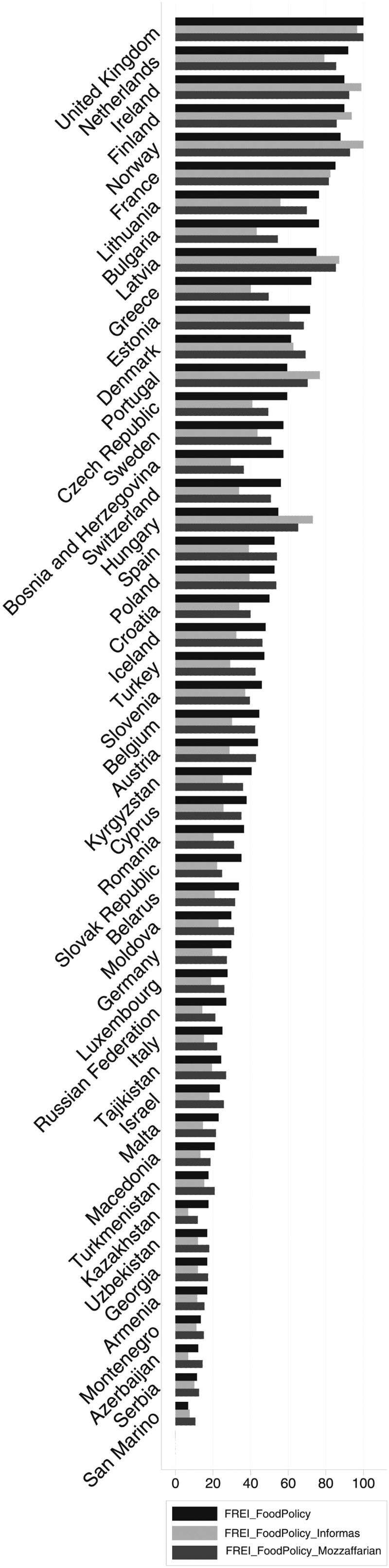
Evidence based health policy, such as that put forward in the European Food and Nutrition Action Plan 2015-2020 and the WHO Global Action Plan on the Prevention and Control of Noncommunicable Diseases, has a role in curbing the consumption of unhealthful foods and drink. We ask how countries are performing in the adoption of these policies and how the comprehensiveness of their food environment policies explains variations in consumption of unhealthful products across Europe.
In order to assess the state of policy adoption, we developed a composite indicator-the Food Regulatory Environment Index (FREI) for which we calculated unweighted and weighted formulations according to the strength of the evidence base. We used linear regression models to explain variations in the consumption of unhealthful products as well as variations in a composite indicator of obesogenic diets.
Overall, wealthier countries in the Region perform better. The weighting of the constituent policies does not affect the rankings. We find negative associations between unweighted and weighted formulations of the Index and household consumption of sugary and carbonate drinks as well as with the composite indicator for obesogenic diets.
The main strength of this study is the comprehensiveness and comparability of the policy data across the relatively large number of countries covered. There is a negative association that is statistically significant, between all formulations of the FREI and the household consumption of sugary and carbonated drinks. There is also a negative association between some FREI formulations and obesogenic diets.
循证健康政策,如欧洲 2015-2020 年食品和营养行动计划以及世界卫生组织预防和控制非传染性疾病全球行动计划中提出的政策,在遏制不健康食品和饮料消费方面发挥了作用。我们想了解各国在采用这些政策方面的表现,以及其食品环境政策的全面性如何解释欧洲各国之间不健康产品消费的差异。
为了评估政策采纳情况,我们开发了一个综合指标——食品监管环境指数(FREI),并根据证据基础的强度计算了无权重和加权两种公式。我们使用线性回归模型来解释不健康产品消费的变化以及致肥胖饮食的综合指标的变化。
总体而言,该地区较富裕的国家表现更好。政策构成的权重不影响排名。我们发现指数的无权重和加权公式与家庭消费含糖和碳酸饮料以及致肥胖饮食的综合指标之间存在负相关关系。
本研究的主要优势在于政策数据在涵盖的相对较多的国家之间具有全面性和可比性。FREI 的所有公式与家庭消费含糖和碳酸饮料之间存在负相关关系,且这种关系在统计学上具有显著性。FREI 的一些公式与致肥胖饮食之间也存在负相关关系。