School of Computer Science and Statistics, Trinity College Dublin, Dublin, Ireland.
J Med Internet Res. 2022 Aug 30;24(8):e37851. doi: 10.2196/37851.
Psychological therapy is an effective treatment method for mental illness; however, many people with mental illness do not seek treatment or drop out of treatment early. Increasing client uptake and engagement in therapy is key to addressing the escalating global problem of mental illness. Attitudinal barriers, such as a lack of motivation, are a leading cause of low engagement in therapy. Digital interventions to increase motivation and readiness for change hold promise as accessible and scalable solutions; however, little is known about the range of interventions being used and their feasibility as a means to increase engagement with therapy.
This review aimed to define the emerging field of digital interventions to enhance readiness for psychological therapy and detect gaps in the literature.
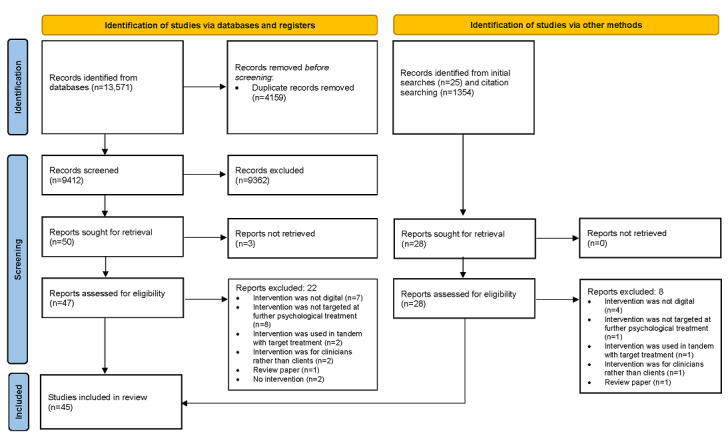
A literature search was conducted in PubMed, PsycINFO, PsycARTICLES, Scopus, Embase, ACM Guide to Computing Literature, and IEEE Xplore Digital Library from January 1, 2006, to November 30, 2021. The PRISMA-ScR (Preferred Reporting Items for Systematic Reviews and Meta-Analyses extension for Scoping Reviews) methodology was applied. Publications were included when they concerned a digitally delivered intervention, a specific target of which was enhancing engagement with further psychological treatment, and when this intervention occurred before the target psychological treatment.
A total of 45 publications met the inclusion criteria. The conditions included depression, unspecified general mental health, comorbid anxiety and depression, smoking, eating disorders, suicide, social anxiety, substance use, gambling, and psychosis. Almost half of the interventions (22/48, 46%) were web-based programs; the other formats included screening tools, videos, apps, and websites. The components of the interventions included psychoeducation, symptom assessment and feedback, information on treatment options and referrals, client testimonials, expectation management, and pro-con lists. Regarding feasibility, of the 16 controlled studies, 7 (44%) measuring actual behavior or action showed evidence of intervention effectiveness compared with controls, 7 (44%) found no differences, and 2 (12%) indicated worse behavioral outcomes. In general, the outcomes were mixed and inconclusive owing to variations in trial designs, control types, and outcome measures.
Digital interventions to enhance readiness for psychological therapy are broad and varied. Although these easily accessible digital approaches show potential as a means of preparing people for therapy, they are not without risks. The complex nature of stigma, motivation, and individual emotional responses toward engaging in treatment for mental health difficulties suggests that a careful approach is needed when developing and evaluating digital readiness interventions. Further qualitative, naturalistic, and longitudinal research is needed to deepen our knowledge in this area.
心理治疗是治疗精神疾病的有效方法;然而,许多精神疾病患者不寻求治疗或早期退出治疗。增加患者对治疗的接受度和参与度是解决精神疾病全球日益严重问题的关键。态度障碍,如缺乏动机,是导致治疗参与度低的主要原因。增加动机和改变准备度的数字干预措施有望成为一种易于获得和可扩展的解决方案;然而,对于所使用的干预措施的范围及其作为增加对治疗的参与度的手段的可行性知之甚少。
本综述旨在定义增强心理治疗准备度的数字干预措施这一新兴领域,并发现文献中的空白。
从 2006 年 1 月 1 日至 2021 年 11 月 30 日,在 PubMed、PsycINFO、PsycARTICLES、Scopus、Embase、ACM 指南计算文献和 IEEE Xplore 数字图书馆中进行文献检索。应用 PRISMA-ScR(系统评价和荟萃分析扩展的首选报告项目扩展用于范围审查)方法。当涉及数字交付的干预措施,且该干预措施的特定目标是增强对进一步心理治疗的参与度,并且该干预措施发生在目标心理治疗之前时,出版物被包括在内。
共有 45 篇出版物符合纳入标准。这些条件包括抑郁症、一般性心理健康状况不明、焦虑和抑郁症共病、吸烟、饮食失调、自杀、社交焦虑、物质使用、赌博和精神病。几乎一半的干预措施(22/48,46%)是基于网络的程序;其他形式包括筛查工具、视频、应用程序和网站。干预措施的组成部分包括心理教育、症状评估和反馈、治疗选择和转诊信息、客户推荐、期望管理和利弊清单。关于可行性,在 16 项对照研究中,7 项(44%)测量实际行为或行动的研究显示出与对照组相比干预措施有效的证据,7 项(44%)没有差异,2 项(12%)表明行为结果更差。总的来说,由于试验设计、对照类型和结果测量的差异,结果是混合的和不确定的。
增强心理治疗准备度的数字干预措施广泛且多样。尽管这些易于获得的数字方法作为一种让人们为治疗做好准备的手段具有潜力,但它们并非没有风险。与心理健康困难治疗参与相关的耻辱感、动机和个体情绪反应的复杂性质表明,在开发和评估数字准备干预措施时需要谨慎。需要进一步的定性、自然主义和纵向研究来加深我们在这一领域的知识。
