Department of Orthopedic Surgery, Chonnam National University Medical School and Hospital, 322 Seoyang-ro, Hwasun-eup, Hwasun-gun, Jeollanam-do, Republic of Korea.
College of Natural Science, School of Statistics, University of Seoul, Seoul, Republic of Korea.
Sci Rep. 2021 Dec 21;11(1):24340. doi: 10.1038/s41598-021-03259-y.
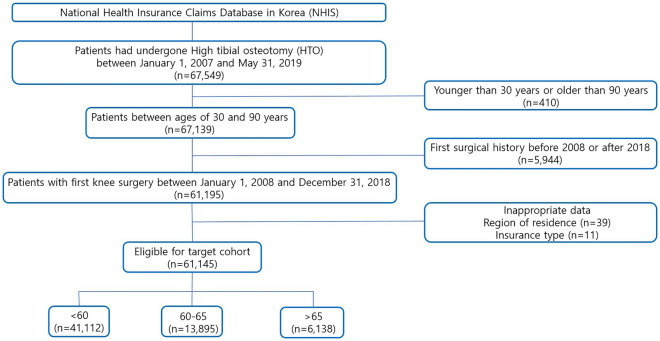
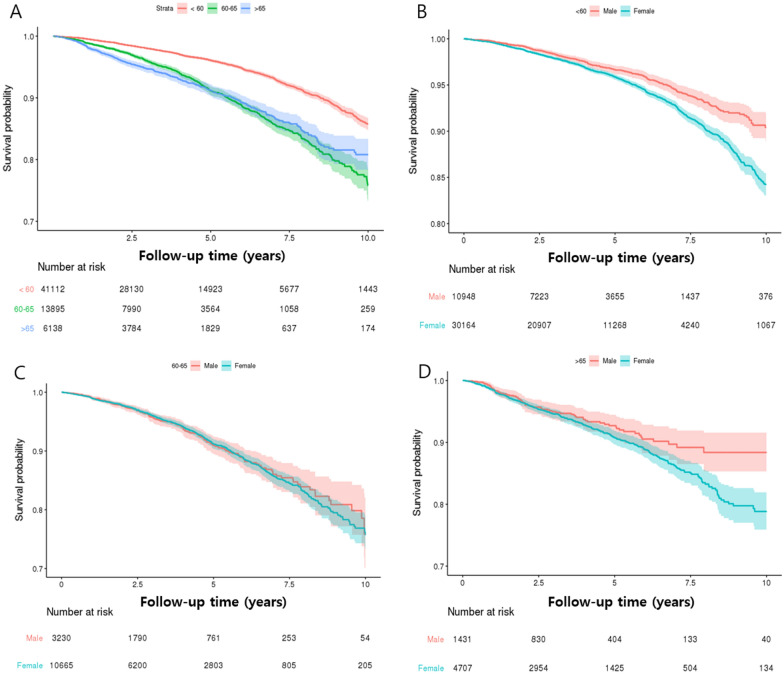
Among various patient risk factors affecting survival after high tibial osteotomy (HTO), the ideal age limit for HTO is unclear. This study was performed to evaluate the effect of age on survival rate and complications after HTO for medial unicompartmental osteoarthritis. Among of 61,145 HTO patients from Korean National Health Insurance database, 41,112 patients underwent the procedure before the age of 60 years (Group A), 13,895 patients between the age of 60 and 65 years (Group B), and 6138 patients after the age of 65 years (Group C). We compared the survival rate in person-years among the three groups from the date of primary surgery until subsequent total knee arthroplasty. Perioperative complications were also recorded. The adjusted hazard ratio (HR) were calculated using the multivariable Cox proportional hazard regression model, adjusting for the potential confounders: age, sex, type of medical insurance, region of residence, hospital type, comorbidities, and Charlson comorbidity index score. The total number of HTO increased 6.5-fold, especially in patients aged > 65 years (by 8.2-fold) from 2008 to 2018. The overall revision rate was 4.2% in Group A, 6.4% in Group B, and 7.3% in Group C. The 5- and 10-year revision rate was significantly lower in Group A (p < 0.001), but no difference between Groups B and C. After adjusting for potential confounders, multivariable regression analysis revealed that revision rate was significantly lower in Group A than Group B (HR: 0.57; p < 0.0001), but no difference between Groups B and C. The incidence of complications was also significantly lower in Group A than in other groups. The inferior survival rate and more perioperative complications after HTO was found in old patients (aged ≥ 60 years) than in young patients. Therefore, the patient age is one of the predicting factors for a high risk of failure after HTO.
在影响高胫骨截骨术(HTO)后生存率的各种患者风险因素中,HTO 的理想年龄限制尚不清楚。本研究旨在评估年龄对内侧单间室骨关节炎行 HTO 后生存率和并发症的影响。在韩国国家健康保险数据库中,61145 例 HTO 患者中,41112 例患者在 60 岁之前(A 组)接受了该手术,13895 例患者在 60-65 岁之间(B 组),6138 例患者年龄在 65 岁之后(C 组)。我们比较了三组患者从初次手术到随后全膝关节置换术的个人年生存率。还记录了围手术期并发症。使用多变量 Cox 比例风险回归模型计算调整后的危险比(HR),调整了潜在混杂因素:年龄、性别、医疗保险类型、居住地、医院类型、合并症和 Charlson 合并症指数评分。2008 年至 2018 年,HTO 的总数增加了 6.5 倍,尤其是年龄>65 岁的患者(增加了 8.2 倍)。A 组的总体翻修率为 4.2%,B 组为 6.4%,C 组为 7.3%。A 组的 5 年和 10 年翻修率明显较低(p<0.001),但 B 组和 C 组之间无差异。在校正潜在混杂因素后,多变量回归分析显示,A 组的翻修率明显低于 B 组(HR:0.57;p<0.0001),但 B 组和 C 组之间无差异。A 组的并发症发生率也明显低于其他组。与年轻患者(<60 岁)相比,老年患者(≥60 岁)行 HTO 后生存率较低,围手术期并发症发生率较高。因此,患者年龄是 HTO 后失败风险较高的预测因素之一。