Lennerz Belinda S, Mey Jacob T, Henn Owen H, Ludwig David S
New Balance Foundation Obesity Prevention Center, Boston Children's Hospital, Boston, MA, USA.
Integrated Physiology and Molecular Medicine, Pennington Biomedical Research Center, Baton Rouge, LA, USA.
Curr Dev Nutr. 2021 Nov 2;5(12):nzab133. doi: 10.1093/cdn/nzab133. eCollection 2021 Dec.
The "carnivore diet," based on animal foods and excluding most or all plant foods, has attracted recent popular attention. However, little is known about the health effects and tolerability of this diet, and concerns for nutrient deficiencies and cardiovascular disease risk have been raised.
We obtained descriptive data on the nutritional practices and health status of a large group of carnivore diet consumers.
A social media survey was conducted 30 March-24 June, 2020 among adults self-identifying as consuming a carnivore diet for ≥6 mo. Survey questions interrogated motivation, dietary intake patterns, symptoms suggestive of nutritional deficiencies or other adverse effects, satisfaction, prior and current health conditions, anthropometrics, and laboratory data.
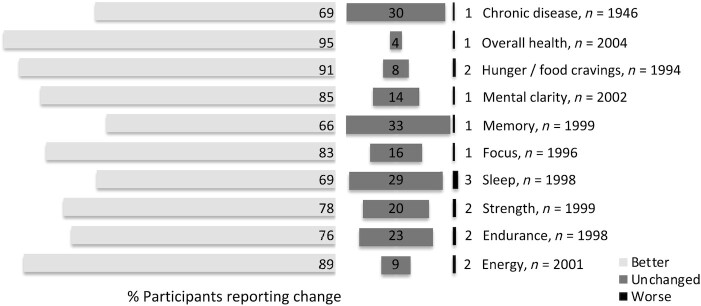
A total of 2029 respondents (median age: 44 y, 67% male) reported consuming a carnivore diet for 14 mo (IQR: 9-20 mo), motivated primarily by health reasons (93%). Red meat consumption was reported as daily or more often by 85%. Under 10% reported consuming vegetables, fruits, or grains more often than monthly, and 37% denied vitamin supplement use. Prevalence of adverse symptoms was low (<1% to 5.5%). Symptoms included gastrointestinal (3.1%-5.5%), muscular (0.3%-4.0%), and dermatologic (0.1%-1.9%). Participants reported high levels of satisfaction and improvements in overall health (95%), well-being (66%-91%), various medical conditions (48%-98%), and median [IQR] BMI (in kg/m) (from 27.2 [23.5-31.9] to 24.3 [22.1-27.0]). Among a subset reporting current lipids, LDL-cholesterol was markedly elevated (172 mg/dL), whereas HDL-cholesterol (68 mg/dL) and triglycerides (68 mg/dL) were optimal. Participants with diabetes reported benefits including reductions in median [IQR] BMI (4.3 [1.4-7.2]), glycated hemoglobin (0.4% [0%-1.7%]), and diabetes medication use (84%-100%).
Contrary to common expectations, adults consuming a carnivore diet experienced few adverse effects and instead reported health benefits and high satisfaction. Cardiovascular disease risk factors were variably affected. The generalizability of these findings and the long-term effects of this dietary pattern require further study.
“肉食者饮食”以动物性食物为基础,排除了大部分或所有植物性食物,最近受到了广泛关注。然而,人们对这种饮食的健康影响和耐受性知之甚少,并且有人对营养缺乏和心血管疾病风险表示担忧。
我们获取了大量肉食者饮食消费者的营养实践和健康状况的描述性数据。
于2020年3月30日至6月24日对自认为食用肉食者饮食≥6个月的成年人进行了一项社交媒体调查。调查问题涉及动机、饮食摄入模式、提示营养缺乏或其他不良反应的症状、满意度、既往和当前健康状况、人体测量学以及实验室数据。
共有2029名受访者(中位年龄:44岁,67%为男性)报告食用肉食者饮食14个月(四分位间距:9 - 20个月),主要动机是健康原因(93%)。85%的人报告每天或更频繁地食用红肉。不到10%的人报告每月食用蔬菜、水果或谷物的频率高于一次,37%的人否认使用维生素补充剂。不良症状的发生率较低(<1%至5.5%)。症状包括胃肠道症状(3.1% - 5.5%)、肌肉症状(0.3% - 4.0%)和皮肤症状(0.1% - 1.9%)。参与者报告高度满意,并且在整体健康(95%)、幸福感(66% - 91%)、各种医疗状况(48% - 98%)以及中位[四分位间距]体重指数(kg/m)(从27.2 [23.5 - 31.9]降至24.3 [22.1 - 27.0])方面有所改善。在报告当前血脂情况的子集中,低密度脂蛋白胆固醇显著升高(172mg/dL),而高密度脂蛋白胆固醇(68mg/dL)和甘油三酯(68mg/dL)处于最佳水平。患有糖尿病的参与者报告了诸多益处,包括中位[四分位间距]体重指数降低(4.3 [1.4 - 7.2])、糖化血红蛋白降低(0.4% [0% - 1.7%])以及糖尿病药物使用减少(84% - 100%)。
与普遍预期相反,食用肉食者饮食的成年人不良反应较少,反而报告了健康益处和高度满意度。心血管疾病风险因素受到不同程度的影响。这些发现的普遍性以及这种饮食模式的长期影响需要进一步研究。