Experimental Psychology, University College London, London, UK.
NIHR Biomedical Research Centre @ Moorfields Eye Hospital and UCL Institute of Ophthalmology, London, UK.
J Vis. 2021 Dec 1;21(13):9. doi: 10.1167/jov.21.13.9.
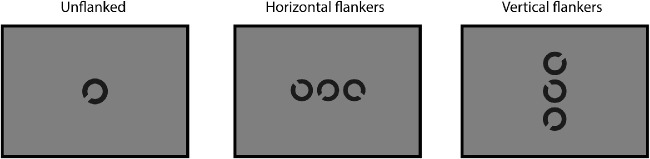
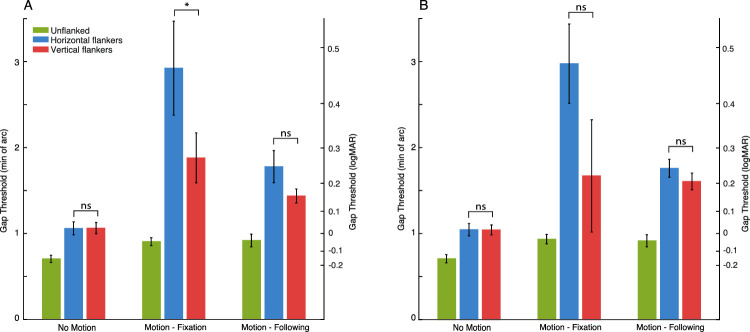
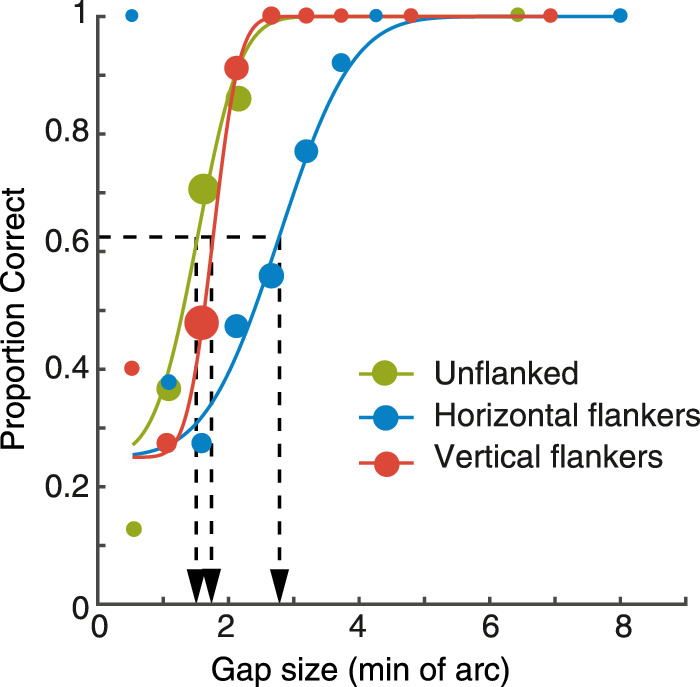
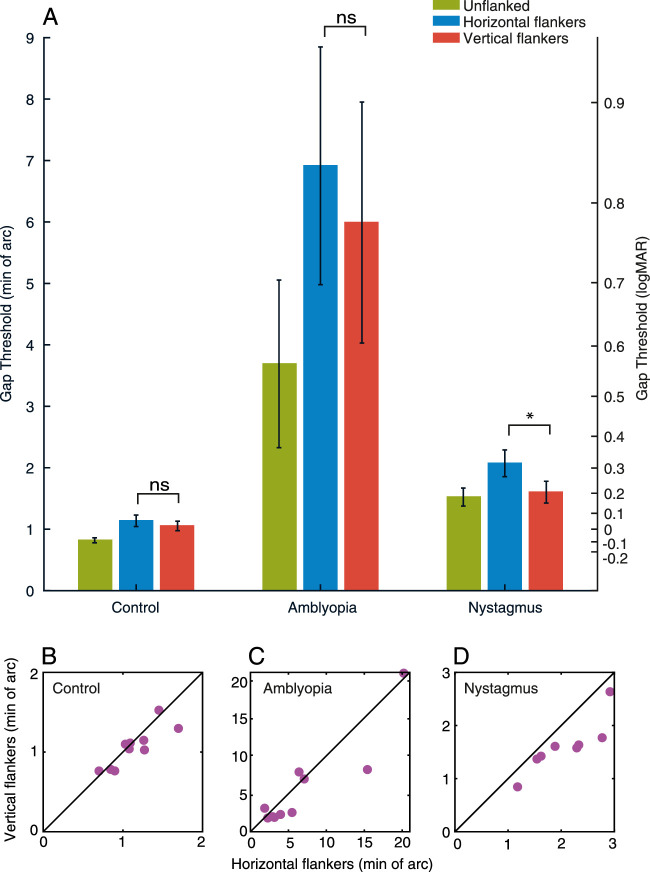
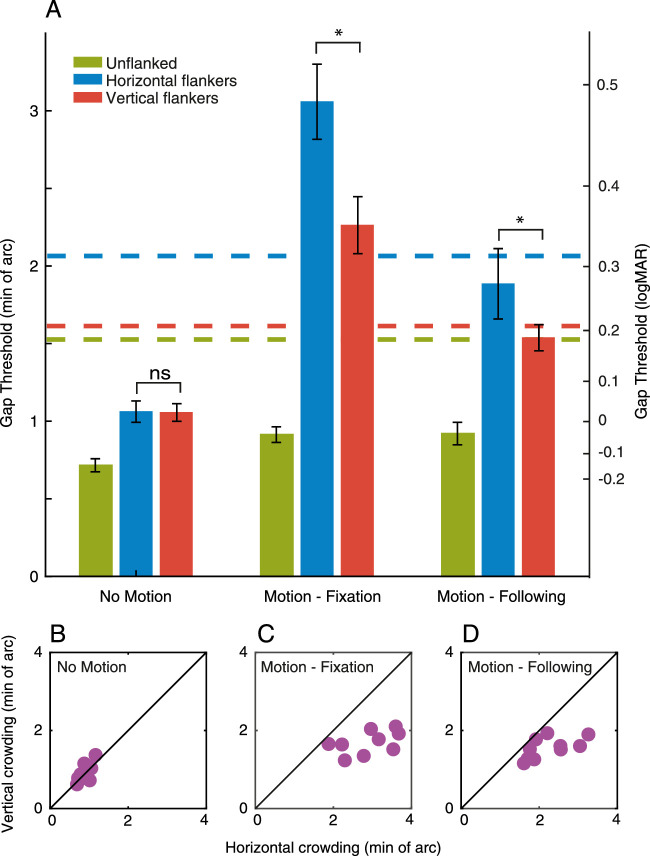
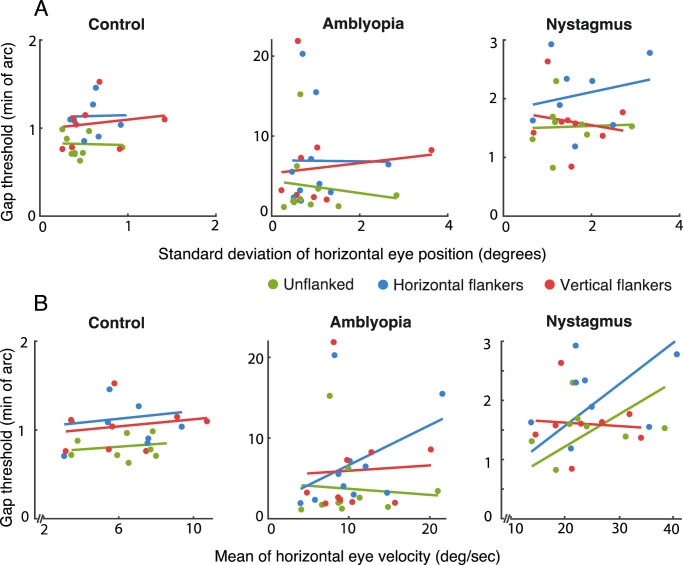
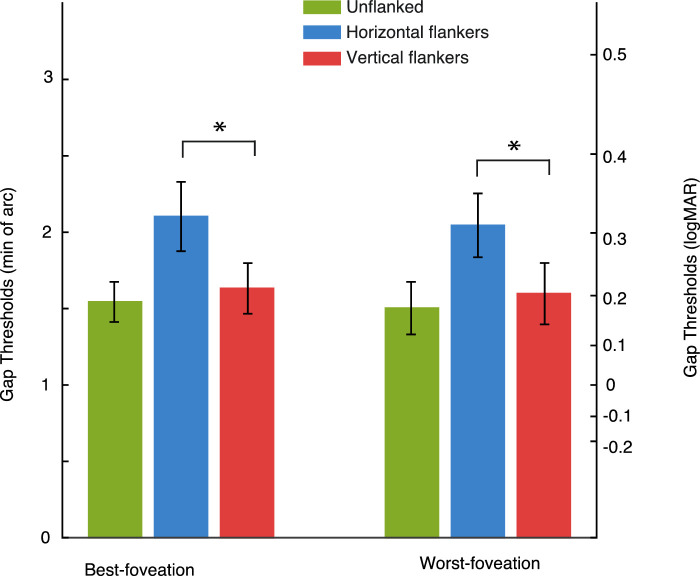
Idiopathic infantile nystagmus syndrome is a disorder characterised by involuntary eye movements, which leads to decreased acuity and visual function. One such function is visual crowding - a process whereby objects that are easily recognised in isolation become impaired by nearby flankers. Crowding typically occurs in the peripheral visual field, although elevations in foveal vision have been reported in congenital nystagmus, similar to those found with amblyopia. Here, we examine whether elevated foveal crowding with nystagmus is driven by similar mechanisms to those of amblyopia - long-term neural changes associated with a sensory deficit - or by the momentary displacement of the stimulus through nystagmus eye movements. A Landolt-C orientation identification task was used to measure threshold gap sizes with and without either horizontally or vertically placed Landolt-C flankers. We assume that a sensory deficit should give equivalent crowding in these two dimensions, whereas an origin in eye movements should give stronger crowding with horizontal flankers given the predominantly horizontal eye movements of nystagmus. We observe elevations in nystagmic crowding that are above crowding in typical vision but below that of amblyopia. Consistent with an origin in eye movements, elevations were stronger with horizontal than vertical flankers in nystagmus, but not in typical or amblyopic vision. We further demonstrate the same horizontal elongation in typical vision with stimulus movement that simulates nystagmus. Consequently, we propose that the origin of nystagmic crowding lies in the eye movements, either through image smear of the target and flanker elements or through relocation of the stimulus into the peripheral retina.
特发性婴儿性眼球震颤综合征是一种以不自主眼球运动为特征的疾病,导致视力和视觉功能下降。其中一种功能是视觉拥挤——一种物体在孤立状态下容易识别,但在附近的侧抑制物的影响下变得受损的过程。拥挤通常发生在周边视野,但在先天性眼球震颤中已经报道了中央凹视力的升高,类似于弱视中发现的情况。在这里,我们研究了眼球震颤引起的中央凹拥挤是否是由与弱视相似的机制引起的——与感觉缺陷相关的长期神经变化——还是由眼球震颤眼动引起的刺激瞬间位移引起的。使用 Landolt-C 定向识别任务来测量有和没有水平或垂直放置的 Landolt-C 侧抑制物时的阈值间隙大小。我们假设,感觉缺陷应该在这两个维度上产生相同的拥挤,而如果起源于眼球运动,则由于眼球震颤的主要水平眼球运动,水平侧抑制物应该产生更强的拥挤。我们观察到眼球震颤拥挤的升高,高于典型视力的拥挤,但低于弱视的拥挤。与起源于眼球运动一致,眼球震颤中水平侧抑制物的升高强于垂直侧抑制物,但在典型或弱视视力中则不然。我们进一步证明,在模拟眼球震颤的刺激运动的典型视力中也存在相同的水平伸长。因此,我们提出眼球震颤拥挤的起源在于眼球运动,要么是由于目标和侧抑制物元素的图像模糊,要么是由于刺激物被重新定位到周边视网膜。