Ministry of Education Key Laboratory for Avian Preventive Medicine, Yangzhou Universitygrid.268415.c, Yangzhou, Jiangsu, China.
Jiangsu Co-innovation Center for Prevention and Control of Important Animal Infectious Diseases and Zoonoses, Yangzhou, Jiangsu, China.
Microbiol Spectr. 2021 Dec 22;9(3):e0143921. doi: 10.1128/spectrum.01439-21.
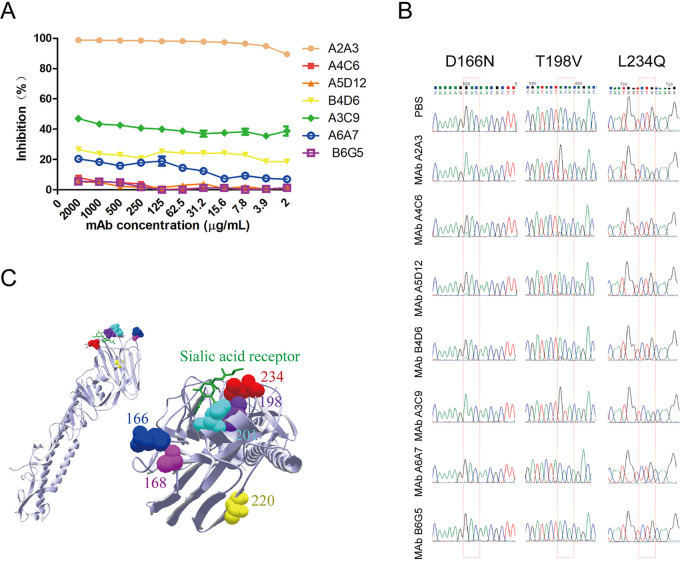
The balance in the functions of hemagglutinin (HA) and neuraminidase (NA) plays an important role in influenza virus genesis. However, whether and how N2 neuraminidase-specific antibodies may affect the attributes of HA remains to be investigated. In this study, we examined the presence of amino acid mutations in the HA of mutants selected by incubation with N2-specific monoclonal antibodies (MAbs) and compared the HA properties to those of the wild-type (WT) A/Chicken/Jiangsu/XXM/1999 (XXM) H9N2 virus. The higher NA inhibition (NI) ability of N2-specific MAbs was found to result in greater proportions of mutations in the HA head. The HA mutations affected the thermal stability, switched the binding preferences from α2,6-linked sialic acid receptor to α2,3-linked sialic acid receptor, and promoted viral growth in mouse lungs. These mutations also caused significant HA antigenic drift as they decreased hemagglutination inhibition (HI) titers. The evolutionary analysis also proved that some HA mutations were highly correlated with NA antibody pressure. Our data demonstrate that HA mutations caused by NA-specific antibodies affect HA properties and may contribute to HA evolution. HA binds with the sialic acid receptor on the host cell and initiates the infection mode of influenza virus. NA cleaves the connection between receptor and HA of newborn virus at the end of viral production. The HA-NA functional balance is crucial for viral production and interspecies transmission. Here, we identified mutations in the HA head of H9N2 virus caused by NA antibody pressure. These HA mutations changed the thermal stability and switched the receptor-binding preference of the mutant virus. The HI results indicated that these mutations resulted in significant antigenic drift in mutant HA. The evolutionary analysis also shows that some mutations in HA of H9N2 virus may be caused by NA antibody pressure and may correlate with the increase in H9N2 infections in humans. Our results provide new evidence for HA-NA balance and an effect of NA antibody pressure on HA evolution.
血凝素 (HA) 和神经氨酸酶 (NA) 的功能平衡在流感病毒的发生中起着重要作用。然而,N2 神经氨酸酶特异性抗体是否以及如何影响 HA 的属性仍有待研究。在这项研究中,我们检查了通过与 N2 特异性单克隆抗体 (MAb) 孵育选择的突变体中 HA 的氨基酸突变的存在,并将 HA 特性与野生型 (WT) A/鸡/江苏/XXM/1999 (XXM) H9N2 病毒进行了比较。发现 N2 特异性 MAb 的更高 NA 抑制 (NI) 能力导致 HA 头部出现更多的突变。HA 突变影响了热稳定性,将结合偏好从 α2,6-连接的唾液酸受体切换为 α2,3-连接的唾液酸受体,并促进了病毒在小鼠肺部的生长。这些突变还导致 HA 血凝抑制 (HI) 滴度降低,从而导致明显的 HA 抗原漂移。进化分析也证明,一些 HA 突变与 NA 抗体压力高度相关。我们的数据表明,NA 特异性抗体引起的 HA 突变影响了 HA 的特性,并可能有助于 HA 的进化。HA 与宿主细胞上的唾液酸受体结合,启动流感病毒的感染模式。NA 在病毒产生的末期裂解新生病毒的受体与 HA 的连接。HA-NA 功能平衡对于病毒的产生和种间传播至关重要。在这里,我们鉴定了由 NA 抗体压力引起的 H9N2 病毒 HA 头部的突变。这些 HA 突变改变了突变病毒的热稳定性和受体结合偏好。HI 结果表明,这些突变导致突变 HA 发生显著的抗原漂移。进化分析还表明,H9N2 病毒 HA 的一些突变可能是由 NA 抗体压力引起的,并且可能与 H9N2 感染在人类中的增加有关。我们的结果为 HA-NA 平衡和 NA 抗体压力对 HA 进化的影响提供了新的证据。