Henke Jan-Wilke, Raja Arslan Sajid, Feist Armin, Huang Guanhao, Arend Germaine, Yang Yujia, Kappert F Jasmin, Wang Rui Ning, Möller Marcel, Pan Jiahe, Liu Junqiu, Kfir Ofer, Ropers Claus, Kippenberg Tobias J
Georg-August-Universität Göttingen, Göttingen, Germany.
Max Planck Institute of Multidisciplinary Sciences, Göttingen, Germany.
Nature. 2021 Dec;600(7890):653-658. doi: 10.1038/s41586-021-04197-5. Epub 2021 Dec 22.
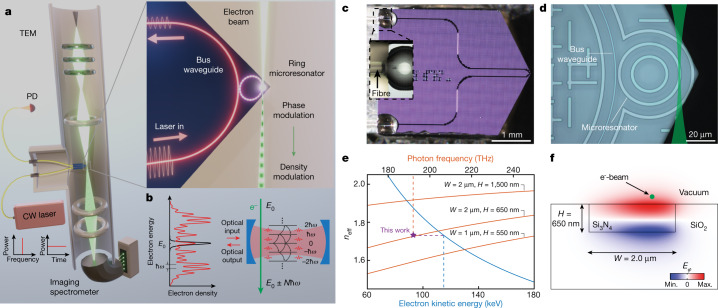
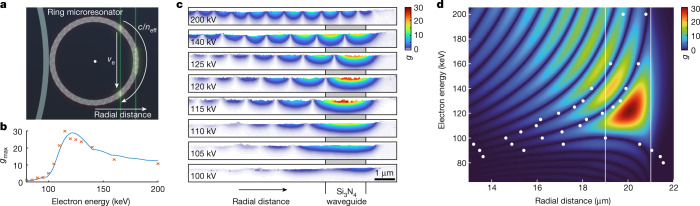
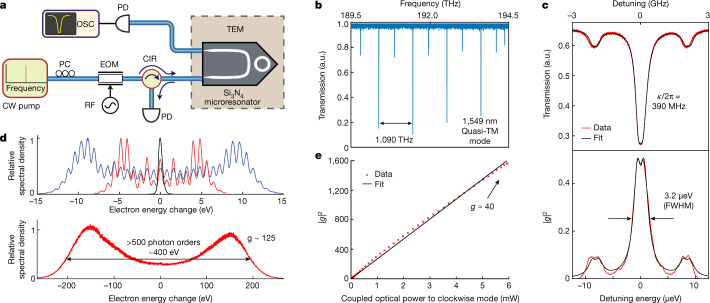
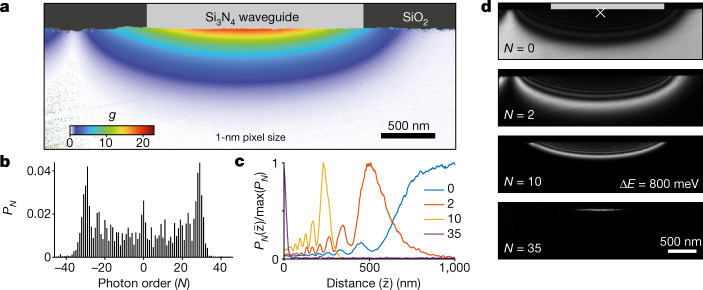
Integrated photonics facilitates extensive control over fundamental light-matter interactions in manifold quantum systems including atoms, trapped ions, quantum dots and defect centres. Ultrafast electron microscopy has recently made free-electron beams the subject of laser-based quantum manipulation and characterization, enabling the observation of free-electron quantum walks, attosecond electron pulses and holographic electromagnetic imaging. Chip-based photonics promises unique applications in nanoscale quantum control and sensing but remains to be realized in electron microscopy. Here we merge integrated photonics with electron microscopy, demonstrating coherent phase modulation of a continuous electron beam using a silicon nitride microresonator. The high-finesse (Q ≈ 10) cavity enhancement and a waveguide designed for phase matching lead to efficient electron-light scattering at extremely low, continuous-wave optical powers. Specifically, we fully deplete the initial electron state at a cavity-coupled power of only 5.35 microwatts and generate >500 electron energy sidebands for several milliwatts. Moreover, we probe unidirectional intracavity fields with microelectronvolt resolution in electron-energy-gain spectroscopy. The fibre-coupled photonic structures feature single-optical-mode electron-light interaction with full control over the input and output light. This approach establishes a versatile and highly efficient framework for enhanced electron beam control in the context of laser phase plates, beam modulators and continuous-wave attosecond pulse trains, resonantly enhanced spectroscopy and dielectric laser acceleration. Our work introduces a universal platform for exploring free-electron quantum optics, with potential future developments in strong coupling, local quantum probing and electron-photon entanglement.
集成光子学有助于对多种量子系统(包括原子、捕获离子、量子点和缺陷中心)中的基本光与物质相互作用进行广泛控制。超快电子显微镜最近使自由电子束成为基于激光的量子操纵和表征的对象,从而能够观察自由电子量子行走、阿秒电子脉冲和全息电磁成像。基于芯片的光子学在纳米级量子控制和传感方面有独特的应用前景,但在电子显微镜中尚未实现。在这里,我们将集成光子学与电子显微镜相结合,展示了使用氮化硅微谐振器对连续电子束进行相干相位调制。高精细度(Q≈10)的腔增强和为相位匹配设计的波导导致在极低的连续波光功率下实现高效的电子 - 光散射。具体而言,我们仅在5.35微瓦的腔耦合功率下就完全耗尽了初始电子态,并在几毫瓦的功率下产生了超过500个电子能量边带。此外,我们在电子能量增益光谱中以微电子伏特分辨率探测单向腔内场。光纤耦合光子结构具有单光学模式的电子 - 光相互作用,可对输入和输出光进行完全控制。这种方法在激光相位板、光束调制器和连续波阿秒脉冲序列、共振增强光谱和介质激光加速的背景下,建立了一个通用且高效的增强电子束控制框架。我们的工作引入了一个探索自由电子量子光学的通用平台,在强耦合、局部量子探测和电子 - 光子纠缠方面有潜在的未来发展。